What should you expect on Oasis of the Seas? Expect a floating town of more than 5,400 guests spread across seven distinct neighborhoods, a ship you can literally get lost in for the first day, and a rhythm that rewards a little planning. She is enormous, she is busy, and she is one of the most family-friendly ways to sail out of the New York area without ever setting foot in an airport. This guide walks through the scale, the neighborhoods you will actually use, how a sea day differs from a port day, where to eat, what to watch, and the surprises that catch nearly every first-timer off guard.
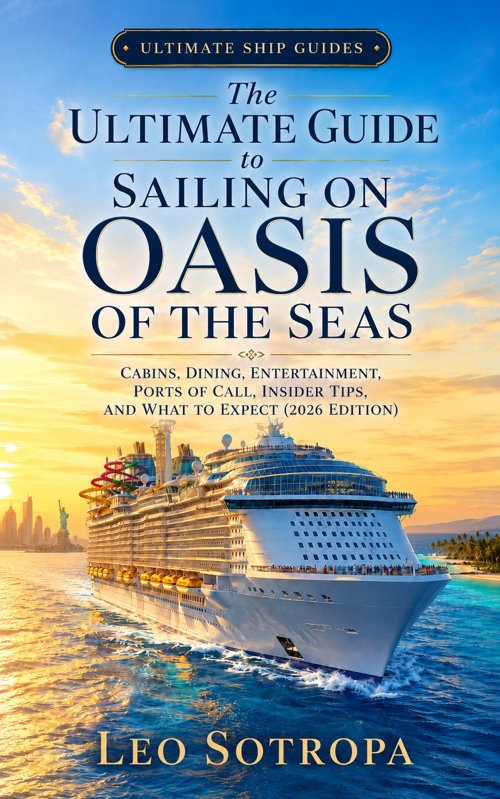
Everything in this article and far more, deck by deck, in The Ultimate Guide to Sailing on Oasis of the Seas.
Get the book →The scale, and the crowds that come with it
Oasis of the Seas measures roughly 226,838 gross tons across about 18 guest decks. Numbers like that are hard to feel until you are standing at one end of the Royal Promenade watching the far end disappear into the distance. She carries more than 5,400 guests at standard occupancy and closer to 6,800 when every berth is filled, plus a couple thousand crew. That is a small city moving across the ocean, and your expectations should be set accordingly.
Here is the honest part about crowds: they are real, but they are concentrated in predictable places and times. The Windjammer buffet at 8:30 on a sea day morning, the main theater fifteen minutes before a headline show, the pool deck at noon when the sun is out, and the gangway during the first hour in port are the genuine pinch points. Everywhere else, the ship is designed to swallow people. Central Park at mid-afternoon can feel almost private. The Boardwalk between shows is calm. The trick is not avoiding crowds entirely, which is impossible, but learning to move against the flow. Eat a little early or a little late, book shows in advance, and use the quieter neighborhoods as pressure valves.
A ship this size also means walking. A lot of it. Expect to log real distance between your cabin, the dining room, and the top-deck thrills, and expect the elevators to be busy at peak times. Comfortable shoes matter more than you think, and giving yourself an extra ten minutes to get anywhere in the first day or two is smart until the layout clicks.
Oasis is the original of her class
It helps to know what you are boarding. Oasis of the Seas was the first Oasis-class ship, debuting in 2009, and she is the vessel that invented the seven-neighborhood megaship concept that every larger Royal Caribbean ship has built on since. The open-air Central Park garden, the Boardwalk with its carousel and stern-facing AquaTheater, the split superstructure that lets sunlight pour down into the middle of the ship, all of that started here. When people talk about the class as a whole, they are describing an idea Oasis proved could work.
Being the original raises a fair question: how does she compare to her newer sisters? The later ships in the class are a touch larger, add a few headline gimmicks, and arrive with the newest decor. Oasis has since been amplified with updated features and venues, so the gap in the experience is smaller than the launch dates suggest. What you give up is marginal, mostly the very latest single slide or waterpark trick. What you get is a ship whose layout has been refined over years of sailing, a crew that has run this exact playbook thousands of times, and, for many guests, a shorter drive and a lower fare than chasing the newest hull elsewhere. If you have never sailed the class before, you will not feel like you are missing anything. This is the ship that set the standard.
For a broader orientation to the ship and how to plan around her, the Oasis of the Seas cruise guide is a good companion to this article.
The neighborhoods you will actually use
Oasis is organized into seven neighborhoods, but you do not need to memorize all of them. Three will structure most of your days, and knowing what each one is for makes the ship feel far smaller.
Central Park
Central Park is an open-air garden running down the middle of the ship, planted with thousands of live plants and lined with quiet restaurants. It is the ship’s calm center, and it is the neighborhood most first-timers underestimate. In the morning it is a peaceful place for coffee from Park Café; in the evening it turns into the most grown-up corner of the ship, softly lit, with live musicians and the specialty restaurants glowing along the path. If the pool deck energy gets to be too much, this is where you retreat. Cabins with Central Park-view balconies open onto this space, which means quiet and greenery but no ocean view, a trade-off worth understanding before you book.
The Boardwalk
The Boardwalk is the family heart of the ship, a seaside-pier zone carved into the stern with a handcrafted carousel, casual food, and the open-air AquaTheater at the far end. Kids gravitate here, and the atmosphere is deliberately playful. It is also where the zip line launches from, sending riders gliding above the neighborhood. Boardwalk-view balcony cabins look down onto all of this, which is fun during the day and lively but potentially noisy when the AquaTheater show is running below.
The Royal Promenade
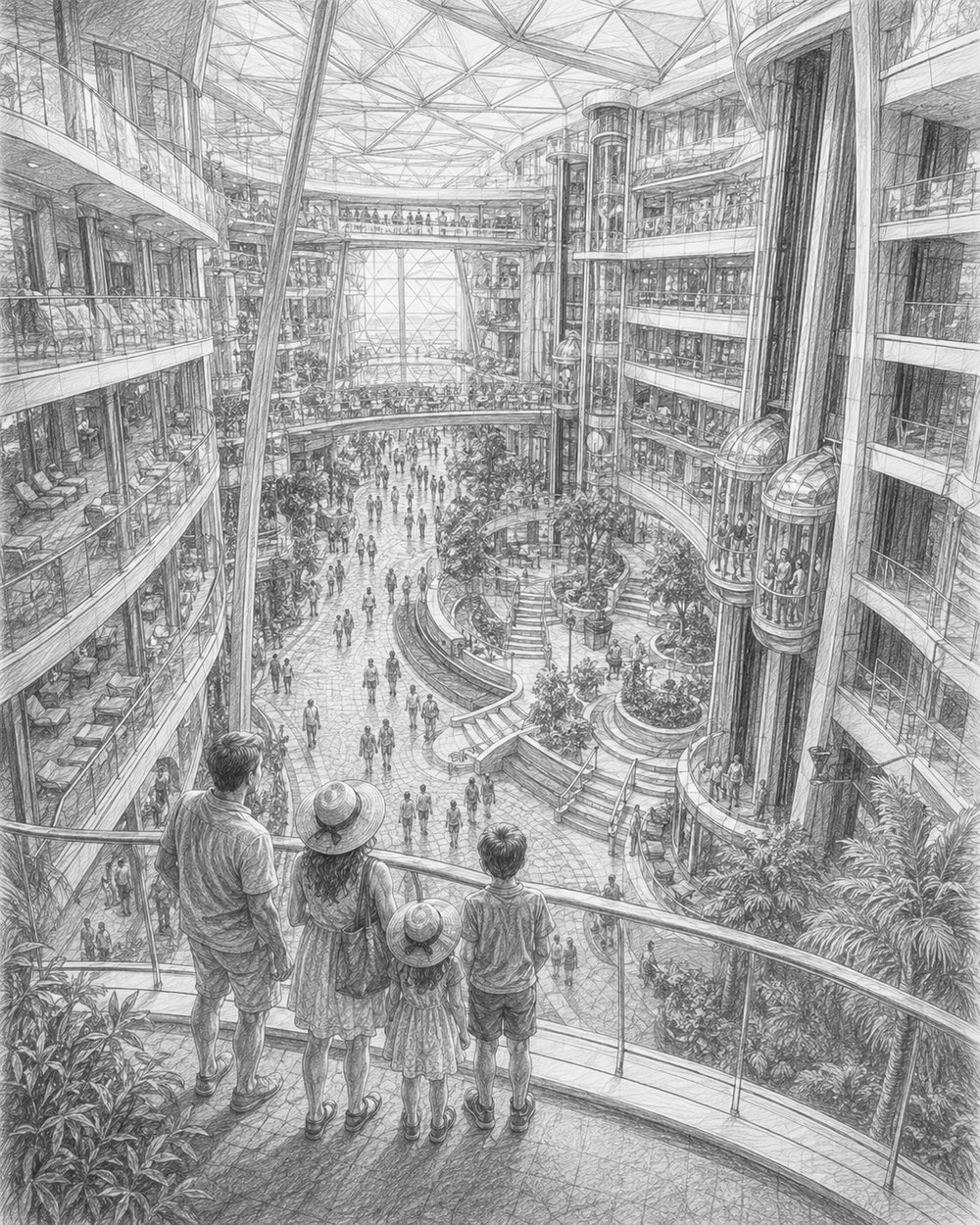
The Royal Promenade is the indoor main street, running through the interior of the ship with shops, bars, casual cafés, and a steady flow of foot traffic. This is the connective tissue of Oasis, the place you pass through on the way to almost everywhere, and the natural spot to grab a slice at Sorrento’s or a pastry at Café Promenade. Parades and events happen here, and it is one of the liveliest places on board at night. Interior cabins that face the Promenade get an inward view of the action rather than an ocean view.
The remaining neighborhoods, the Pool and Sports Zone up top, the Vitality Spa and Fitness area, Entertainment Place with the casino and ice rink, and the Youth Zone, fill in around these three. You will use them, but the Park, the Boardwalk, and the Promenade are the ones worth learning first.
A sea day versus a port day
Oasis sails round-trip from Cape Liberty in Bayonne, New Jersey, and one thing that surprises people from the Northeast is how much genuine sea time the longer runs include. A seven-night Perfect Day and Bahamas cruise pairs sea days with stops at Nassau and Perfect Day at CocoCay. A nine-night Eastern Caribbean sailing adds ports such as Puerto Plata alongside Nassau and CocoCay, and some longer itineraries reach San Juan, St. Thomas, or St. Maarten. Because Cape Liberty is a long way north of the Caribbean, sea days are not filler, they are a real feature of these itineraries. Always confirm the exact ports for your sailing in the Royal Caribbean app, since schedules shift.
What a sea day feels like
A sea day on Oasis is when the ship is at its fullest and most alive. Everyone is on board, so the pool deck fills early, the FlowRider has a line, and the trivia, live music, and poolside events run all day. This is the day to reserve your specialty dinners and your show seats, to grab a lounger before mid-morning if the sun matters to you, and to spread out into Central Park or a quiet bar when the top decks feel packed. Sea days are also when the big production shows tend to run, so plan your evening around the schedule rather than against it.
What a port day feels like
Port days flip the rhythm. Once thousands of guests head ashore, the ship empties out and becomes wonderfully quiet. If you ever wanted the pool deck or the FlowRider to yourself, staying aboard during a port stop is the secret. At Perfect Day at CocoCay, the included beaches, the Oasis Lagoon pool, and the tram cover a full day at no extra cost, while the Thrill Waterpark, the zip line, Coco Beach Club, and the adults-only Hideaway Beach are paid add-ons worth booking ahead if you want them. In Nassau you have Paradise Island and Atlantis, the Queen’s Staircase, and Junkanoo Beach within reach; in Puerto Plata the Mount Isabel de Torres cable car and Fort San Felipe; and at the farther ports, Old San Juan and El Morro, Magens Bay on St. Thomas, or Maho Beach on St. Maarten. Book excursions you care about in advance and confirm all-aboard times before you wander.
Dining: included versus specialty
Expect to eat well without spending a dollar beyond your fare if you want to. The included dining covers a lot of ground: the Main Dining Room for a proper sit-down dinner, the sprawling Windjammer buffet, Café Promenade and Sorrento’s for quick bites on the Promenade, Park Café in Central Park, and El Loco Fresh for casual Mexican. You could sail the whole cruise on the included venues and never feel shortchanged.
The specialty restaurants cost extra and are where you go for a special night. Chops Grille is the steakhouse, Giovanni’s handles Italian, Izumi covers Japanese and sushi, Hooked Seafood does New England-style seafood, and Playmakers is the sports bar. Two are worth calling out for anyone asking what to expect. Portside BBQ is the casual smokehouse, an easygoing plate of brisket and ribs that has become a favorite, and it usually costs far less than the upscale rooms. At the other end, 150 Central Park is the ship’s fine-dining flagship, a small, tasting-menu-style restaurant tucked into the garden that is the closest Oasis comes to a true occasion dinner. Prices are relative to the included venues, and you should confirm current pricing and reserve in the app, ideally before you sail or on the first sea day when tables go fast.
A practical tip: if you plan to try more than one specialty restaurant, look for a dining package rather than paying à la carte, and book your reservations early. For more of these small optimizations, the Royal Caribbean Oasis of the Seas tips collection goes deeper.
Entertainment: three shows you should not miss
Oasis runs several major productions per cruise, and three of them define the entertainment lineup. Expecting to just wander into them is the classic first-timer mistake; the good ones fill up, so reserve seats in the app when you board.
- The Broadway-style theater show is a full-scale production staged in the main theater, the kind of polished, big-cast musical you would expect to pay handsomely for on land, included in your fare here.
- The AquaTheater high-diving show is the one that genuinely surprises people. Staged in the open air at the stern above the deepest pool at sea, it combines high divers, acrobats, and synchronized swimmers against the backdrop of the ocean. Sitting under the stars watching divers plunge from platforms high above the water is an Oasis signature.
- The ice-skating show takes place in a full ice rink built into the middle of the ship, a genuine oddity at sea and a crowd-pleaser. Seating is limited, so this is one to book early.
Beyond the headliners, expect live music across the neighborhoods, Promenade parades, comedy and cabaret in smaller venues, and a casino in Entertainment Place. There is always something on; the daily schedule in the app is the thing to check each morning.
Thrills and pools
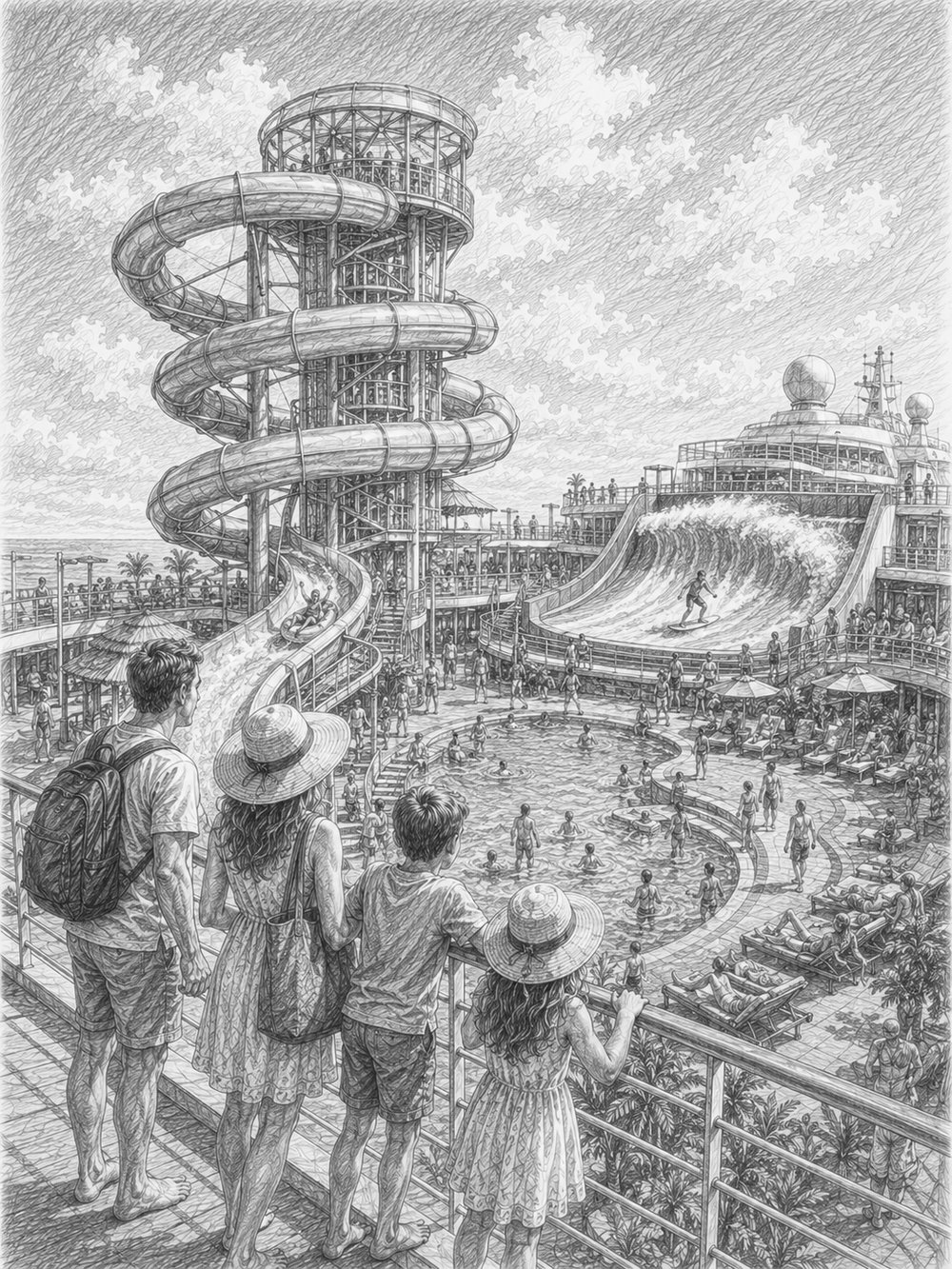
This is where Oasis earns her reputation with active families and anyone who likes an adrenaline hit between meals. The Ultimate Abyss is a ten-story dry slide, the tallest slide at sea, dropping from the pool deck down toward the Boardwalk in a few seconds of controlled chaos. The Perfect Storm is a trio of waterslides for the wetter version of the same idea. The FlowRider surf simulator lets you try bodyboarding or stand-up surfing on a wave that never stops, and it draws a crowd of both riders and spectators. There is a rock-climbing wall, and a zip line that carries you over the Boardwalk, nine decks up, in one of the more unusual things you will do on a cruise.
On the water side, expect multiple pools, an adults-only Solarium for a quieter swim, and Splashaway Bay, the kids’ splash area with fountains and small slides. The pools are busiest on sea days at midday and quietest during port stops and early mornings. None of the thrill attractions cost extra, though some have height or age requirements and can close in bad weather, so check the app for hours and conditions. If you are traveling with kids, the Adventure Ocean youth program is organized by age and the Boardwalk carousel is a hit with the youngest sailors.
The app runs your cruise
Download the Royal Caribbean app before you leave home and set up your account, because on Oasis it is genuinely central to the experience. It holds your boarding pass, the deck maps you will lean on for the first day, the daily schedule, and your show and dining reservations, and it handles check-in. Your SeaPass card is your cashless payment and your cabin key. Daily gratuities are added automatically to your account. One thing to plan for: there is no free ship-wide Wi-Fi, so if you want to stay connected you will buy an internet plan, and buying it before you sail is often cheaper. Even offline, the app works for schedules and maps over the ship’s network, so it is useful whether or not you pay for internet.
What might surprise a first-timer
A few things routinely catch new Oasis guests off guard, and knowing them in advance smooths the whole trip.
- The drive-to convenience. Cape Liberty sits in Bayonne, across the harbor from Lower Manhattan, with parking at the port. For much of the Northeast this is a giant ship you can reach by car, with no flights and no lost luggage, and sail-away offers views toward the Statue of Liberty.
- You cannot see it all. On a seven-night cruise, most people finish without visiting every venue. Trying to do everything is the fastest way to feel rushed. Pick a few priorities and let the rest be a reason to come back.
- Reservations decide your week. The best shows, specialty tables, and the FlowRider slots go to people who book in the app early. Walk-ups often work, but planning the headline items removes the stress.
- The sea days are real. From the Northeast, the longer itineraries include full days at sea by design. If you expected nonstop ports, reset that expectation, and lean into the on-board activities instead.
- Where your cabin sits matters. On a longer nine-night sailing, a well-placed room away from show-noise venues and pool-deck thump makes a noticeable difference to your rest.
- It is busy but rarely chaotic. The ship is engineered to move thousands of people. Lines exist, but they move, and the quiet corners are always there if you know where to look.
If this is your very first sailing on the ship, the dedicated first-time cruise on Oasis of the Seas walkthrough covers the embarkation-day details, and if you are weighing the Cape Liberty logistics specifically, the Oasis of the Seas Cape Liberty cruise guide gets into parking and the drive.
Get the complete Oasis of the Seas playbook
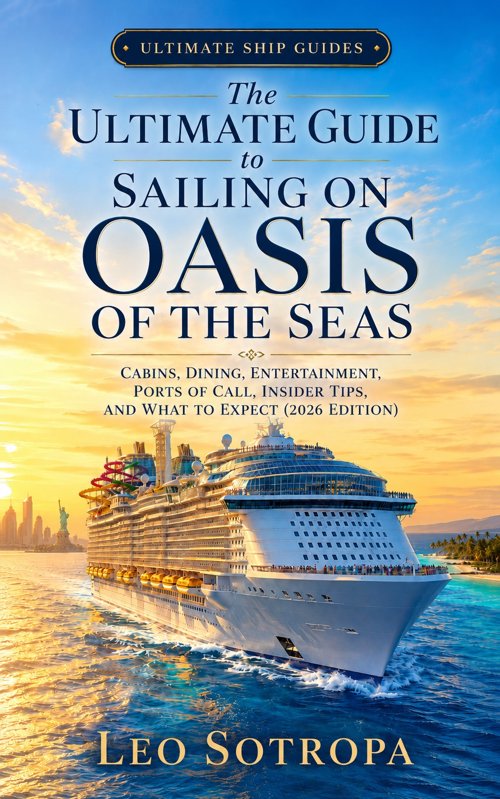
If you want every one of these decisions mapped out before you board, “The Ultimate Guide to Sailing on Oasis of the Seas” turns this overview into a full plan. It is part of the Ultimate Ship Guides series by Leo Sotropa, with clear action steps in every chapter so you know exactly what to book, when to book it, and how to make the most of your week at sea.
Frequently asked questions
Is Oasis of the Seas too big and crowded to enjoy?
She is big, and at full capacity she carries close to 6,800 guests, but the design spreads people out across seven neighborhoods. Crowds concentrate at predictable spots and times, the buffet at breakfast, the theater before shows, the pool deck at noon. Eat a little off-peak, book shows in advance, and use Central Park as a quiet retreat, and the ship rarely feels overwhelming.
How does Oasis compare to the newer ships in her class?
Oasis was the first Oasis-class ship and the one that invented the seven-neighborhood layout the whole class uses. The newer sisters are slightly larger and add a few of the latest headline features, but Oasis has been amplified over the years, so the real-world difference is small. First-time cruisers to the class will not feel like they are missing out.
Are there sea days, or is it all ports?
Because Oasis sails from Cape Liberty in New Jersey, the longer itineraries include genuine sea days rather than a nonstop string of ports. A seven-night cruise mixes sea days with Nassau and Perfect Day at CocoCay, and the nine-night runs add ports like Puerto Plata. Confirm the exact ports for your sailing in the Royal Caribbean app.
Do I have to pay extra to eat well?
No. The included venues, the Main Dining Room, Windjammer, Sorrento’s, Café Promenade, Park Café, and El Loco Fresh, cover a full cruise comfortably. Specialty restaurants like Chops Grille, Giovanni’s, Portside BBQ, and 150 Central Park cost extra for a special night. If you want several specialty meals, a dining package usually beats paying per restaurant.
Which shows should I book, and how?
Aim for the three signatures: the Broadway-style theater production, the open-air AquaTheater high-diving show, and the ice-skating show. All are included in your fare, but seating is limited and the best times fill up, so reserve in the Royal Caribbean app as soon as you board rather than relying on walk-ups.
Do the thrill attractions cost extra?
No. The Ultimate Abyss dry slide, the Perfect Storm waterslides, the FlowRider, the rock wall, and the zip line are all included. Some have height or age requirements and can close in bad weather, so check hours and conditions in the app. The pools and the adults-only Solarium are included too; only certain CocoCay attractions and specialty dining carry extra charges.
What should a first-timer do before boarding?
Download the Royal Caribbean app, complete online check-in, and set up your reservations for shows and specialty dining in advance. Plan for no free ship-wide Wi-Fi by buying an internet plan ahead if you need one, pack comfortable shoes for all the walking, and pick a few priorities rather than trying to see everything in one cruise.
Ready for the whole ship in one place? It is all in The Ultimate Guide to Sailing on Oasis of the Seas.
Get the book →
Meet Leo: The Heartbeat Behind ‘A Country A Month’
Journeying through the pages of A Country A Month, you might often feel the rhythm of a storyteller’s heartbeat, pulsating through each line, each image, and each adventure shared. That heartbeat belongs to none other than our remarkable website editor, Leo.
With a lens in one hand and a pen in the other, Leo seamlessly marries his passions for photography and writing. His eye captures moments that words can barely describe, yet his eloquence brings those images to life, transcending borders and connecting us all through shared stories. An avid traveler, every country he’s visited has added another chapter to his expansive tale, and through our platform, he generously shares these chapters with us.