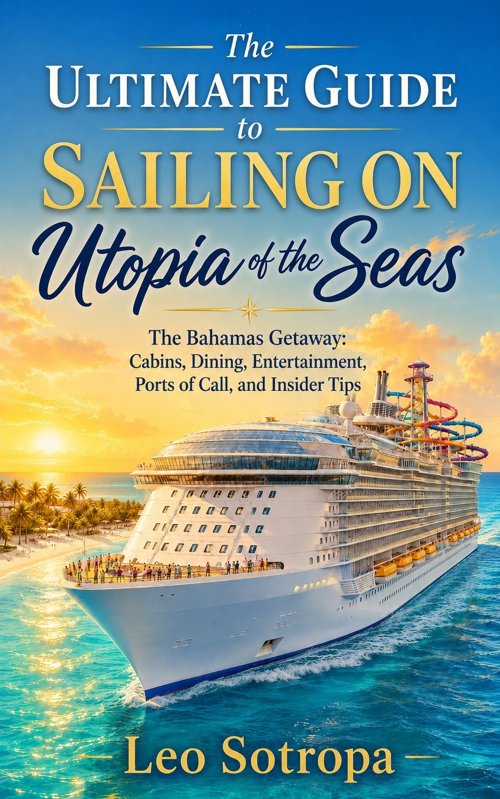
Is there a single, honest handbook written just for one ship, so you can walk aboard already knowing where to eat, which cabin to book, and how to spend a short sailing well? Yes. The Ultimate Guide to Sailing on Utopia of the Seas: The Bahamas Getaway by Leo Sotropa is exactly that: an independent, ship-specific guide to Royal Caribbean’s Utopia of the Seas, written for a fast 3- and 4-night trip where the ship itself is the main event. If you have a sailing booked, or you are deciding whether to book one, this is the Utopia of the Seas book that helps you plan the trip instead of guessing at it.
This page describes what the book covers, who it suits, and why a guide built around one ship beats a generic cruise primer. Utopia of the Seas is a big, energetic ship packed into a short cruise, and that combination rewards a little preparation. The guide is here to give you that preparation without the overwhelm.
What this book actually is
This is a title in the Ultimate Ship Guides series, and it is independent and unofficial. It is not published by the cruise line, and it does not read like marketing. It is a practical handbook focused on one ship, Utopia of the Seas, so every page is about the vessel you are actually sailing on rather than cruising in the abstract.
Utopia of the Seas is Royal Caribbean’s newest and largest Oasis-class ship. She runs to roughly 236,860 gross tons across about 18 guest decks and carries more than 5,600 guests, climbing toward 6,800 when completely full. That scale matters, because a ship this size can either feel like a maze or feel like it was built for you, and the difference usually comes down to knowing the layout before you board. The book maps her seven neighborhoods and the full Oasis-class amenity set so the size works in your favor.
What sets Utopia apart is her role. She is dedicated to short getaways: 3- and 4-night Bahamas sailings round-trip from Port Canaveral, about an hour from Orlando and its theme parks. Royal Caribbean calls it “the world’s biggest weekend,” and the vibe is lively, party-leaning, and high-energy. On a trip this short, the ship is the destination as much as the ports are, which is exactly why a ship-specific guide earns its place. The book is written to help you get full value out of a compressed schedule, where a wasted afternoon is a bigger loss than it would be on a longer voyage.
The latest edition comes in Kindle and a 6×9 paperback, and it is illustrated with graphite chapter illustrations. Every chapter ends with clear, practical Action Steps, so reading it is not a passive exercise. You finish each section with something concrete to do, whether that is a reservation to make, a deck plan to check, or a decision to lock in before you sail.
What is inside
The guide follows the shape of an actual trip, from the moment you start planning to the last port day. Here is how the chapters break down and what each one gives you.
The ship’s layout and neighborhoods
The book opens with a tour of the decks and spaces, and how to move around Utopia without wasting vacation time. Oasis-class ships are organized into seven neighborhoods, and the guide walks through each one: Central Park, the open-air garden with thousands of live plants and quieter restaurants; the Boardwalk, a family zone with a handcrafted carousel and the open-air AquaTheater at the stern; the Royal Promenade, the indoor main street of shops and bars; the Pool and Sports Zone; the Vitality Spa and Fitness area; Entertainment Place, home to the casino, ice rink, and music; and the Youth Zone. Once you understand how these connect, a huge ship starts to feel navigable, and you stop losing time to backtracking.
If you want a preview of how the ship feels day to day, the free companion article on what to expect on Utopia of the Seas covers the atmosphere before you commit to the book.
The cabin guide
Choosing a stateroom is one of the few decisions that is hard to undo, and it is where the book earns its keep for many readers. It covers the full range of cabins: interiors, including the clever Virtual Balcony rooms with a real-time ocean screen; ocean-view rooms; true balcony staterooms; the Boardwalk-view and Central Park-view balconies that face inward into the neighborhoods; and suites up to the Royal Loft and multi-room family options.
More useful than the list is the honest guidance on which to book and which to avoid. On a short cruise you will barely spend time in the room, so an interior is often the best value, and a Virtual Balcony interior adds daylight for a little more. For an all-round pick, the book points to a midship ocean-view balcony on the mid-decks for space, light, and the steadiest ride. It is equally frank about trade-offs: Central Park-view balconies are quiet but have no sea view and less breeze, while Boardwalk-view balconies are fun for watching the AquaTheater but can get noisy during shows. It flags the cabins to check against the deck plan, too, like rooms directly under the pool deck where early-morning deck-chair noise carries, rooms over or under the AquaTheater and Boardwalk venues, rooms beside busy elevator banks, and far-forward high-deck rooms for anyone prone to motion. On a 3- or 4-night trip these matter less, but light sleepers still benefit from knowing what sits above and below them.
Readers who want a deeper look at this one topic can start with the free guide to the best cabins on Utopia of the Seas, then use the book for the full breakdown.
The dining guide
Utopia offers more than 40 ways to dine and drink, which is generous and also a little bewildering on a short trip. The book sorts it out. It explains what is already included, such as the Main Dining Room, the Windjammer buffet, Café Promenade, Park Café, Sorrento’s pizza, El Loco Fresh, and the casual spots that keep you fed without extra charges. Then it covers the specialty venues that cost more and tells you which are worth the splurge: Chops Grille for steak, Hooked for seafood, Izumi, Giovanni’s Italian, Playmakers sports bar, and Johnny Rockets. Just as important, it tells you what to reserve before you board, because the best tables and times on a busy weekend sailing go quickly. The lively bar scene gets its due as well, since it fits the weekend mood of the ship.
Entertainment, shows, and the signature thrills
This is where Utopia shows off, and where timing makes or breaks your day. The guide covers the headline thrills: the Ultimate Abyss, a 10-story dry slide that is the tallest slide at sea; the Perfect Storm trio of waterslides; the FlowRider surf simulator; a rock-climbing wall; a zip line over the Boardwalk; a full ice-skating rink; multiple pools and hot tubs; and an adults-only Solarium. It also walks through the shows, which include a Broadway-style theater production, a high-diving acrobatic show at the open-air AquaTheater, and an ice show. The insider value here is timing: knowing when to hit the big attractions to beat the lines, so you actually experience the ship instead of standing in queues on a trip that is already short. On a weekend sailing the popular slides and the surf simulator draw crowds at predictable hours, and the theater and AquaTheater shows have set times worth planning around, so a little scheduling goes a long way toward fitting the highlights into two or three full days.
The ports of call
Even though the ship is a destination in itself, the port days matter, and the guide gives them a full chapter with destination guides, top excursions, and must-do shortlists. The 4-night Bahamas getaway typically calls at Nassau and Perfect Day at CocoCay with a sea day, while the 3-night version is a shorter weekend built around CocoCay and usually Nassau. The book tells you to confirm the exact ports for your sailing, then helps you make the most of each.
Perfect Day at CocoCay is often the highlight of a short Utopia cruise, so the book treats it seriously. It separates what is included, like the several beaches, the Oasis Lagoon that is the largest freshwater pool in the Bahamas, the freshwater areas, and the island tram, from the paid extras such as the Thrill Waterpark, home to the tallest waterslide in the Caribbean, the zip line, the Coco Beach Club, and the adults-only Hideaway Beach. Because a CocoCay day can be the best day of the trip, the guide helps you decide in advance whether the add-ons are worth it for your group.
For Nassau, it points you to the real landmarks worth your time, from Paradise Island and the Atlantis resort and aquarium to the Queen’s Staircase and Fort Fincastle, Junkanoo Beach, the straw market, and Blue Lagoon Island, most of them walkable from the pier or a short ride away, with advice on confirming and booking ahead. If the itinerary is what draws you, the free article on the Utopia of the Seas short Bahamas cruise gives a useful overview.
Money and value
Cruise pricing is where surprises hide, and the book is honest about it. It explains what is already included in your fare, when add-on packages actually pay off, and how to avoid the upcharges that quietly inflate a bill. It also covers the mechanics that trip up first-timers: the app doubles as your boarding pass, deck maps, daily schedule, reservations, and check-in; SeaPass runs your cashless onboard account; daily gratuities are added automatically; and there is no free ship-wide Wi-Fi, only paid plans. None of this is meant to scare you off spending; it is meant to help you spend where it counts and skip what does not fit your trip. Because the book keeps price talk relative rather than quoting figures, the advice stays useful over time.
Family know-how and adults-only escapes
Utopia is built to serve very different travelers at once, and the book addresses both. Families get guidance on the Adventure Ocean youth program organized by age, Splashaway Bay kids’ aqua park, teen spaces, and how to keep everyone happy on a busy ship. Adults looking for calm get the escapes, including the adults-only Solarium onboard and the Hideaway Beach at CocoCay. On a party-leaning weekend sailing, knowing where the quiet corners are is genuinely valuable.
Embarkation strategy, pro tips, and Action Steps
The first few hours of a cruise set the tone, and the book has an embarkation-day strategy to get you aboard and enjoying the ship quickly rather than standing in lines. It closes the practical arc with a chapter of pro tips, common pitfalls, and frequently asked questions, the kind of accumulated know-how that usually only comes after a few sailings. And because every chapter ends with Action Steps, you are never left with information you cannot use. Each section hands you a short, concrete to-do list, which is how a guide turns into an actual plan.
Who it is for
The book is written for a wide range of readers, and it is honest about serving each of them.
- First-timers who feel a little intimidated by a ship this big and want clear, confidence-building guidance from the moment they book.
- Families juggling kids’ clubs, dining times, and pool days, who need to keep everyone happy without a spreadsheet.
- Seasoned cruisers who know the drill but have not sailed Utopia specifically, and want ship-level detail rather than general cruise advice.
- Gift-givers looking for a thoughtful present for anyone who has a Utopia sailing booked, since it is genuinely useful rather than a generic keepsake.
If you are still deciding whether the ship suits your travel style, the free first-time cruise on Utopia of the Seas article is a good place to start before you buy.
Why a ship-specific guide beats a generic cruise primer
General cruise books have to hedge. They describe a category of vacation, not the ship you are on, so their advice stays vague where you most need specifics. A ship-specific guide can name the exact venue to reserve, the exact cabin to avoid, and the exact slide worth lining up for early. On Utopia, where the ship is the destination and the schedule is short, that precision translates directly into a better trip.
It also reduces pre-cruise stress. Instead of arriving with a vague sense that there is a lot to do, you arrive with a plan: dinners booked, a cabin chosen for the right reasons, a CocoCay decision already made, and a rough map of the ship in your head. That is the real payoff. The book does not promise a perfect vacation, and it is careful to tell you to confirm current details, venues, itineraries, and prices in the Royal Caribbean app, because those things change. What it delivers is preparation, so the parts you can control are handled before you step aboard. For a broader planning overview, the free Utopia of the Seas cruise guide pairs well with the book.
About the author and the series
The book is written by Leo Sotropa as part of the Ultimate Ship Guides series, a collection of independent, ship-by-ship handbooks. The approach across the series is the same: practical, honest, and specific to one vessel, with Action Steps that turn reading into a plan. The companion website at acountryamonth.com hosts free articles on Utopia of the Seas and other ships, so you can read a fair amount before deciding whether the full book is worth it. The free reading is a genuine sample of the approach, not a teaser, and it gives you an honest sense of the voice and level of detail before you spend anything.
Get The Ultimate Guide to Sailing on Utopia of the Seas
The Ultimate Guide to Sailing on Utopia of the Seas: The Bahamas Getaway by Leo Sotropa is an independent, ship-specific handbook in the Ultimate Ship Guides series, available on Kindle and paperback, with clear action steps in every chapter to turn your short Bahamas getaway into a plan.
Frequently asked questions
Is this an official Royal Caribbean book?
No. It is an independent, unofficial guide written by Leo Sotropa in the Ultimate Ship Guides series. That independence is the point, because it lets the book give honest opinions about which cabins to avoid, which specialty restaurants are worth the extra cost, and where to spend and where to save, without a marketing angle.
Should I get the Kindle or the paperback?
Both cover the same material, so it comes down to how you like to read. The Kindle edition is convenient to carry and search on your phone or tablet while you are aboard, which is handy given that there is no free ship-wide Wi-Fi. The 6×9 paperback is nice for planning at home and includes the graphite chapter illustrations in print. Some readers buy both, one to plan with and one to travel with.
Is the book up to date?
The guide is written to stay useful, focusing on the ship’s layout, cabins, dining structure, thrills, and ports rather than fleeting details. It keeps prices relative rather than quoting exact figures, and it repeatedly tells you to confirm current venues, itineraries, and prices in the Royal Caribbean app before you sail. That way the strategy holds up even as specifics shift.
Does it cover Utopia’s specific ports?
Yes. There is a full ports-of-call chapter focused on the Bahamas getaway itinerary, with destination guides for Perfect Day at CocoCay and Nassau, including which experiences are included and which paid extras are worth it. It covers the included beaches and the Oasis Lagoon at CocoCay, the Thrill Waterpark and Hideaway Beach add-ons, and Nassau landmarks like Atlantis, the Queen’s Staircase, and Junkanoo Beach, with advice to confirm your exact ports for your sailing.
Is it good for first-time cruisers?
Very much so. First-timers get the most from it, because it explains the things veterans take for granted, like how the app works as your boarding pass and daily schedule, how the SeaPass account and automatic gratuities work, and how to handle embarkation day. The Action Steps at the end of each chapter give newcomers a clear checklist so a big ship feels manageable.
Would it make a good gift?
Yes, especially for anyone who already has a Utopia of the Seas sailing booked. It is a practical present that gets used rather than shelved, and the paperback with its chapter illustrations feels like a real book to hand over. For a cruise-lover in your life, it is a thoughtful way to help them get more out of a trip they are already excited about.
Does the book replace the Royal Caribbean app?
No, and it does not try to. The app is where you confirm live details, make reservations, check the daily schedule, and use your digital boarding pass, and the book tells you to rely on it for anything current. The guide does the part the app cannot: it explains strategy, gives honest opinions, and helps you decide what to book in the first place. Used together, the book plans the trip and the app runs it: you arrive with your decisions made and reservations lined up, and you use the app onboard to keep track of the daily schedule and any last-minute changes. That division of labor is exactly how the guide is meant to be used.

Meet Leo: The Heartbeat Behind ‘A Country A Month’
Journeying through the pages of A Country A Month, you might often feel the rhythm of a storyteller’s heartbeat, pulsating through each line, each image, and each adventure shared. That heartbeat belongs to none other than our remarkable website editor, Leo.
With a lens in one hand and a pen in the other, Leo seamlessly marries his passions for photography and writing. His eye captures moments that words can barely describe, yet his eloquence brings those images to life, transcending borders and connecting us all through shared stories. An avid traveler, every country he’s visited has added another chapter to his expansive tale, and through our platform, he generously shares these chapters with us.