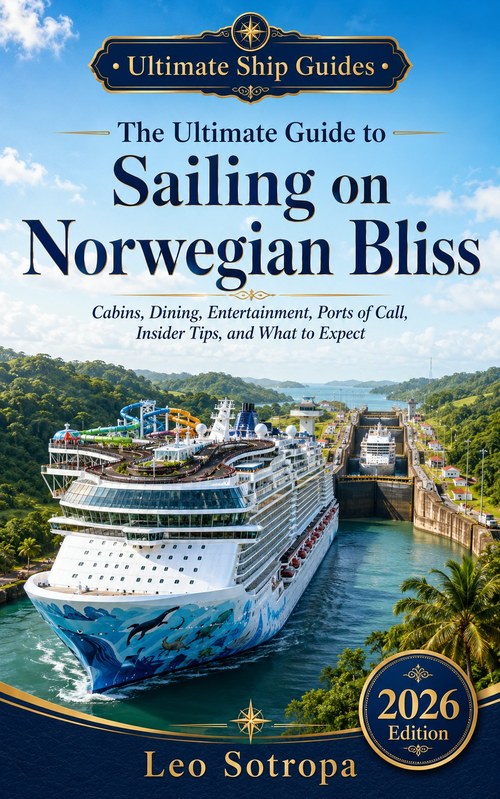
Is The Ultimate Guide to Sailing on Norwegian Bliss the right book for your cruise? If you have a sailing booked on Norwegian Bliss and you want to walk aboard already knowing where to go, what to reserve, and how to spend your money well, then yes — this is written for exactly that. It is an independent, ship-specific handbook to Norwegian Bliss by Leo Sotropa, part of the Ultimate Ship Guides series, and it does one job: it teaches you this particular ship so your first hours don’t disappear into wandering, guessing, and standing in the wrong line.
Norwegian Bliss is a big, busy Breakaway Plus-Class megaship — around 168,000 gross tons, roughly twenty decks, and about 4,004 guests at double occupancy, closer to 4,900 when she sails full. A ship that size rewards the people who arrive with a plan and quietly costs the people who don’t. This book is the plan. Below is what it covers, who it helps, and why a guide built around one ship beats a general cruise primer that treats every vessel as interchangeable.
What this book is
This is an independent, unofficial handbook to a single ship. It is not published by the cruise line, and it is not a broad introduction to cruising that mentions Norwegian Bliss in passing. Every chapter is about her: her layout, her cabins, her restaurants, her entertainment, her thrills, and the ports she visits. That focus is the whole point. Instead of generic advice that applies to any of a hundred ships, you get specifics tied to the decks you’ll actually walk and the venues you’ll actually book.
The book comes in two formats: a Kindle ebook you can carry on your phone, and a 6×9 paperback you can flag and scribble in. It is illustrated with graphite chapter illustrations, and — the feature readers tend to mention most — every chapter ends with clear, practical Action Steps. Those turn reading into doing: book this now, note that on the deck plan, pack this, reserve that before you board. You are never left with a pile of interesting facts and no idea what to do first.
One honest note the book makes itself: a printed guide is timeless by design, but a live ship changes. Menus rotate, show lineups shift, venues get refreshed. So the guide teaches you how the ship works and how to decide, then tells you to confirm the current specifics — venues, times, itineraries, prices — in the Norwegian Cruise Line app. That combination, durable strategy plus a live check, is what keeps it useful sailing after sailing.
What’s inside
The guide follows the shape of a real cruise, from the moment you’re deciding on a cabin to the day you step ashore in a foreign port. Here is what each part gives you.
The ship’s layout and how to navigate her
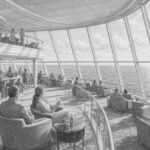
The book opens with a tour of the decks and spaces so the ship stops feeling like a maze by the second day. Norwegian Bliss was the first Norwegian ship designed with a two-deck, wraparound Observation Lounge — a huge forward-facing room with floor-to-ceiling panoramic windows and leather chairs, purpose-built for scenic cruising. The guide shows you where that lounge sits and why it matters, along with the pool deck, the Aqua Park, the top-deck attractions, and the quiet corners most guests never find. Knowing the geography before you board is the single biggest time-saver on a ship this large, and it means you spend your vacation in the good spots instead of hunting for them.
The cabin guide: which to book, which to avoid
This is the chapter that can save you real money and real regret, because the cabin is usually the biggest single decision you make. The book walks the full range on Norwegian Bliss — Inside, Oceanview, Balcony, Club Balcony Suite, Mini-Suites, Spa cabins, the solo Studios with their own Studio Lounge, and The Haven suites at the top. It explains the trade-offs plainly: an Inside or a solo Studio for best value, a midship Balcony on the mid-decks for the best all-round mix of scenery and steady ride, and The Haven when space, service, and views matter most.
Just as important, it tells you what to avoid. Rooms directly under the pool deck, the Garden Café, or the Speedway can be noisy. Cabins near nightlife venues can keep you up. Forward high-deck rooms move more, which matters if anyone in your party is prone to motion, and some lower-deck balconies have obstructed views you won’t spot from the booking page. The guide tells you to confirm each of these against the deck plan before you commit — the kind of check that turns a frustrating week into a comfortable one. If you want to compare options before you buy the book, the companion article on the best cabins on Norwegian Bliss is a good place to start.
The dining guide and how Freestyle Cruising works
Dining on a Norwegian ship runs on Freestyle Cruising, and the book explains it because it’s the core difference that trips up first-timers. There are no fixed dining times, no assigned tables, and no formal dress codes — you eat when, where, and with whom you like, across a wide range of restaurants. The complimentary options include the main dining rooms and the Garden Café buffet, so you can cruise well without spending a cent extra on food.
Then there are the specialty restaurants, which carry an extra charge or run through a dining package: Cagney’s Steakhouse, Le Bistro for French, Ocean Blue for seafood, Onda by Scarpetta for Italian, Teppanyaki for Japanese hibachi, Food Republic, and the Q Texas Smokehouse, among others. The guide tells you which are worth the splurge, which to reserve before boarding because they fill up, and how to think about a dining package versus paying à la carte. It does the same for the bars — the Sugarcane Mojito Bar, the District Brew House, the Cavern Club, and the A-List Bar — so you know what kind of night each one is before you walk in. The freedom of Freestyle is wonderful once you understand it; the book makes sure you understand it before you’re standing at a podium at seven o’clock wondering why there’s a wait.
Entertainment and the signature thrills
Norwegian Bliss carries Broadway-scale and headline entertainment — she has featured the Tony-winning Jersey Boys and other productions — plus comedy, live music, and shows across the week. The guide covers what to expect and, more usefully, the timing tricks that get you a good seat without giving up half your evening to a queue. It reminds you to confirm the current lineup in the app, since shows change between sailings.
The thrills get their own attention. The Speedway is a two-level electric go-kart racetrack, roughly 1,000 feet long, that extends out over the side of the ship — an extra charge, and one of the most popular things aboard, which means it’s one of the first to book up. The Aqua Park adds freefall and tube waterslides plus a kids’ area, and there’s open-air laser tag on the top deck. The book gives you insider timing to beat the lines on all of it, because on a full ship the difference between a two-minute wait and a forty-minute one is simply knowing when to show up. For a preview, the companion piece on the Haven and the Speedway covers both in more detail.
The ports of call, built around the Panama Canal
The book’s marquee voyage is the Panama Canal — a longer, repositioning-style sailing that typically runs between Los Angeles and Miami in either direction, over roughly fifteen to nineteen nights. It heads down the Mexican Pacific and Central America, transits the Panama Canal, then continues to Colombia and the Caribbean. This is not a simple week-long loop; it’s a bucket-list route with more sea days than a typical cruise, which suits Freestyle’s flexibility and the ship’s many attractions.
The ports-of-call chapter gives you destination guides, top excursions, and must-do shortlists for the stops along the way: Cabo San Lucas with El Arco and its marina and beaches; Acapulco with its bay and the La Quebrada cliff divers; Puerto Quetzal, the gateway to colonial Antigua, the volcanoes, and coffee country in Guatemala; Puntarenas in Costa Rica, for rainforest national parks and wildlife — monkeys, sloths, and birds; Cartagena in Colombia, with its walled Old Town and forts; Falmouth in Jamaica on some sailings; and Great Stirrup Cay, Norwegian’s private Bahamas island, for a relaxed beach finale before Miami. Direction and exact ports vary by sailing, so the book tells you to confirm your itinerary rather than assume.
The centerpiece is the canal day itself: a full day transiting the locks and crossing the isthmus that divides two oceans. The guide coaches you through it — be up early for the first locks, use the Observation Lounge and the open decks, bring sun protection and water, and follow the onboard narration explaining the engineering and history. It’s a long, fascinating day, and Bliss’s two-deck Observation Lounge makes her one of the best ships to watch it from. If the canal is why you’re sailing, the companion articles on the Norwegian Bliss Panama Canal voyage and the specific transit-day tips are worth reading alongside the book.
Honest money advice
Cruise pricing is where good intentions leak away in small charges, so the book keeps this section blunt and practical. It lays out what is already included — the main dining rooms, the buffet, the core experience — so you don’t pay twice for things you already have. It explains when packages actually pay off versus when they don’t, given your habits, and how to sidestep the upcharges that catch people off guard. On a longer voyage it also covers the practical money side of visiting multiple countries: US dollars are widely used across much of the route and are official in Panama, but Mexico, Guatemala, Costa Rica, Colombia, and Jamaica each have their own currency, and it’s worth carrying small local cash for markets and taxis even where cards are common. Prices are kept relative throughout, because numbers date and the smart way to decide doesn’t.
Family know-how and adults-only escapes
Norwegian Bliss works for very different kinds of traveler at the same time, and the book handles both. Families get the practical rundown on the kids’ areas, the waterslides, laser tag, and how to keep everyone happy across a long sailing with plenty of sea days. Couples and solo travelers get the quieter side: The Haven by Norwegian is an exclusive, keycard-only suite complex — a ship-within-a-ship with its own pool, restaurant, lounge, sun deck, and concierge and butler service — and the guide explains what it buys you and whether it’s worth it for your trip. Solo travelers also get the Studios and the Studio Lounge, a genuinely thoughtful bit of ship design that the book makes sure you don’t overlook.
Embarkation strategy and the pro tips
The first day sets the tone, so the book gives you an embarkation-day strategy: what to do the moment you’re aboard, what to reserve first, and how to use the early hours before the ship gets busy. A longer Panama Canal voyage adds a documents wrinkle — because it visits multiple countries and is not a closed-loop US itinerary, a passport is required, and some ports or nationalities may need extra documents, so the guide tells you to check current entry rules well ahead. There’s also a chapter of pro tips, common pitfalls, and FAQs that collects the small lessons most people only learn the hard way. And, as everywhere in the book, the chapters close with Action Steps so you finish each one with something concrete to do.
Who it’s for
First-timers get the most obvious benefit: the book removes the fog. Freestyle Cruising, the key card as your cashless account, service charges, the paid Wi-Fi plan, the app that runs your day — all of it is explained before you board, so your first cruise doesn’t start with confusion. If this is your first Norwegian sailing, the companion guide on Freestyle Cruising for first-timers pairs well with the book.
Families get a way to keep a wide age range engaged on a long voyage, with the thrills, the pools, and the ports all mapped out in advance. Seasoned cruisers get something different: not an introduction they don’t need, but the specifics of this ship — where the good cabins hide, which specialty restaurant is actually worth it here, how to work the canal day — that even experienced travelers can’t know until they’ve sailed her. And because it’s organized and illustrated, it makes a genuinely thoughtful gift for anyone who already has a Norwegian Bliss sailing booked. A guide to their exact ship lands better than a generic cruise book, and the Action Steps give the recipient something to do with it right away.
Why a ship-specific guide beats a generic primer
A general cruise book has to speak to every ship, so it can’t tell you which cabin on your ship has an obstructed view, which restaurant to reserve before you board, or where to stand for the Panama Canal transit. It stays vague because it has to. A ship-specific guide can name the deck, the venue, and the decision — and that’s where the real time and money savings live.
The deeper value is stress. Most pre-cruise anxiety comes from not knowing: not knowing how dining works, whether you booked the right cabin, what to do first, whether you’ll waste the port day. Reading a book written for Norwegian Bliss specifically replaces that uncertainty with a plan, and a plan is calming. You board knowing roughly how your week will go and where the good decisions are, which frees you to actually relax. If you’d like a sense of the ship before committing, the free companion overviews — the Norwegian Bliss cruise guide and what to expect on Norwegian Bliss — cover the basics, and the book goes considerably deeper.
About the author and the series
The book is written by Leo Sotropa as part of the Ultimate Ship Guides series — a collection of independent, ship-specific handbooks, each dedicated to a single vessel rather than to cruising in general. The series is built on a simple idea: the more precisely a guide matches your actual ship, the more useful it is, and the less time you waste once you’re aboard. The companion website, acountryamonth.com, hosts free articles for each ship covered, so you can read a good deal before you decide whether the full book is for you. Between the free guides and the paperback or Kindle edition, you can go as light or as thorough as you like.
Get The Ultimate Guide to Sailing on Norwegian Bliss
The Ultimate Guide to Sailing on Norwegian Bliss by Leo Sotropa, part of the Ultimate Ship Guides series, is an independent, ship-specific handbook available on Kindle and 6×9 paperback, with clear Action Steps in every chapter. It turns a big, unfamiliar ship into a cruise you can plan with confidence.
Frequently asked questions
Is this an official Norwegian Cruise Line book?
No. It is an independent, unofficial guide written by Leo Sotropa. It isn’t published or endorsed by the cruise line, which is the point — it gives you honest, practical opinions about which cabins to book, which restaurants are worth the extra charge, and where the ship falls short, the kind of candor an official brochure can’t offer.
Should I get the Kindle version or the paperback?
Both contain the same guide, so it comes down to how you like to read. The Kindle edition lives on your phone and travels with you aboard, which is handy for checking Action Steps on the go. The 6×9 paperback is easy to flag, annotate, and hand around the family at the planning stage, and it makes a nicer gift. Plenty of readers use the paperback to plan and keep the Kindle version on their phone for the trip.
Is the book up to date?
It reflects the latest edition and is written to stay useful over time by teaching how the ship works and how to make good decisions, rather than chasing details that change. Because menus, show lineups, venues, and itineraries do shift between sailings, the book tells you to confirm the current specifics in the Norwegian Cruise Line app. That pairing — durable strategy plus a live check — keeps it accurate sailing after sailing.
Does it cover the specific ports on the Panama Canal itinerary?
Yes. There’s an in-depth ports-of-call chapter built around the Panama Canal voyage, with destination guides, top excursions, and must-do shortlists for stops such as Cabo San Lucas, Acapulco, Puerto Quetzal, Puntarenas, Cartagena, Great Stirrup Cay, and the canal transit itself. Because direction and exact ports vary by sailing, the book tells you to confirm your own itinerary and book popular tours early, since they sell out.
Is it good for first-time cruisers?
Very much so. It explains the things first-timers find confusing — how Freestyle Cruising works, how the key card and onboard account function, what’s included versus what costs extra, and how to use the app — all before you board. First-timers tend to get the biggest payoff, because the book removes the guesswork that makes an early cruise stressful.
Would it make a good gift?
Yes, especially for someone who already has a Norwegian Bliss sailing booked. A guide to their exact ship feels more personal than a generic cruise book, the graphite illustrations make the paperback pleasant to give, and the Action Steps mean the recipient can start planning right away rather than just adding it to a shelf.
Does the book replace the Norwegian Cruise Line app?
No — they do different jobs and work best together. The app handles the live details of your specific sailing: current menus, show times, reservations, and your onboard account. The book gives you the strategy the app doesn’t: which cabin to book, which venues are worth it, how to plan the canal day, and what to do first. Use the book to plan and decide, and the app to confirm and execute once you’re aboard.

Meet Leo: The Heartbeat Behind ‘A Country A Month’
Journeying through the pages of A Country A Month, you might often feel the rhythm of a storyteller’s heartbeat, pulsating through each line, each image, and each adventure shared. That heartbeat belongs to none other than our remarkable website editor, Leo.
With a lens in one hand and a pen in the other, Leo seamlessly marries his passions for photography and writing. His eye captures moments that words can barely describe, yet his eloquence brings those images to life, transcending borders and connecting us all through shared stories. An avid traveler, every country he’s visited has added another chapter to his expansive tale, and through our platform, he generously shares these chapters with us.