If you have never sailed Holland America Line and you are looking at Nieuw Statendam, here is the short answer: this is a calmer, more classic style of cruising than the big-resort brands, built around live music, enrichment and Northern European itineraries — and it suits couples, solo travellers and anyone who wants a comfortable ship rather than a theme park at sea. Nieuw Statendam is the second Pinnacle-class ship in the fleet, carrying about 2,666 guests at double occupancy across roughly twelve guest decks and around 99,900 gross tons. That is mid-sized by modern standards: big enough to hold several restaurants and a proper theatre, small enough that you learn your way around by the second morning. This guide walks a first-timer through what the line is actually like, how the Have It All fare adds up, what Club Orange buys you, how to use the Navigator app, where to eat, and the mistakes newcomers most often make.
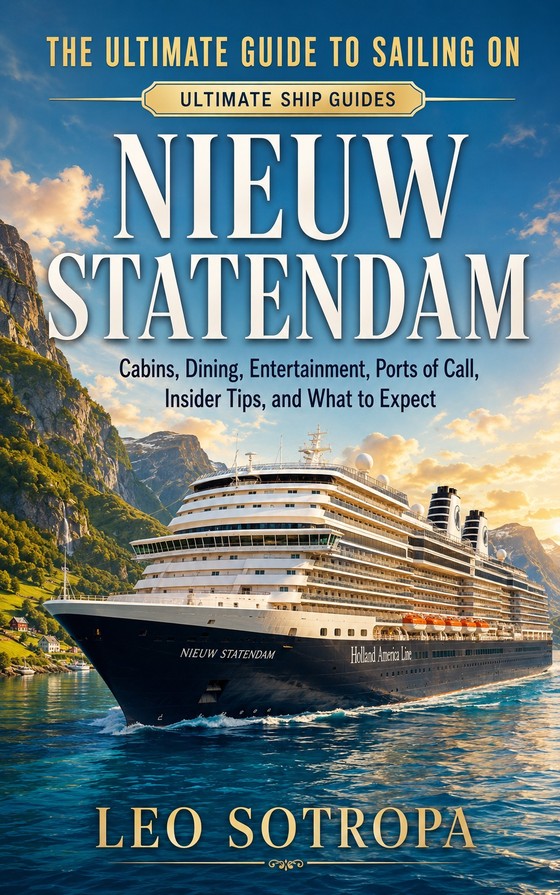
Everything in this article and far more, deck by deck, in The Ultimate Guide to Sailing on Nieuw Statendam.
Get the book →Who Holland America suits — and who it doesn’t
Holland America has been at this a long time. The company was founded in Rotterdam in 1873 and spent decades carrying cargo and emigrants from that quay to New York, and something of that heritage still runs through the modern fleet — the Dutch officers, the maritime tradition, the unhurried pace. Nieuw Statendam was designed by Adam D. Tihany and Bjørn Storbråten around a music theme and christened by Oprah Winfrey, so the interiors are handsome and grown-up rather than neon and loud.
That tells you most of what you need to know about fit. If you want a ship where the evening centres on a good band, a well-poured drink and a long dinner, you will feel at home. If you want waterslides, go-karts and a rock wall to keep three children entertained for a week, this is not that ship and you should choose a different line. Nieuw Statendam skews toward adults — couples, solo cruisers, groups of friends and multi-generational families where the children are older and happy to entertain themselves. It is not childless, but it is quiet by the standards of the mega-ships.
The other thing that shapes the experience is the itinerary. Nieuw Statendam sails Holland America’s home waters — Northern Europe, based in Rotterdam with some departures from Dover or Amsterdam. There are two quite different voyages under that heading, and knowing which one you booked matters more than almost anything else, so it is worth reading a dedicated Nieuw Statendam cruise guide before you commit.
The two itineraries — Baltic capitals or Norwegian fjords
The first voyage is the Baltic capitals run: Copenhagen, Oslo, Stockholm, Helsinki, Tallinn and Visby on Gotland, among others. This is a city-hopping cruise. Most days you wake in a European capital, spend the day walking cobbled old towns and museums, and sail overnight to the next. Copenhagen gives you Nyhavn, Tivoli Gardens and smørrebrød; Stockholm has the archipelago approach and the Vasa Museum; Tallinn’s walled medieval old town is one of the best-preserved anywhere; and little Visby, with its medieval walls and roofless churches, is the small port that quietly steals the cruise.
The second is the Norwegian fjords: Stavanger, Ålesund, Olden, Bergen and the Geirangerfjord, with longer runs pushing toward the Arctic Circle and the North Cape. This is a scenery cruise, not a city cruise. The high point is often not a port at all but the hours spent sailing into a fjord with waterfalls on either side. If you want detail on either route, the Baltic capitals itinerary and the Norwegian fjords itinerary are both worth reading before you book, because they call for different packing, different excursions and even different cabin choices.
There are also long-form “Collector’s Voyages” — up to about four weeks, combining stretches of the Baltic capitals into one long sailing. These are a genuine differentiator for the line and a wonderful thing if you have the time, but they are a big first cruise; most newcomers are better off starting with a one or two week voyage. The season runs roughly May to September, and ports vary by sailing, so always confirm the current schedule in the Navigator app rather than trusting an old brochure.
How Have It All adds up — and the rule that breaks the maths
Have It All is Holland America’s bundled fare, and understanding it is the single most useful thing a first-timer can do before booking. For roughly a set daily amount per person on top of the cruise fare, it folds in four things: a drinks package, Wi-Fi, a shore-excursion credit, and specialty dining. Bought separately, those four items would usually cost more than the bundle, which is why Have It All is the default recommendation for most guests.
But there is a rule inside it that breaks the arithmetic if you are not paying attention, and it is the specialty-dining allowance. The number of included specialty dinners scales with the length of your voyage, not by any figure you might assume: one night on a 6–9-night voyage, two nights on a 10–20-night voyage, and three nights on a 21-night-and-longer sailing. So on a week-long Baltic cruise, Have It All gives you a single specialty dinner — not one for every night, and not one you can spread thin across the trip. First-timers routinely misread this, plan four steakhouse nights in their heads, and are surprised at the extra charges. Plan your specialty meals around the actual allowance for your voyage length, and treat anything beyond it as a paid extra.
Two more points on the maths. The drinks package has a per-item price ceiling, so most everyday wines, beers and cocktails are covered while the rarest bottles are not — check the cap if you drink at the top end. And the shore-excursion credit is a fixed amount per person, so it takes the sting out of one tour rather than paying for a week of them. None of this makes Have It All a bad deal; it usually is a good one. It just rewards guests who know exactly what is inside it.

Club Orange — a different kind of upgrade
Club Orange is easy to confuse with Have It All, but it is a separate paid upgrade that does something quite different. Where Have It All bundles consumables — drinks, Wi-Fi, tours, dinners — Club Orange upgrades your standing on the ship. It gives you access to an exclusive Club Orange restaurant for breakfast and dinner, expanded menus in the main Dining Room, priority embarkation and tender access, and a stateroom upgrade within your booked category.
Two of those benefits matter more than the brochure suggests on a Northern European cruise. Priority tender access is genuinely valuable in the fjords and at smaller Baltic ports, where the ship anchors offshore and guests are ferried in by tender; skipping the queue can add an hour of daylight ashore. And the priority embarkation smooths what is otherwise the most stressful part of any first cruise. Whether Club Orange is worth it depends on how much you value those things and whether the cabin bump lands you somewhere better. It is not essential, but it is one of the more sensible upgrades on this ship — more useful, for many guests, than jumping a full cabin grade.
The Navigator app — your onboard control panel
Download the Navigator app before you sail and log in with your booking. On board it becomes your daily control panel: the schedule of what is on and when, dining reservations, deck plans, your onboard account, and messaging so your group can find each other without paying for shoreside data. Because Nieuw Statendam’s live music runs to a timetable across several venues, the app is the honest way to see what starts where and plan an evening rather than wandering and hoping.
Set the app up at home while you still have easy Wi-Fi, then use it as your first reference for anything that changes — and on a port-heavy Northern European sailing, times do change. It is also where you confirm the current itinerary and any late adjustments to ports, which the printed material will not reflect. Treat the Navigator app as the source of truth and the paper daily programme as a backup.
Dining: what’s included and what costs extra
You can eat very well on Nieuw Statendam without spending a penny beyond your fare. The included venues are the main Dining Room, the Lido Market buffet, the Dive-In burger counter, the New York Deli & Pizza, and the complimentary Grand Dutch Café, where bitterballen and Dutch beer are a small, characterful nod to the line’s roots. That is a genuinely full week of good meals with no surcharge.
The paid specialty restaurants are where the ship shows off, and there are four: the Pinnacle Grill steakhouse, Tamarind for pan-Asian, Rudi’s Sel de Mer for French seafood by Rudi Sodamin, and Canaletto for Italian. Each carries a cover charge, though your Have It All allowance covers a set number of them depending on voyage length as described above. A sensible first-timer plan is to use your included specialty night on the restaurant you are most curious about, eat the rest of the week in the Dining Room and Lido, and add one more paid dinner only if a special occasion calls for it.
| Included with your fare | Specialty (cover charge) |
|---|---|
| The Dining Room | Pinnacle Grill (steakhouse) |
| Lido Market buffet | Tamarind (pan-Asian) |
| Dive-In (burgers) | Rudi’s Sel de Mer (French seafood) |
| New York Deli & Pizza | Canaletto (Italian) |
| Grand Dutch Café | Club Orange restaurant (via upgrade) |
Music, the theatre and the best room on the ship
Nieuw Statendam is built around its music, and the heart of that is Music Walk — a run of connected live-music venues, all included in your fare. You get B.B. King’s Blues Club for soul and blues, Billboard Onboard with its duelling pianists working through requests, and the Rolling Stone Rock Room, a proper five-piece rock band that is a Pinnacle-class exclusive. One evening spent moving between the three is one of the best things the ship does, and it costs nothing extra.
One honest caveat: Lincoln Center Stage, the classical chamber music troupe, is not a fixed venue on every sailing. The performers rotate between ships and appear on select voyages only, so do not book expecting it — check the Navigator app for your dates. The main theatre, the World Stage, is a striking 270-degree LED space that hosts “BBC Earth in Concert” and other productions, and it is worth an evening. There is more detail on all of it in a full rundown of the Music Walk and entertainment if that is what draws you to the ship.
The most valuable room aboard, though, is not a music venue — it is the Crow’s Nest, the forward observation lounge with floor-to-ceiling windows. On these itineraries it is built for exactly what you came to do: watching a coastline slide past. On a fjord morning or a scenic Baltic approach into Stockholm or Oslo, it fills early. Get there before the ship does, with a coffee, and you have the best seat on the vessel. Elsewhere on board you will find Explorations Central enrichment talks, a casino, and the Greenhouse Spa.
Choosing a cabin
The cabin categories run from Interior and Ocean View up through Verandah, Spa staterooms, Signature Suites, Neptune Suites — which add the Neptune Lounge and a concierge — and the single Pinnacle Suite. For best value, an Interior or Ocean View is hard to beat; you spend little time in the room on a port-heavy cruise. The best all-round choice is a midship Verandah on the mid-decks, and on these particular itineraries a Verandah earns its keep in a way it would not in the Caribbean: a private balcony on a fjord morning or a scenic Baltic approach is worth the step up. At the top, a Neptune Suite adds real comfort and the lounge.
A few rooms to approach with caution, and confirm on the deck plan before you book: cabins directly under the Lido pool deck or the buffet can be noisy in the early morning; rooms under the World Stage or near the Music Walk can carry sound at night; forward high-deck rooms feel motion first if anyone in your party is prone to seasickness; and some verandahs are obstructed by lifeboats or structure. For a first cruise, a midship Verandah on a middle deck sidesteps nearly all of it. There is a fuller breakdown of the layout in this guide to what to expect on Nieuw Statendam.
Booking, embarkation and packing for the north
Embarking in Rotterdam
Rotterdam is the home port and it is worth arriving a day early — not only to remove the risk of a delayed flight costing you the cruise, but because the city is bound up with the line’s own story. This is where the company began in 1873. You can see the Hotel New York, the old Holland America headquarters on the water, and the original ss Rotterdam moored nearby as a hotel, alongside the Markthal, the Cube Houses, the Erasmusbrug and, a little further out, Kinderdijk’s windmills. A pre-cruise night here turns the embarkation port into a genuine part of the trip; the practicalities are covered in this guide to sailing from Rotterdam.
On embarkation day, complete your online check-in in the Navigator app in advance, bring your passport and any printed documents, and arrive within your assigned boarding window rather than all at once at opening. If you have Club Orange, this is where its priority embarkation pays off. Otherwise the process is calm by cruise standards — Holland America does not herd thousands of guests aboard at once the way the largest ships must.
Packing for cool Northern Europe
This is where first-timers most often get it wrong. Northern Europe in the cruise season is mild, not tropical, and the weather turns quickly — a warm afternoon in Copenhagen can become a cold, wet evening in a fjord. Pack layers you can build up and strip off: a waterproof outer shell, a warm mid-layer, and comfortable, genuinely broken-in walking shoes for cobbled old towns and steep fjord viewpoints. Bring a small daypack for ports, a European travel adapter, and something smart for the evenings, since Nieuw Statendam keeps a slightly more traditional dinner dress code than the casual mega-ships. If you are on a fjord itinerary, add gloves and a hat for the open decks; the wind on the water is colder than the shore.
Common first-timer mistakes
A handful of avoidable errors account for most of the frustration newcomers report. Skip these and your first Holland America cruise goes smoothly.
- Misreading the Have It All specialty-dining rule and planning more paid dinners than the allowance covers for your voyage length.
- Not knowing whether you booked the Baltic capitals or the Norwegian fjords — they call for different clothes, tours and expectations.
- Packing for a beach holiday instead of layering for cool, changeable Northern European weather.
- Booking flights that land on the morning of embarkation instead of arriving in Rotterdam a day early.
- Expecting Lincoln Center Stage or a specific act to be aboard when it may not be — always confirm in the Navigator app.
- Choosing a forward high-deck or under-the-Lido cabin without checking the deck plan for noise or motion.
- Booking a four-week Collector’s Voyage as a first cruise before knowing whether the line suits you.
None of these is complicated once you know to look for it. The line rewards a bit of homework: understand the fare bundle, pick the right cabin, pack for the climate, and arrive early.
Get the complete Nieuw Statendam playbook
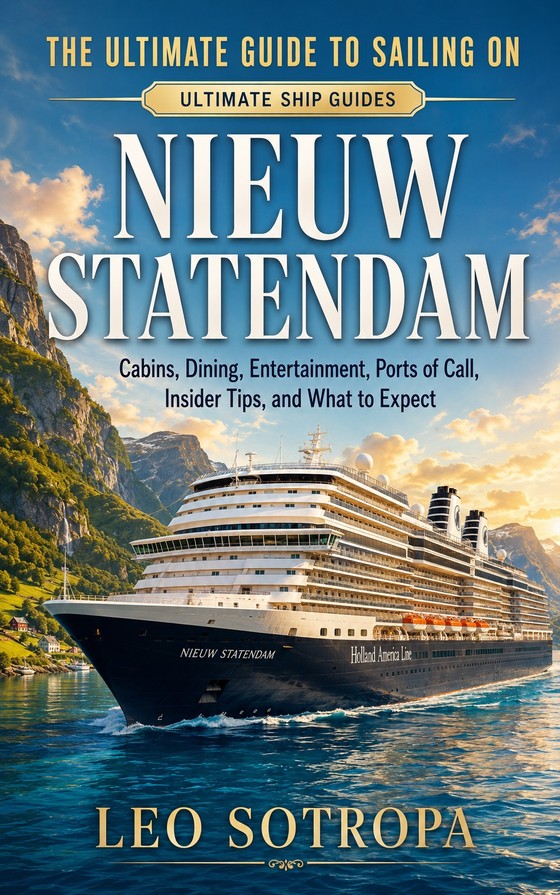
For a chapter-by-chapter walkthrough of everything above — the fare maths, the cabins to book and avoid, the dining plan and the ports — pick up “The Ultimate Guide to Sailing on Nieuw Statendam.” It is part of the Ultimate Ship Guides series by Leo Sotropa, with clear action steps in every chapter so you board knowing exactly what to do.
Frequently asked questions
Is Nieuw Statendam a good ship for a first Holland America cruise?
Yes. As the second Pinnacle-class ship she is modern, mid-sized at about 2,666 guests, and easy to learn quickly. The style is calm and music-focused rather than a floating theme park, which suits couples, solo travellers and adults more than families chasing waterslides. If that matches what you want, she is an excellent introduction to the line.
Is the Have It All fare worth buying?
For most guests, yes. It bundles a drinks package, Wi-Fi, a shore-excursion credit and specialty dining for roughly a set daily amount per person, which usually costs less than buying those items separately. The catch is that the included specialty dinners scale with voyage length — one on a 6–9-night sailing, two on a 10–20-night, three on 21-plus — so plan your dinners around that allowance.
What is the difference between Have It All and Club Orange?
Have It All bundles consumables — drinks, Wi-Fi, tours and dinners. Club Orange is a separate paid upgrade that improves your standing aboard: an exclusive restaurant, expanded Dining Room menus, priority embarkation and tender access, and a stateroom upgrade within your category. On these itineraries the priority tender access is the standout benefit.
Which cabin should a first-timer book?
A midship Verandah on a middle deck is the best all-round choice, and a private balcony genuinely earns its keep on a fjord morning or a scenic Baltic approach. If budget is tight, an Interior or Ocean View is fine since you spend little time in the room. Avoid forward high-deck cabins if anyone is prone to motion, and check the deck plan for rooms under the Lido or near the Music Walk.
Can I eat well without paying for specialty restaurants?
Absolutely. The Dining Room, the Lido Market buffet, Dive-In, the New York Deli & Pizza and the Grand Dutch Café are all included and give you a full week of good meals. The Pinnacle Grill, Tamarind, Rudi’s Sel de Mer and Canaletto carry a cover charge, but you are never obliged to use them.
How do I know whether I booked the Baltic or the fjords?
Check your port list in the Navigator app. If you see Copenhagen, Oslo, Stockholm, Helsinki, Tallinn and Visby, you are on the Baltic capitals city-hopping route. If you see Stavanger, Ålesund, Olden, Bergen and the Geirangerfjord, you are on the Norwegian fjords scenery route. They call for different clothing and shore plans, so confirm early.
What should I pack for a Northern European cruise?
Layers for cool, changeable weather: a waterproof shell, a warm mid-layer, and broken-in walking shoes for cobbled towns and fjord viewpoints. Add a European adapter, a small daypack for ports, and something smart for the slightly more traditional evening dress code. On a fjord itinerary, bring gloves and a hat for the open decks, where the wind off the water is colder than ashore.
Ready for the whole ship in one place? It is all in The Ultimate Guide to Sailing on Nieuw Statendam.
Get the book →
Meet Leo: The Heartbeat Behind ‘A Country A Month’
Journeying through the pages of A Country A Month, you might often feel the rhythm of a storyteller’s heartbeat, pulsating through each line, each image, and each adventure shared. That heartbeat belongs to none other than our remarkable website editor, Leo.
With a lens in one hand and a pen in the other, Leo seamlessly marries his passions for photography and writing. His eye captures moments that words can barely describe, yet his eloquence brings those images to life, transcending borders and connecting us all through shared stories. An avid traveler, every country he’s visited has added another chapter to his expansive tale, and through our platform, he generously shares these chapters with us.