Can you take a cruise from Rotterdam in the Netherlands? Yes — and on Holland America Line it is the most fitting departure point there is. The company was founded in Rotterdam in 1873, and for decades its ships carried cargo and emigrants from that very quay across the Atlantic to New York. When you sail Nieuw Statendam out of her home port, you are leaving from the place where the whole line began. This guide covers how to reach the cruise terminal, what to see in the city if you arrive a day or two early, why some of these voyages leave from Dover or Amsterdam instead, and how to plan a Northern Europe cruise around a Rotterdam departure.
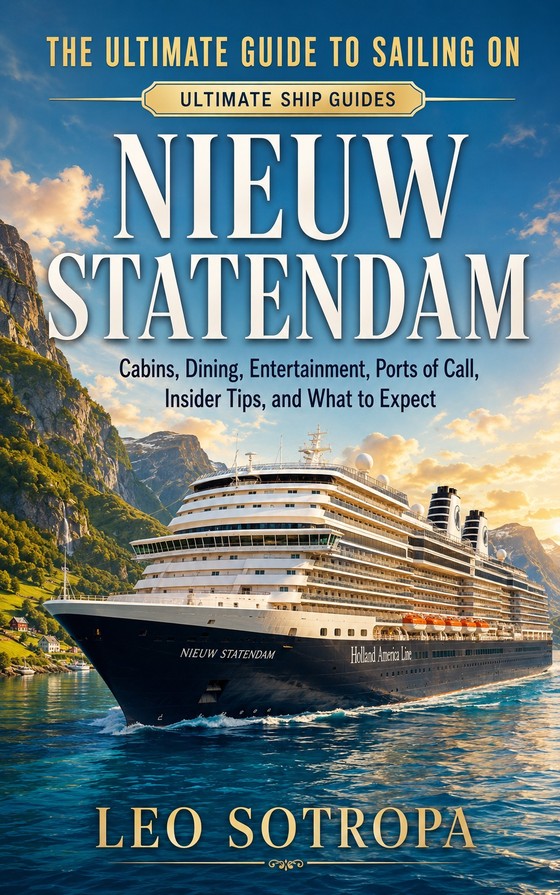
Everything in this article and far more, deck by deck, in The Ultimate Guide to Sailing on Nieuw Statendam.
Get the book →Why Rotterdam is the home port that matters
Most cruise ports are simply convenient — a place with deep water, road access, and a terminal building. Rotterdam is different for Holland America because it is the origin story. The line was born here in 1873 and ran its ships from these waters for generations, which is why so many of its vessels carry Dutch names and why Nieuw Statendam herself continues a naming tradition that stretches back well over a century. Sailing from here is not a marketing angle bolted on afterward; it is the company returning to its own front door.
Nieuw Statendam is the second Pinnacle-class ship in the fleet, a sister to Koningsdam and Rotterdam, at roughly 99,900 gross tons with about twelve guest decks and around 2,666 guests at double occupancy. Her interiors, designed by Adam D. Tihany and Bjørn Storbråten, run on a music theme from bow to stern, and she was christened by Oprah Winfrey. She is large enough to feel substantial in open water but small enough to hold a genuinely Dutch character — which lands differently when you board her in a Dutch port. If you want the full picture of the ship before you focus on the departure logistics, the Nieuw Statendam cruise guide lays out her decks, venues, and layout in one place.
Getting to the cruise terminal
Rotterdam is one of the easier European ports to reach, largely because it sits inside a dense, well-run transport network. Most travelers fly into Amsterdam Schiphol, which has direct train connections south to Rotterdam Centraal in well under an hour. From Rotterdam Centraal you are a short taxi or rideshare from the cruise terminal, and the city’s metro and tram system covers the gap cheaply if you are traveling light. If you are coming from elsewhere in Europe, high-speed rail links Rotterdam to Brussels, Paris, and beyond, which makes a rail-and-sail approach genuinely practical rather than a novelty.
A few practical notes worth planning around:
- Confirm your exact terminal and embarkation window in the Navigator app before you travel. Rotterdam handles both river cruise and ocean cruise traffic, and you want to arrive at the correct berth.
- Build in a buffer for the Schiphol-to-Rotterdam leg. Trains are frequent and reliable, but embarkation day is not the moment to run the connection tight.
- If you booked Club Orange, you get priority embarkation, which is worth remembering when you plan your arrival time at the terminal.
- Rotterdam is flat, walkable, and bike-friendly, so you do not need a car in the city itself — factor that into how you handle any pre-cruise nights.
Because the connections are so good, the strongest advice for a Rotterdam departure is simple: arrive at least a day early. It protects you against flight delays, it lets your body adjust, and it gives you time in a city that most cruise passengers rush straight through.
How many pre-cruise nights make sense depends on how much of the city you want. One night is enough to defuse the risk of a delayed flight and see a couple of central sights. Two nights turns it into a proper stop — enough to add a half-day trip out to Kinderdijk and still have a relaxed embarkation morning. Because Rotterdam is compact and the transport is quick, you rarely need more than that, and any extra days are often better spent extending your trip at the far end of the itinerary in a Baltic capital or a fjord town.
What to see in Rotterdam before you sail
Rotterdam was largely rebuilt after the war, so unlike the medieval old towns you will meet later on a Baltic itinerary, it reads as a bold, modern, architecturally confident city. That contrast is part of the appeal. Here is what to prioritize if you have a day or two before boarding.
The Markthal
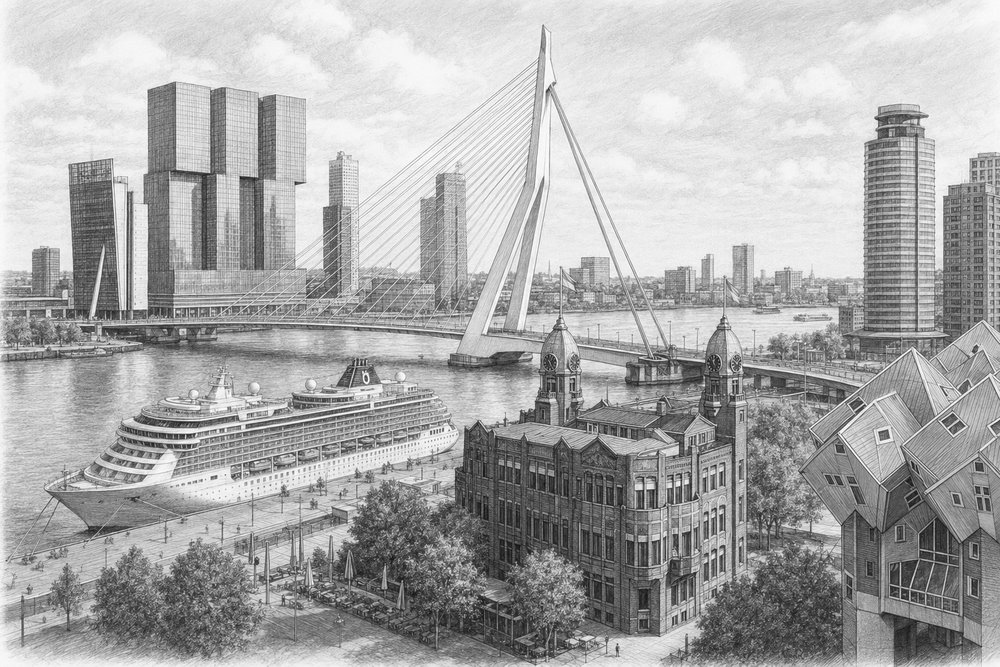
The Markthal is a covered market hall shaped like a vast horseshoe arch, with apartments built into the curve and an enormous painted ceiling overhead. Inside you will find stalls selling cheese, fresh fish, stroopwafels, and prepared food from across the world. It is the easiest possible introduction to Dutch food and a good place to graze before you board — and a sharp reminder of how differently this city approaches public space compared with the historic capitals ahead.
The Cube Houses
A short walk from the Markthal, the Cube Houses are a cluster of bright yellow homes tilted at forty-five degrees, stacked like a forest of tipped-over dice. One of them is open to visitors as a show house so you can see how anyone actually lives inside a tilted cube. It takes ten minutes to see and it is one of the most photographed sights in the city.
The Erasmusbrug
The Erasmusbrug — nicknamed “the Swan” for its angled white pylon — spans the Nieuwe Maas and connects the older north bank to the redeveloped south. Walking or cycling across it gives you the best single view of Rotterdam’s waterfront, and it is close enough to the terminal district that it fits neatly into an embarkation-morning stroll.
Kinderdijk’s windmills
If you have a full spare day, Kinderdijk is the classic Dutch excursion: a line of nineteen historic windmills strung along the water, kept working as they were centuries ago to drain the low-lying polder. It sits a short distance outside Rotterdam and is reachable by a combination of local transport or a waterbus down the river, which is a scenic way to arrive. This is the postcard image of the Netherlands, and it is genuinely close to your departure port.
The Hotel New York and the original ss Rotterdam
These two are essential for anyone sailing Holland America, because they are the line’s own history made physical. The Hotel New York occupies the former Holland America headquarters on the Wilhelminakade — the twin-towered building from which the company ran its transatlantic operations, and the last thing many emigrants saw before their ships pulled away toward New York. You can eat in its café or simply walk the quay in front of it and feel the weight of the place.
A little further along the water, the original ss Rotterdam — the former flagship of the line — is moored permanently as a hotel and museum ship. Touring her, or even just having a drink aboard, is the clearest way to understand what Nieuw Statendam is descended from. Standing on the deck of the old ship, in the city where the company was founded in 1873, before boarding her modern successor, is the kind of throughline you cannot manufacture at a generic embarkation port.
Some sailings leave from Dover or Amsterdam
Rotterdam is Nieuw Statendam’s natural home base in Northern Europe, but she does not depart exclusively from there. Some of her Northern Europe voyages leave from Dover in England or from Amsterdam instead, so the single most important thing to check before you book flights or trains is which port your specific sailing actually uses. Do not assume Rotterdam just because that is the line’s historic home — confirm the embarkation port in the Navigator app and on your booking.
The practical implications are worth thinking through:
- A Dover departure usually means flying into London and traveling down to the coast, which is a different logistics chain than a Rotterdam or Amsterdam start.
- Amsterdam is even closer to Schiphol than Rotterdam is, which can simplify arrival if your sailing happens to leave from there.
- Whichever port you use, the same advice applies — arrive early, and treat the embarkation city as part of the trip rather than a place to sprint through.
Because the departure port can vary, this is one itinerary where reading your documents carefully genuinely pays off. If you are new to the line and want a grounding in how Holland America handles embarkation, documents, and onboard accounts, the first-time Holland America guide to Nieuw Statendam walks through the practical basics.
Planning a Northern Europe cruise from here
A Rotterdam departure puts you at the doorstep of two very different Northern Europe voyages, and knowing which one you have booked shapes everything from what you pack to which cabin you want.
Baltic capitals
The Baltic route strings together the great capitals of the north — Copenhagen, Oslo, Stockholm, Helsinki, Tallinn, and smaller stars like Visby on Gotland, among others. It is a city-heavy, culture-heavy itinerary: Nyhavn and Tivoli in Copenhagen, the Vasa Museum and Gamla Stan in Stockholm, the Rock Church and Senate Square in Helsinki, and Tallinn’s walled medieval old town. Visby, the small walled town with its roofless churches, is the port that quietly steals the trip for many people. If this is the voyage you are drawn to, the Nieuw Statendam Baltic capitals guide goes port by port.
Norwegian fjords
The fjords voyage is the opposite in character — fewer big cities, more raw landscape. It runs to Stavanger, Ålesund, Olden, Bergen, and the Geirangerfjord, with longer sailings pushing toward the Arctic Circle and the North Cape. Here the scenery is the main event, and the ship’s forward-facing spaces earn their keep as you slide between the cliffs. For the detail on ports, scenic cruising, and what to expect on deck, see the Norwegian fjords guide.
There are also long-form Collector’s Voyages — some running up to about four weeks and combining the Baltic capitals into one extended sailing — which are a genuine differentiator for the line. The season across all of these runs roughly from May to September, and ports vary from sailing to sailing, so always confirm the current schedule and port list in the Navigator app rather than relying on any fixed assumption.
A few things shape which of these voyages suits you. The Baltic run is the better fit if you are drawn to cities, museums, and long walks through old towns, and if you want a different national character in every port. The fjords run rewards you if you would rather watch the world go by from a deck chair, and it involves more scenic-cruising days where the ship itself is the vantage point rather than a means of getting to the next city. Weather leans cool and changeable on both, even in high summer, so pack layers and a waterproof shell regardless of which one you choose. A number of the ports on both routes are tender ports, where the ship anchors offshore and small boats ferry you in — another reason a Club Orange booking, with its priority tender access, can be worth considering on these itineraries.
Choosing a cabin for these waters
The cabin question is more consequential on a Northern Europe cruise than on a warm-weather one, because so much of the experience is about watching a coastline go by. Nieuw Statendam offers Interior, Ocean View, and Verandah staterooms, Spa staterooms, Signature Suites, Neptune Suites with access to the Neptune Lounge and a concierge, and the single Pinnacle Suite at the top.
| Priority | Best pick | Why |
|---|---|---|
| Best value | Interior or Ocean View | You spend the scenic hours in public rooms and on deck anyway. |
| Best all-round | Midship Verandah, mid-decks | A private balcony pays off in a fjord or on a scenic Baltic approach. |
| Top of the range | Neptune Suite | Lounge, concierge, and more room for a longer voyage. |
A Verandah genuinely earns its keep when you are threading the Geirangerfjord or making a slow scenic approach into a Baltic capital — being able to step outside your own door in the cold morning air, coffee in hand, is worth the upgrade for many people. When you check the deck plan, it is worth steering away from a few locations: rooms directly under the Lido pool deck or the buffet, cabins beneath the World Stage or near the Music Walk, forward high-deck rooms if anyone in your party is prone to motion, and any verandah marked as obstructed. For a fuller walk-through of the onboard spaces these cabins connect to, what to expect on Nieuw Statendam covers the ship’s public rooms in detail.
Making the most of the ship on a scenic itinerary
The single most valuable room aboard on a Northern Europe sailing is the Crow’s Nest, the forward observation lounge with floor-to-ceiling windows. It was built for exactly this kind of cruising — watching a coastline unfold in comfort — and on the fjord runs in particular it becomes the natural gathering place when the scenery turns dramatic. Get there early on a big scenic-cruising morning.
The other thread running through the ship is music. The Music Walk connects live-music venues that are all included in your fare: B.B. King’s Blues Club, Billboard Onboard with its duelling pianists, and the Rolling Stone Rock Room with its five-piece rock band, which is a Pinnacle-class exclusive. One note on expectations — Lincoln Center Stage is not a fixed venue here; the classical troupe rotates between ships and appears on select sailings only, so do not count on it being aboard your particular voyage. The World Stage, the 270-degree LED theatre that hosts “BBC Earth in Concert,” rounds out the entertainment, and the complimentary Grand Dutch Café — bitterballen and Dutch beer — is a fitting place to toast a Dutch departure.
On the value side, Have It All is the line’s bundled fare, adding a drinks package, Wi-Fi, a shore-excursion credit, and specialty dining (one night on 6–9-night voyages, two on 10–20, and three on 21+). On a longer Baltic or fjords run with plenty of port days and shore excursions, that bundle can make real sense — but weigh it against how much you actually plan to drink and dine, and confirm the current terms in the Navigator app.
Get the complete Nieuw Statendam playbook
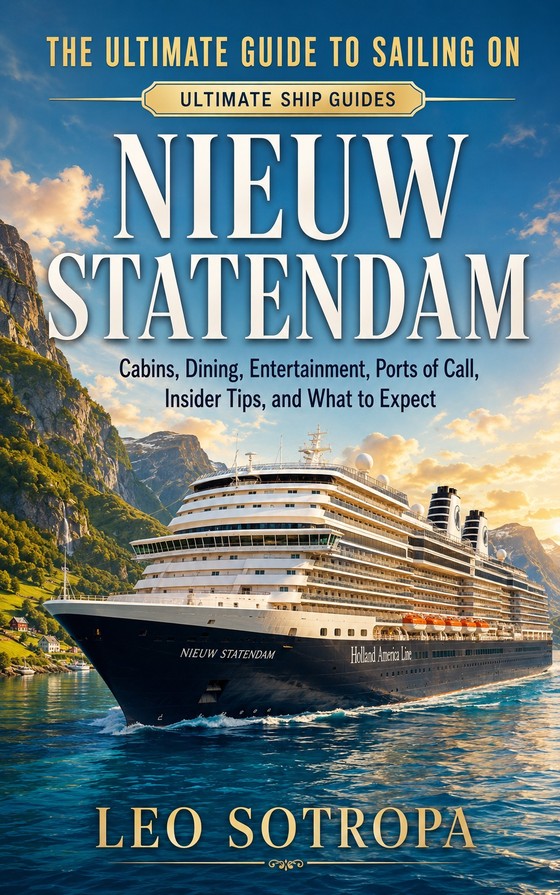
If you want every one of these decisions — the Rotterdam pre-cruise days, the cabin choice, the Baltic-versus-fjords call — mapped out with clear action steps, read “The Ultimate Guide to Sailing on Nieuw Statendam.” It is part of the Ultimate Ship Guides series by Leo Sotropa, written so each chapter ends with something concrete to do.
Frequently asked questions
Can you cruise from Rotterdam in the Netherlands?
Yes. Rotterdam is Holland America Line’s historic home port — the company was founded here in 1873 — and Nieuw Statendam sails Northern Europe itineraries from the city. It is arguably the most fitting departure point on the line, since this is where its ships have left from for generations. Just confirm your specific sailing’s embarkation port in the Navigator app, as some voyages leave from Dover or Amsterdam instead.
How do I get to the Rotterdam cruise terminal?
Most travelers fly into Amsterdam Schiphol and take a direct train south to Rotterdam Centraal in under an hour, then a short taxi, rideshare, or metro ride to the terminal. High-speed rail also links Rotterdam to Brussels and Paris. Build in a buffer on embarkation day and confirm your exact berth in the Navigator app, since Rotterdam handles both river and ocean cruise traffic.
What should I see in Rotterdam before I sail?
Prioritize the Markthal for food, the tilted Cube Houses, and a walk across the Erasmusbrug for the best waterfront view. With a full spare day, add Kinderdijk’s windmills. For anyone sailing Holland America, the Hotel New York — the line’s former headquarters — and the original ss Rotterdam, now moored as a hotel and museum ship, connect directly to the company’s history.
Why does Rotterdam matter to Holland America Line?
Because the line was founded in Rotterdam in 1873 and ran its ships from the city for decades, carrying cargo and emigrants from that quay to New York. Sailing Nieuw Statendam from Rotterdam is the company returning to its own origin, which is why the Dutch character of the ship lands so strongly when you board her there.
Do all Nieuw Statendam Northern Europe cruises leave from Rotterdam?
No. Rotterdam is her natural home base, but some Northern Europe sailings depart from Dover in England or from Amsterdam. Always check your specific voyage’s embarkation port in the Navigator app and on your booking before arranging flights or trains — do not assume Rotterdam just because it is the line’s historic home.
What kinds of itineraries sail from here?
Two main types. Baltic capitals voyages visit Copenhagen, Oslo, Stockholm, Helsinki, Tallinn, and Visby, among others. Norwegian fjords voyages run to Stavanger, Ålesund, Olden, Bergen, and the Geirangerfjord, with longer sailings reaching toward the North Cape. There are also long Collector’s Voyages of up to about four weeks. The season runs roughly May to September; confirm the current ports in the Navigator app.
Which cabin is best for a Northern Europe cruise?
For value, an Interior or Ocean View works well since you spend scenic hours in public rooms and on deck. For the best all-round experience, a midship Verandah on the mid-decks pays off in a fjord or on a scenic Baltic approach. For a longer voyage, a Neptune Suite adds the Neptune Lounge and concierge. Avoid cabins under the Lido or buffet, near the World Stage or Music Walk, or forward high-deck rooms if you are prone to motion.
Ready for the whole ship in one place? It is all in The Ultimate Guide to Sailing on Nieuw Statendam.
Get the book →
Meet Leo: The Heartbeat Behind ‘A Country A Month’
Journeying through the pages of A Country A Month, you might often feel the rhythm of a storyteller’s heartbeat, pulsating through each line, each image, and each adventure shared. That heartbeat belongs to none other than our remarkable website editor, Leo.
With a lens in one hand and a pen in the other, Leo seamlessly marries his passions for photography and writing. His eye captures moments that words can barely describe, yet his eloquence brings those images to life, transcending borders and connecting us all through shared stories. An avid traveler, every country he’s visited has added another chapter to his expansive tale, and through our platform, he generously shares these chapters with us.