The short answer: Living in Spain on a fixed income means a rich social life that happens cheaply in public — €2 coffees, €12–17 meals, free tapas in Granada — fast, cheap fiber that keeps family a video call away, and walkable cities where you won’t miss the car you sold. The two things to manage are the currency (your income is in dollars) and homesickness (the quiet killer of expat dreams).
The budgets tell you a fixed income works in Spain. This is about what that life actually feels like day to day — the good, and the honest hard parts — so you know what you’re signing up for.
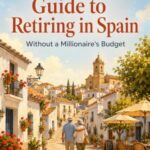
This summarizes the daily-life and “if things change” chapters of No-Nonsense Guide to Retiring in Spain by Leo Sotropa.
The cheapest good social life in Europe
Spain hands budget retirees an almost unfair advantage: a rich social life that’s cheap by design. Much of it happens in public — on plazas, café terraces, and in tapas bars — rather than behind closed living-room doors. A cappuccino is about €2 and nobody rushes you off the table; a budget restaurant meal is €12–17; a mid-range three-course dinner for two runs €38–55. In Granada, your drink still arrives with free tapas, so lunch can cost the price of a beer. You don’t buy a social life here so much as step into one — which is exactly what a fixed income needs.
The rhythm you’re signing up for
Life runs on Spanish time: later meals, an afternoon lull, evenings that stretch. Mornings might be a flat walk along a beach promenade to the café where the waiter no longer asks and just brings the café con leche. It’s warm, personal, and unhurried — genuinely lovely once you stop fighting it. That same unhurriedness shows up at the town hall, where patience is a cultural skill rather than a personal failing: expect multiple visits for simple tasks, bring copies, smile at the clerk, and treat the second trip as the process working, not breaking.
Staying connected to home
Homesickness — not money, not weather — is the quiet killer of expat dreams, so name it and plan for it. Spain makes the logistics easy: 600 Mbps fiber for €30–45/month means crisp, effortless video calls with the grandkids, some of the best broadband value in Europe. Set it up on day one; it’s the backbone of your link to home. The AVE high-speed rail links major cities (Seville to Madrid in about two and a half hours), so when family visits — and they will, once they realize you live near a Spanish beach — the country is easy to show off. Plan visits in both directions, keep a U.S. foothold, and carry a few irreplaceable photographs; small anchors make the unfamiliar bearable while the new life takes root.
Building a community so you don’t float away
The early months lean on expat networks — large, active communities (online groups with well over a hundred thousand members, plus InterNations and local meetups), thickest on the Costa Blanca, the Costa del Sol, and in Valencia and Madrid. They’re a soft landing. But the goal is to grow past them into a real local life, which is where the language comes in.
The language, told straight
You don’t need to be fluent, but the effort to learn Spanish is the single highest-return investment in your own happiness — every halting sentence buys a warmer neighbor and a friendlier pharmacist. Beware the expat-bubble trap: it’s entirely possible to live on parts of the Costa Blanca or Costa del Sol and almost never need Spanish, which is precisely why so many people there stay strangers in their own town. A realistic plan for a retiree (not a university exam): start with basics before you leave, arrive able to greet, thank, and ask directions, and keep going with a class or an app once you land.
The car you won’t miss
Your American car is one of the easiest things to let go. Spanish cities are built for people on foot — dense, walkable centers where the pharmacy, the market, the doctor, and the café are a stroll from your door — and a monthly transit pass runs about €30. Ditching the car erases insurance, fuel, parking, and maintenance, often one of a retiree’s biggest hidden savings. (Inland and in smaller towns, a car becomes advisable, so factor that into where you land.)
If money tightens: the levers you can pull
A dollar-funded budget lives or dies on the exchange rate, and the euro can swing 15% in a year (recently $1.04 to $1.20 and back to $1.15). If the dollar weakens or savings run lower than planned, you have real options without going home:
- Move inland or to a smaller town — one-bedrooms from €400–600 versus €800–1,100 on the coast, plus a more authentically Spanish daily life.
- Choose a cheaper cultural city — Granada runs a single person €1,200–1,600/month.
- Switch your healthcare mix — after your padrón year, moving to the convenio especial (€157/month at 65+) trims costs, while optionally keeping a cheap private policy for dental and faster specialists.
- Hedge your behavior, not the market — hold a euro buffer of several months’ expenses so a bad exchange-rate month never forces a bad decision, and move money on a steady monthly schedule.
Notice how wide the dial is: a lean single life inland or in Granada runs near €1,400/month, a comfortable single life in Valencia or Alicante closer to €1,940. You can turn that dial without leaving the country.
Does it actually work out? The “73%” myth
You may have seen a scary viral claim that something like 73–74% of Americans leave Spain within two years. Treat it with skepticism: the original article was deleted and reposted, and the expat community widely disputes the figure. Yes, a real share of people do return — usually because life happens (health, family, a spouse passing), not because Spain failed them. The retirees who thrive are the ones who did the work first: they chose a city that fit their income, learned some Spanish, built community beyond the bubble, and budgeted for the currency.
A middle path: snowbirding instead of choosing
“Spain or home?” isn’t always the question. Because you’re a U.S. citizen, Social Security pays you in either country indefinitely, and if you keep Medicare Part A (and, wisely, Part B), you preserve the option to split the year. Some retirees discover the honest answer is “both, on a schedule” — Spanish everyday life for most of the year, U.S. months for family and Medicare-covered care. It’s a legitimate plan, not a failure to commit.
Food, tapas, and eating well for less
Food is where a fixed income quietly wins. Markets are cheap and fresh, cooking at home is inexpensive, and eating out is gentle on the wallet — a budget meal €12–17, a mid-range three-course dinner for two €38–55. In parts of Andalusia, Granada above all, a drink still comes with a free tapa, so an evening out can cost the price of a couple of beers. The menú del día — a fixed-price weekday lunch of several courses with a drink — is one of Europe’s great cheap meals. You eat better here for less, and you do it in company, on a terrace, unhurried.
Etiquette, lightly held
You don’t need an etiquette rulebook, but a few orientations help you land softly. Spanish social life leans warm, personal, and unhurried: greetings matter, politeness in shops and offices is noticed, and life moves at a human pace by design, not by accident. Meals run late, the afternoon has a lull, and evenings stretch. Match the rhythm rather than fighting it and doors open faster — the neighbor, the pharmacist, the clerk at the town hall all warm to someone who greets them and isn’t in a hurry.
The first months are the hard ones (and that’s normal)
Be ready for a dip. The first months carry the steepest bureaucracy, the loneliest stretch before a social circle forms, and the low hum of everything being unfamiliar at once. That’s not a sign you made a mistake; it’s the normal shape of a big move. This is exactly why you carried a few irreplaceable photographs, kept a U.S. foothold, and set up crystal-clear video calls home — small anchors that make the unfamiliar bearable while the new life takes root. It does take root. Be patient with the settling-in, and lean on the expat networks early while your Spanish and your local friendships grow.
Is it actually safe?
Yes. Spain is by the numbers a very safe country, and violent crime is rare. What you’ll actually meet is opportunistic — pickpocketing in tourist-dense spots and on busy transit — and ordinary precautions handle it: a zipped bag worn in front, no phone left on the café table, awareness in crowds. For a retiree used to American headlines, the day-to-day feeling of safety in a Spanish city is often one of the quiet, unexpected pleasures of the move.
Want the full playbook for thriving on a fixed income — community, culture, the language plan, and the “if things change” chapter? It’s in No-Nonsense Guide to Retiring in Spain.
FAQ
Can you live well in Spain on a fixed income?
Yes — the social life is cheap and public, healthcare is world-class and affordable, and cities are walkable. A single person lives comfortably on €1,400–2,000/month, less inland.
What’s the hardest part of retiring in Spain?
Homesickness and the slow, in-person bureaucracy — not cost. Both are manageable with planning: build community beyond the expat bubble, and treat paperwork as a patience exercise.
What if the dollar weakens against the euro?
Budget conservatively, hold a euro buffer, and know your levers: moving inland, choosing a cheaper city, or switching to public healthcare can all trim a stretched budget without leaving Spain.
Keep reading: Cost of living in Spain for retirees · Best places to retire in Spain on a budget · The complete guide to retiring in Spain

Meet Leo: The Heartbeat Behind ‘A Country A Month’
Journeying through the pages of A Country A Month, you might often feel the rhythm of a storyteller’s heartbeat, pulsating through each line, each image, and each adventure shared. That heartbeat belongs to none other than our remarkable website editor, Leo.
With a lens in one hand and a pen in the other, Leo seamlessly marries his passions for photography and writing. His eye captures moments that words can barely describe, yet his eloquence brings those images to life, transcending borders and connecting us all through shared stories. An avid traveler, every country he’s visited has added another chapter to his expansive tale, and through our platform, he generously shares these chapters with us.