A good Cancun food plan is not a list of dishes detached from the trip. It accounts for when people eat, which neighborhoods suit different meals, where reservations matter, what prices mean, and how to recognize a place designed only for passing visitors.
Use this article with the complete Cancun travel guide, the three-day itinerary, and the where-to-stay guide.
Here is the first thing to unlearn if you have read a guidebook for Paris or Rome before this one: Cancun does not have eight or nine dense, walkable historic districts stacked with centuries of layered street life. It has something else entirely, and once you stop looking for what is not here, what actually is here comes into sharp focus. This article treats the city exactly the way it divides for a real visitor: three distinct stretches of the Hotel Zone, told by kilometer marker rather than street name, the separate mainland city of Downtown, the working ferry district of Puerto Juarez, and, because so many Cancun trips include it as something close to a fifth home base, Isla Mujeres as a bonus area.
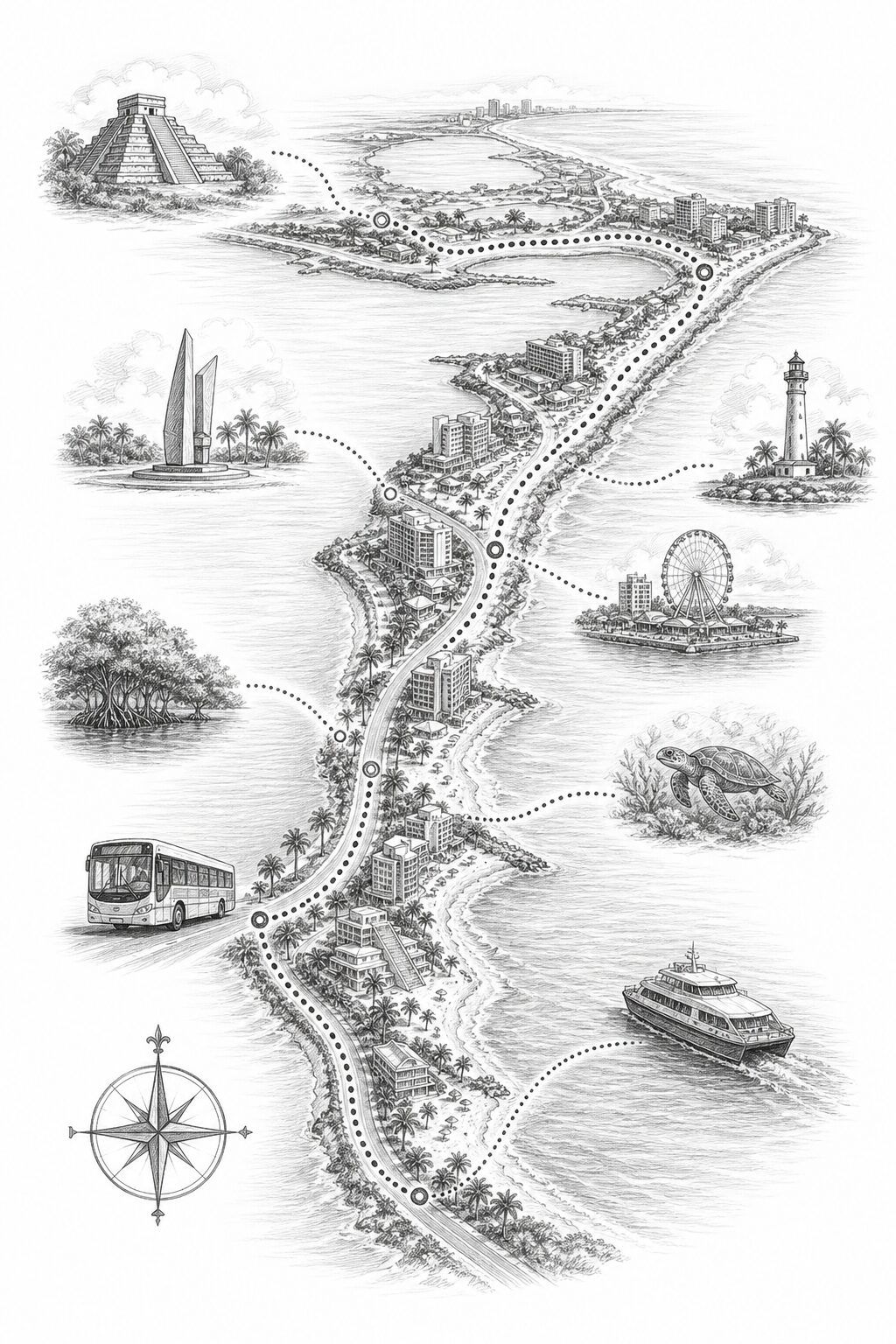
How it fits together, in one paragraph: picture the numeral 7. That is the literal shape of the Hotel Zone, a 22.5 km sandbar curling out from the mainland into a hook, with the calm Bahia de Mujeres inside the curve and the open Caribbean along the outer edge. The whole sandbar is threaded by one road, Boulevard Kukulcan, marked with kilometer signs from Km 0 near the mainland bridge to Km 23 near the airport end, and those kilometer numbers are how everyone here, hotels, taxi drivers, this book, actually locates anything. Across a short bridge at the sandbar’s northern hinge sits Downtown, the real city, and just north of Downtown, Puerto Juarez, where the ferries leave for Isla Mujeres, visible offshore the whole time you are here.
Before the first section, one honest orientation note: in a heritage city, the neighborhoods chapter is where you spend your museum-and-old-town hours. In Cancun, this article is where you decide which beach, which stretch of water, and which pace of resort life fits you, because that decision matters more here than any single sight. Read it that way and it will serve you exactly as well as a walking-tour chapter serves a visitor to a city built five centuries earlier.
A practical note on the kilometer markers themselves, since you will see them everywhere from the moment you book: nearly every Hotel Zone hotel listing, taxi conversation, and restaurant address in Cancun references its position by Km number rather than a street name, because Boulevard Kukulcan is, for most of its length, the only street there is. Get comfortable reading a hotel’s address as a kilometer figure before you arrive, since that number alone tells you more about your actual trip, which beach you will swim at, how far the malls and ferries sit, than almost any other detail in a listing.
Zona Hotelera North, Km 0 to 9: the family stretch
Who will love it: families with young kids, and anyone who wants calm, shallow, turquoise water without negotiating waves.
This is the gentlest curve of the Hotel Zone’s 7 shape, hugging the sheltered Bahia de Mujeres, and it is the part of the sandbar closest to both the mainland bridge and the ferry docks at Puerto Juarez. The character here leans toward mid-rise, family-oriented resorts rather than the towering mega-properties further along the strip, and the water itself is the whole point: calm, shallow, and bay-facing, genuinely gentler on a nervous young swimmer than anything on the Caribbean side.
Two public beaches anchor this stretch. Playa Langosta, around Km 5, and Playa Tortugas, around Km 6.5, both come with lifeguards and restrooms, the basic infrastructure that turns a beach visit from an adventure into an easy morning. Playa Tortugas adds a bungee tower and several water-sports outfitters, which pulls a livelier, slightly younger crowd; expect parasailing, banana boat rides, and jet ski rentals lined up along the sand here, all bookable on the spot rather than requiring advance reservation, with prices worth confirming before you climb aboard rather than after. Playa Langosta’s far end, by contrast, draws noticeably fewer people and is the better pick if you want the same calm water with more elbow room and none of the watersports-outfitter noise.
Food along the North Zone runs mostly through hotel restaurants, since this stretch has fewer freestanding options than the Curve further south, but the Km 5 to 6 corridor does have a handful of independent seafood spots serving the bay-facing crowd directly, worth seeking out for a change of pace from your resort’s buffet.
Best time to visit: honestly, any time, though mornings are calmest for swimming with young children, before any afternoon breeze picks up chop on the bay. This is also your most convenient stretch for a spontaneous Isla Mujeres run, since Puerto Juarez’s ferry docks sit just across the bridge, and the island itself is visible from the beach on a clear day, a nice bit of foreshadowing for the day trip in the complete guide.
Zona Hotelera Middle, “the Curve,” Km 9 to 14: the entertainment spine
Who will love it: shoppers, nightlife-seekers, and anyone who wants the Hotel Zone’s biggest, glossiest energy within walking distance of their room.
Locals call this stretch the Curve because it wraps around Punta Cancun, the point where the sandbar’s shape bends hardest, and it is the undisputed center of gravity for the whole Hotel Zone. Cancun’s biggest shopping malls cluster here, La Isla with its canals, open-air layout, and small aquarium that draws a genuine mix of shoppers and families rather than just window-browsers, Kukulcan Plaza, and Forum by the Sea, alongside the highest concentration of big-name resort towers on the strip and the nightclub row that gives the Hotel Zone its after-dark reputation. If you came to Cancun for a lively vacation with restaurants, bars, and people-watching built into your walk to dinner, this is where that vacation actually happens.
The Curve is also departure territory: tour boats to Isla Mujeres leave from the Playa Caracol pier here, and MUSA snorkel and dive trips (the underwater sculpture museum, covered fully in the complete guide) typically depart from operators based in this stretch as well.
One thing to be ready for along this stretch specifically: this is the epicenter of the Hotel Zone’s timeshare pitch, an aggressive and time-consuming staple of the boulevard and the mall entrances. Reps offer “free” tickets, tours, or gifts in exchange for sitting through a high-pressure sales presentation, and the pitch itself is a polished, practiced routine. A polite, firm decline costs you nothing and is the expected, understood response; if you are curious enough to engage, budget a lost morning for it, not a lost ten minutes (the complete guide has the fuller scam catalog).
Food here means the mall food courts on the casual end and a run of mid-to-high-end restaurants aimed squarely at resort guests on the other, and prices throughout run close to US resort-town levels; this is not the stretch for a budget meal. Daytime belongs to the malls and the shopping-and-aquarium crowd, while evening is when the nightlife wakes up, and this is genuinely the loudest section of the boulevard after dark, worth factoring in if you are choosing a hotel here and value sleep. If you want the same convenient location with a calmer dinner, step one block back from the boulevard’s club row toward the lagoon side, where the restaurant options quiet down considerably without giving up the central address.
Zona Hotelera South, Km 14 to 23: the open-Caribbean side
Who will love it: couples wanting quieter resort grounds, and anyone chasing the single best beach photograph in the city.
This is the outer edge of the sandbar’s curve, running from the Curve down toward Punta Nizuc near the airport, and it faces the open Caribbean rather than the sheltered bay. That single geographic fact changes everything about how this stretch feels: bigger surf, stronger currents (always respect the posted flag warnings, which are taken seriously here), the most dramatic ocean views on the strip, and mega-resorts spaced further apart than the density of the Curve, giving the whole area a noticeably quieter, more spread-out feel.
The headline here is Playa Delfines, around Km 17.5, the best free public beach in Cancun and, not coincidentally, the spot with the giant “CANCUN” letters that anchor half the photographs anyone brings home. Free parking for more than 300 cars makes it genuinely accessible even if you are not staying nearby, though that lot fills by mid-morning in high season; arrive before 10am, or take the R-1/R-2 bus and skip the parking question entirely.
Frequently asked questions
How many days are enough for Cancun?
Three well-planned full days cover a strong first visit, while four or five allow slower neighborhoods, additional museums, or a day trip. Count usable sightseeing days rather than hotel nights.
What should be booked first?
Reserve the experience you would be most disappointed to miss, then secure lodging and any limited-entry sights. Verify current rules and opening information on the official operator’s website shortly before travel.
How do you avoid rushing?
Group each day geographically, allow time for security and transport, and treat extra stops as optional. One demanding reservation plus nearby flexible experiences usually produces a better day than a chain of timed entries.
Continue planning Cancun
- Complete Cancun travel guide
- 3 days in Cancun: first-time itinerary
- Where to stay in Cancun
- Best things to do in Cancun
- Cancun food guide
- Cancun first-time tips
- Cancun on a budget

Meet Leo: The Heartbeat Behind ‘A Country A Month’
Journeying through the pages of A Country A Month, you might often feel the rhythm of a storyteller’s heartbeat, pulsating through each line, each image, and each adventure shared. That heartbeat belongs to none other than our remarkable website editor, Leo.
With a lens in one hand and a pen in the other, Leo seamlessly marries his passions for photography and writing. His eye captures moments that words can barely describe, yet his eloquence brings those images to life, transcending borders and connecting us all through shared stories. An avid traveler, every country he’s visited has added another chapter to his expansive tale, and through our platform, he generously shares these chapters with us.