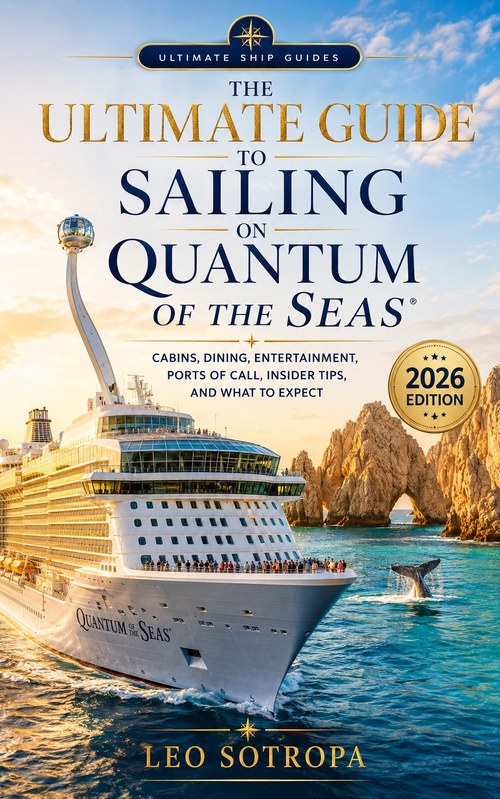
Is the Quantum of the Seas book worth reading before you sail? If you have a voyage booked on Royal Caribbean’s Quantum of the Seas and you want to walk aboard already knowing where to eat, which cabin to book, how to ride the North Star without waiting all afternoon, and what to do in each Mexican port, then yes — this is the guide written for exactly that. The Ultimate Guide to Sailing on Quantum of the Seas by Leo Sotropa is a ship-specific handbook that turns a huge, unfamiliar vessel into a place you can navigate with confidence on day one.
This page explains what the book is, what is inside it, who it helps most, and why a guide built around one ship beats a generic cruise primer. Quantum of the Seas is the original Quantum-Class ship — the one that first introduced the North Star observation capsule, the RipCord by iFly skydiving simulator, SeaPlex, Two70, and the robot-staffed Bionic Bar. She carries roughly 4,180 guests at double occupancy across about 16 guest decks and some 168,000 gross tons. That is a lot of ship to learn on your own while your vacation clock is running. The book exists to shorten that learning curve.
What this book actually is
This is an independent, unofficial handbook to one ship. It is part of the Ultimate Ship Guides series, and it is not published by or affiliated with Royal Caribbean. That independence matters: the author is free to tell you which cabins to skip, where the money traps are, and which specialty restaurants earn the upcharge and which do not. A cruise line’s own marketing will not do that. This book will.
It is available as a Kindle ebook and as a 6×9 paperback, and it is illustrated with graphite chapter illustrations. Every chapter closes with a short set of clear, practical Action Steps — the small decisions to make and bookings to lock in before you sail, so the advice does not just sit as theory. You read a chapter, you do two or three concrete things, you move on. That structure is the difference between a book you enjoy and a book that actually changes your trip.
One thing to be clear about from the start: this is a planning and know-how guide, not a live schedule. Venues, itineraries, and prices change from sailing to sailing, so the book teaches you how the ship works and then tells you to confirm the current specifics — showtimes, restaurant hours, port timings, and pricing — in the Royal Caribbean app for your own voyage. It is written to stay useful across the latest edition rather than to chase a single season.
What’s inside
The book follows the shape of a real cruise, from choosing a cabin to stepping off in each port. Here is what each part covers and why it earns its place.
The ship’s layout, decks, and how to move around her
Quantum of the Seas is organized into distinct spaces rather than one long strip, and if you do not understand the geography you will waste real vacation hours backtracking. The book walks you through the decks and the signature areas — the indoor Royal Esplanade promenade, the Solarium adults-only retreat, the Music Hall, the Vitality Spa, SeaPlex, Two70, and the pool decks — so you arrive with a mental map instead of a folded deck plan you keep flipping. It explains where the crowds gather and when, and the quiet routes between them, which is the kind of thing you normally only learn on the last day of a trip.
The cabin guide: which to book, which to avoid
This is the chapter that can save you the most money and the most sleep. The book covers every category the ship offers: the value Virtual Balcony interior, where a floor-to-ceiling screen streams the real ocean in real time; the Ocean View; the Balcony staterooms, all outward-facing; the Studio cabins built for solo travelers with no single supplement; and the suites up to the two-deck Royal Loft Suite.
More useful than the categories is the honest steering. For a short getaway, the book points to the Virtual Balcony interior as the best value — you get a sense of the sea and daylight without paying balcony prices. For an all-round pick, it favors a midship Balcony on the mid-decks, which gives you space, natural light, and the steadiest ride — and that steadiness genuinely helps on the open Pacific stretches this ship sails. Just as important, it names the rooms to avoid on the deck plan: cabins directly under the pool deck or SeaPlex where overhead noise carries, rooms near Two70 or the Music Hall where nightlife runs late, forward high-deck rooms for anyone prone to motion, and lower-deck balconies where a lifeboat blocks your view. If you want to go deeper before buying, the site’s free companion piece on the best cabins on Quantum of the Seas covers the same ground as a taster.
The dining guide: included, specialty, and what to reserve
Dining aboard a big Royal Caribbean ship is a two-tier system, and knowing the tiers is how you eat well without overspending. The book lays out what is already included in your fare — the Main Dining Room, the Windjammer buffet, Café Promenade, and Sorrento’s pizza — so you understand you can eat generously without paying a cent extra. Then it walks through the specialty venues that cost more: Wonderland with its imaginative, playful dishes; Jamie’s Italian; Chops Grille for steak; Izumi for Japanese; the Chef’s Table; and Johnny Rockets.
The value comes from the guidance on which splurges are worth it and, crucially, what to reserve before you board. Popular specialty tables and show-style dining fill up, and the best times go first. The book tells you what to lock in early through the app and what you can safely leave until you are aboard, so you are not scrambling on embarkation day or settling for a 9:30 seating you did not want.
Entertainment, shows, and the signature thrills
The thrills are the reason many people choose this class of ship, and they are also where the lines form. The North Star lifts you in a jewel-shaped glass capsule on a mechanical arm about 300 feet above the sea for 360-degree views; the book tells you to reserve it early and notes it is often complimentary on sea days, which is exactly the sort of timing detail that decides whether you ride it or watch other people ride it. RipCord by iFly puts you in a vertical wind tunnel for indoor skydiving, and the FlowRider surf simulator is on board too.
SeaPlex is the largest indoor active space at sea, with bumper cars, roller skating, basketball, an arcade, and Xbox. Two70 is a multi-story venue with a glass wall onto the ocean by day and immersive Vistarama and Roboscreen shows by night. There is also the Music Hall, a rock wall, and Adventure Ocean for kids. The book’s real contribution here is insider timing — when to show up so you spend your day riding and watching rather than queuing, so the thrills feel like the highlight of the trip instead of the source of its longest waits.
The ports of call chapter
Quantum of the Seas sails the West Coast, based in Los Angeles for Baja and Mexican Riviera cruises round-trip from the San Pedro terminal. Sailings run from short three-night Ensenada getaways up to five-, six-, and seven-night Baja and Mexican Riviera voyages, and the book gives each port real attention rather than a one-line mention.
In Cabo San Lucas, often an overnight and a tender port, it points you toward El Arco at Land’s End, Medano Beach, Lover’s Beach, the water taxis, sport fishing, and seasonal whale watching. In Ensenada, it covers the La Bufadora blowhole, the wineries of the Valle de Guadalupe, and the town’s taco and street-food scene. At Santa Catalina Island’s Avalon — another tender port — it flags the Casino building, glass-bottom boats, snorkeling at Lover’s Cove, golf carts, and the botanic garden. On longer Mexican Riviera runs that add Mazatlán and Puerto Vallarta, it covers Mazatlán’s historic Centro, the malecón, and El Faro lighthouse, and Puerto Vallarta’s Malecón, the Church of Our Lady of Guadalupe, Zona Romántica, and Playa Los Muertos. It also handles the practical side of embarkation in Los Angeles — the Battleship USS Iowa and Cabrillo Marine Aquarium nearby, and the strong advice to fly in a day early because LA traffic is heavy. For destination-specific planning you can read the free guides to the Baja Mexico itinerary and the Mexican Riviera route before you commit to the book.
One repeated, practical note runs through the port chapter: Cabo and Catalina are tender ports, meaning you take a small boat ashore, and the book explains why you start early and how tendering changes your timing. That single point saves people a frustrating morning.
Honest money and value advice
The book is straight about where a cruise fare ends and the extras begin. Your SeaPass card is a cashless account, daily gratuities are added automatically, and Wi-Fi is a paid plan — none of that is hidden, but first-timers are often surprised by it. The money chapter explains what is already included, when a drinks, dining, or internet package actually pays off for your style of travel and when it does not, and how to sidestep the small upcharges that quietly add up. The goal is not to spend nothing; it is to spend on the things that are worth it to you and skip the rest with a clear conscience. That clarity is worth more than any single discount, because it removes the low-level worry that you are being nickel-and-dimed without realizing it.
Family know-how and adults-only escapes
A ship this size has to work for very different people at once. For families, the book covers Adventure Ocean for kids and how to build a day around SeaPlex and the pool decks without losing each other. For grown-ups who want quiet, it points to the adults-only Solarium and the calmer corners of the ship. The practical upshot is a trip where the kids are entertained and the adults still get an afternoon that feels like a rest.
Embarkation strategy, pro tips, and Action Steps
The book closes the loop with an embarkation-day plan — how to arrive, what to do first, and how to make your opening hours count instead of standing in lines — plus a chapter of pro tips, common pitfalls, and FAQs drawn from real sailings. And because every chapter ends with Action Steps, the whole thing is built to be used, not just read. You finish a section already knowing the two or three things to book or decide, which is why the advice tends to stick rather than blur together the way a long, unbroken guide often does.
Who it’s for
First-timers get the most obvious benefit. A first cruise on a ship of this scale is genuinely disorienting, and having a single, ordered source for cabins, dining, thrills, ports, and money removes most of the pre-cruise anxiety. You stop worrying about the things you do not know because someone has already mapped them.
Families benefit because the book treats the ship as something to be shared by different ages and gives you a way to plan around that rather than hoping it works out. The first-time cruiser guide to Quantum of the Seas on the site is a good free companion for anyone in this group.
Seasoned cruisers get something different: the ship-specific detail they cannot get from general cruising experience. Knowing how to work a buffet is not the same as knowing which cabins on this hull sit under SeaPlex or when the North Star is quietest. And the book makes a genuinely good gift for anyone who has a sailing booked — it is a considerate, useful present that shows up long before the trip and pays off during it.
Why a ship-specific guide beats a generic cruise primer
A general “how to cruise” book has to speak about every ship at once, which means it cannot tell you anything precise about the one you are actually on. It can tell you what a tender port is in the abstract. It cannot tell you that Cabo and Catalina are tender ports on your itinerary, that you should start early, and how that reshapes your day. It can say balcony cabins are nice. It cannot tell you that a midship Balcony on the mid-decks gives you the steadiest ride on the Pacific crossings, or which specific rooms sit under the noise.
That precision is the whole point. Because this book is about Quantum of the Seas and nothing else, every recommendation is tied to real spaces, real venues, and real ports you will actually encounter. That is what reduces pre-cruise stress: instead of a vague sense that you should plan, you get a specific list of decisions with specific answers. You spend the days before your cruise making choices rather than worrying about the ones you have not thought of yet.
About the author and the series
The book is written by Leo Sotropa as part of the Ultimate Ship Guides series — a set of independent, ship-by-ship handbooks that each take a single vessel and cover it properly rather than skimming a whole fleet. The series companion website is acountryamonth.com, where you will find free guides for this ship that pair naturally with the book, including a broad Quantum of the Seas cruise guide. The free articles are a fair way to sample the voice and the level of detail; the book pulls all of it together into one ordered, illustrated volume with Action Steps you can work through in the weeks before you sail.
Get The Ultimate Guide to Sailing on Quantum of the Seas
The Ultimate Guide to Sailing on Quantum of the Seas by Leo Sotropa, part of the Ultimate Ship Guides series, is an independent, ship-specific handbook available on Kindle and paperback, with clear Action Steps in every chapter so you board ready. Get the cabin, dining, thrills, and Mexican-port know-how in one place before you sail.
Frequently asked questions
Is this book official or independent?
It is fully independent and unofficial. It is not published by or affiliated with Royal Caribbean, which is exactly why it can be honest about which cabins to avoid, where the money traps are, and which specialty restaurants are worth the extra cost. You get the candid version rather than marketing.
Kindle or paperback — which should I get?
Both contain the same guidance, so it comes down to how you like to use it. The Kindle ebook is easy to search and carry on your phone while you are aboard, which is handy for checking a port or a dining note on the spot. The 6×9 paperback is nice for planning at home and, with its graphite chapter illustrations, makes a better physical gift. Many readers use the ebook on the ship and keep the paperback for planning.
Is the information up to date?
The latest edition reflects how the ship is laid out and how her venues, cabins, and ports work. Because cruise lines change showtimes, restaurant hours, itineraries, and prices from sailing to sailing, the book deliberately teaches you how the ship works and then tells you to confirm the current specifics in the Royal Caribbean app for your own voyage. That is how it stays useful rather than going stale on a single detail.
Does it cover this ship’s specific ports?
Yes. It has a full ports-of-call chapter built around the Baja and Mexican Riviera sailings from Los Angeles — Cabo San Lucas, Ensenada, Santa Catalina Island, and, on longer voyages, Mazatlán and Puerto Vallarta — with landmarks, excursions, and must-do shortlists for each. It also flags which ports are tender ports and how that affects your timing.
Is it good for first-time cruisers?
It is especially good for first-timers. A big ship can be overwhelming on your first cruise, and the book gives you an ordered walkthrough of cabins, dining, thrills, ports, money, and embarkation so you board knowing what to expect. The Action Steps at the end of each chapter turn all of that into a short to-do list you can actually complete before you leave.
Would it make a good gift?
Yes — it is a thoughtful gift for anyone who has a Quantum of the Seas sailing booked. The paperback is illustrated and pleasant to hand over, and the practical Action Steps mean the recipient gets real use out of it in the weeks before their trip rather than a book that sits on a shelf.
Does it replace the Royal Caribbean app?
No, and it is not meant to. The app is where you confirm live details — showtimes, reservations, hours, and prices for your specific sailing — and the book repeatedly tells you to do exactly that. What the book adds is the judgment the app does not: which choices are worth making, which cabins and venues to pick or skip, and how to plan a day so you spend your time well. Use them together.

Meet Leo: The Heartbeat Behind ‘A Country A Month’
Journeying through the pages of A Country A Month, you might often feel the rhythm of a storyteller’s heartbeat, pulsating through each line, each image, and each adventure shared. That heartbeat belongs to none other than our remarkable website editor, Leo.
With a lens in one hand and a pen in the other, Leo seamlessly marries his passions for photography and writing. His eye captures moments that words can barely describe, yet his eloquence brings those images to life, transcending borders and connecting us all through shared stories. An avid traveler, every country he’s visited has added another chapter to his expansive tale, and through our platform, he generously shares these chapters with us.