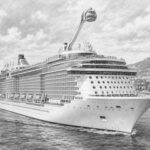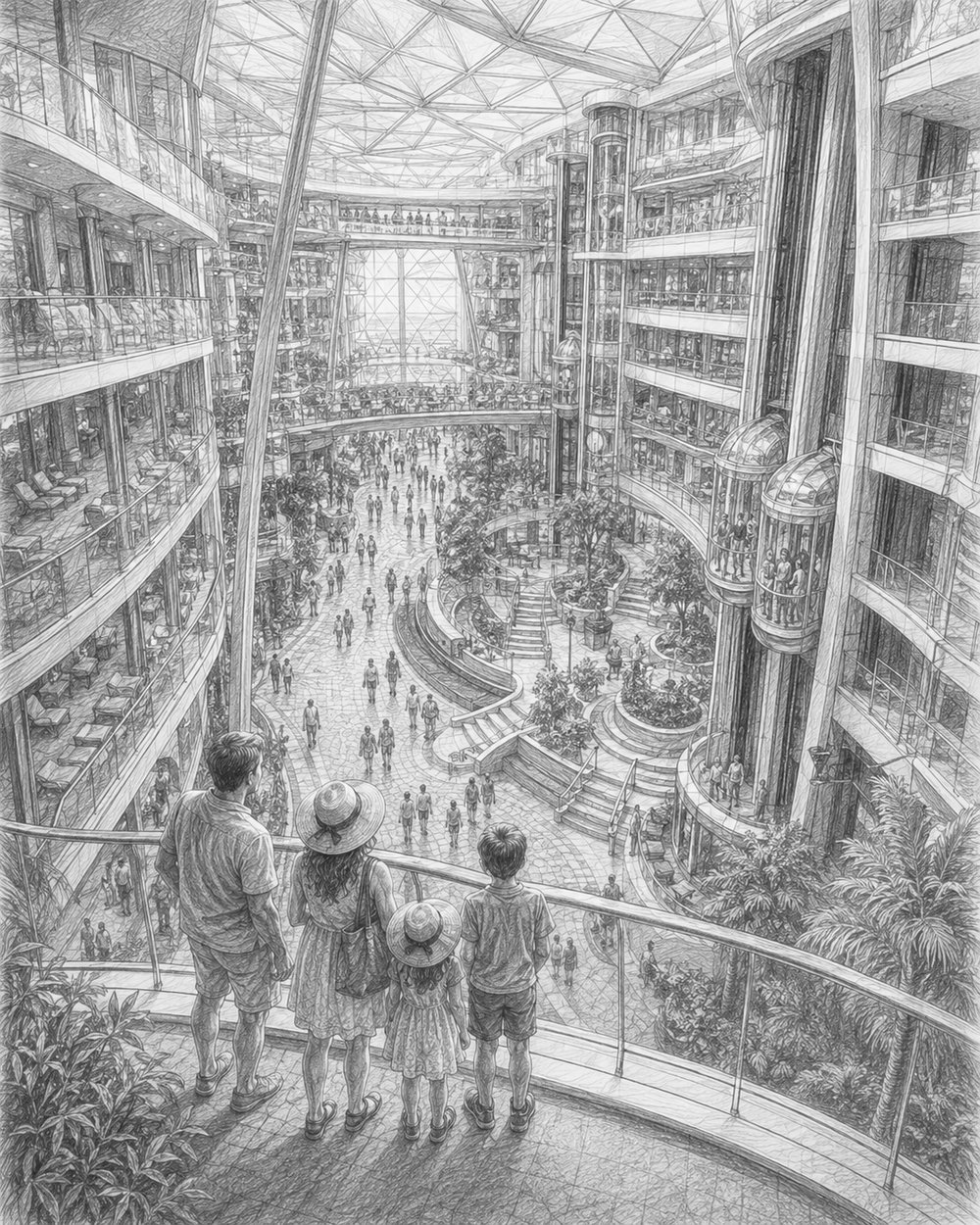
What should you expect on Quantum of the Seas? A big, tech-forward Royal Caribbean ship where the standout attractions live indoors as much as out — a glass observation capsule that lifts you 300 feet over the Pacific, a skydiving wind tunnel, robot bartenders, and a transforming theater — all wrapped around a West Coast run to Baja and the Mexican Riviera from Los Angeles. She is the original Quantum-Class ship, and day to day she feels less like a floating resort chasing a beach and more like an activity-packed small city that happens to visit Cabo and Ensenada. Here is how the ship flows once you are aboard, what to book first, and how a typical Mexico sailing settles into a rhythm.
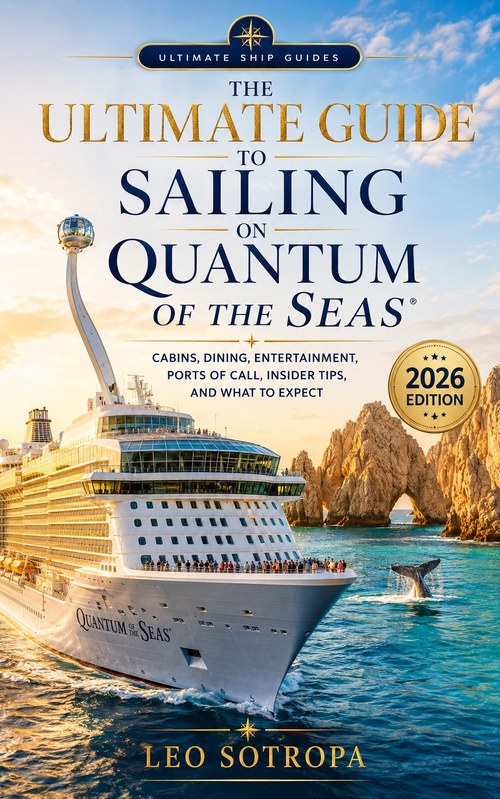
Everything in this article and far more, deck by deck, in The Ultimate Guide to Sailing on Quantum of the Seas.
Get the book →The ship in one picture: what Quantum of the Seas is
Quantum of the Seas is a roughly 168,000-gross-ton ship with about 16 guest decks, carrying around 4,180 guests at double occupancy and up to roughly 4,900 when full. Those numbers matter less than what they translate to on board: wide indoor spaces, a lot of glass, and a design that assumes the weather might not always cooperate. Quantum-Class ships were built to sail cooler, less predictable routes, so the marquee features — the North Star, RipCord by iFly, SeaPlex, Two70, the Bionic Bar — are engineered to work whether it is 80 degrees off Cabo or gray and breezy on the open Pacific stretch back to Los Angeles.
She is the class lead, and if you have sailed older Royal Caribbean ships the difference you notice first is the tech. Your day runs through the Royal Caribbean app, and several of the best experiences — a capsule ride, a surf lesson, a specialty dinner — reward guests who plan a day or two ahead rather than wandering up and hoping for a slot. If you want the ship-wide overview before you sail, a full Quantum of the Seas cruise guide covers the layout deck by deck; this article is about what the experience feels like once you step aboard.
The North Star: book it before you do anything else
The North Star is the single most photographed thing on the ship. It is a jewel-shaped glass observation capsule mounted on a mechanical arm that swings up and out over the side, lifting you about 300 feet above the sea for slow, 360-degree views. On a clear sea day heading toward Mexico it is genuinely spectacular — the full length of the ship below you, the wake trailing behind, and open Pacific in every direction.
Here is the practical part. The North Star is often complimentary on sea days, but capacity per ride is small and the slots go quickly. Open the app the moment you board and grab a sea-day time before the good slots fill; aim for the golden hour before sunset or a bright mid-morning slot when visibility is best. On port days the capsule sometimes runs as a paid ride over land, but the free sea-day ride is the one to prioritize. Anyone uneasy with heights should know the capsule is fully enclosed glass and the motion is gentle and slow.
RipCord by iFly and the FlowRider: the thrill pair
RipCord by iFly is a skydiving simulator — a vertical wind tunnel that floats you on a column of air so you get the sensation of freefall without jumping out of anything. It is beginner-friendly: an instructor is in the chamber with you the whole time, the session is short, and first-timers get a briefing and a flight suit. Reserve a slot early through the app, because the introductory sessions are the most popular and they cluster on sea days.
Nearby, the FlowRider surf simulator throws a sheet of fast-moving water up an angled surface so you can boogie-board or stand-up surf. It is a spectator sport as much as a participation one, and the staff run both beginner and advanced sessions. If you have kids or teens, this pair plus SeaPlex is where they will disappear for hours. For more tactics on timing these, the Royal Caribbean Quantum of the Seas tips rundown is worth a read.
SeaPlex: the largest indoor active space at sea
SeaPlex is the ship’s indoor sports and activity complex, billed as the largest active space at sea, and it earns the title by cramming a startling number of things into one flexible hall. Across a day it becomes bumper cars, a roller-skating rink, a basketball and pickup-sports court, an arcade, and an Xbox gaming zone. The schedule rotates, so the floor that hosted bumper cars in the afternoon might be a dance party later.
The move here is to check the app’s daily schedule and treat the timed sessions — bumper cars and roller skating especially — like the reservable attractions they effectively are. They are free, but they run in blocks and fill up. SeaPlex is also the ship’s weather insurance: when the Pacific turns choppy and the outdoor pool deck empties, this is where the energy moves indoors.
Two70: the ship’s transforming showpiece
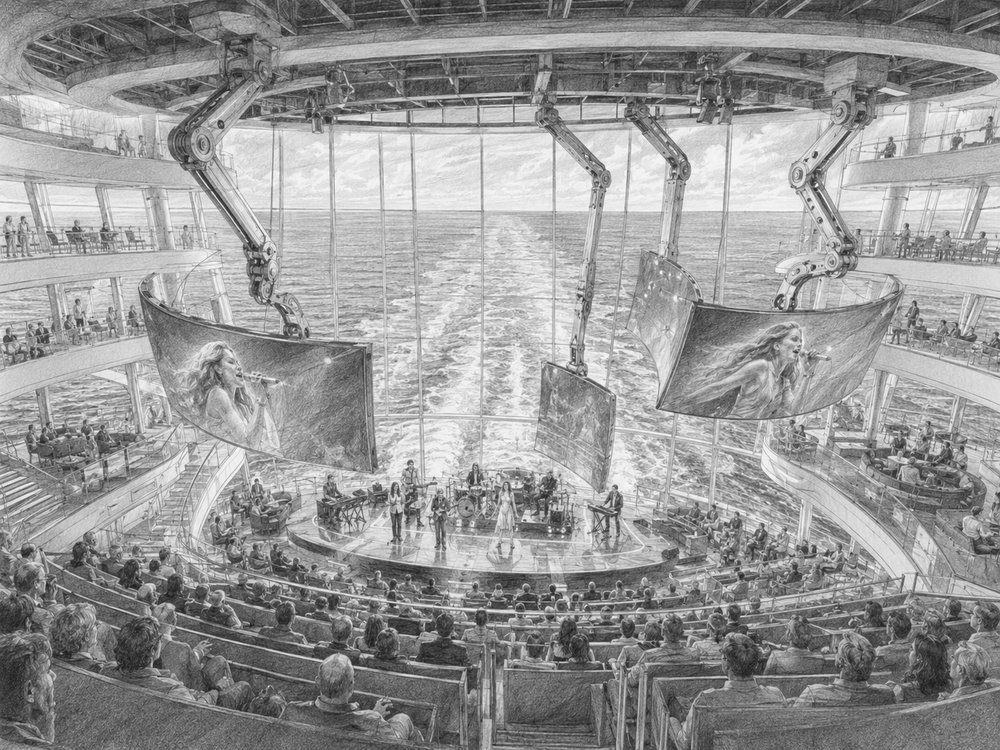
Two70 is the most clever room on the ship, and it changes personality with the time of day. By day it is a calm, light-filled lounge at the stern with a two-and-a-half-story glass wall looking back over the wake — a good spot for coffee, a book, or a quiet afternoon at sea. By night that glass wall disappears behind Vistarama, a wall-to-wall digital canvas that turns the whole back of the room into an immersive screen, and Roboscreens — screens mounted on robotic arms that move and reposition during the performance — join live performers for the evening shows.
The night shows in Two70 are among the best entertainment on board and worth planning your evening around. Check the app for show times and arrive early enough to get a good seat. It is a good example of how the whole ship is designed to earn its keep indoors.
The Bionic Bar and the Royal Esplanade
The Bionic Bar is exactly what it sounds like: two robotic arms mix and pour your drink. You order from a tablet, choose your ingredients or pick a preset, and watch the arms shake, stir, and strain. It is a gimmick, but a genuinely fun one — the kind of thing you do once for the novelty and the photo, and maybe again because the ordering lets you customize freely. Drinks are charged to your SeaPass, counting against a beverage package or your account like any other bar.
The Bionic Bar sits on the Royal Esplanade, the ship’s indoor promenade and social spine. This is the corridor you will pass through constantly — it connects shops, bars, and casual food, and it is where daytime activities and pop-up events happen. Café Promenade lives here for quick coffee and snacks. When in doubt, get to the Esplanade and reorient; learning it early makes the whole ship feel smaller.
The Music Hall, the Solarium, and the quieter corners
Not everything on Quantum is a headline thrill, and the quieter venues are a big part of why the ship works over a full week. The Music Hall is a two-level live-music and nightlife venue — bands, a bar, pool tables, and a late crowd. It is where the ship goes after the main shows wrap, with its own rhythm that builds through the evening.
The Solarium is the opposite end of the mood: an adults-only indoor-outdoor retreat with a pool, loungers, and a glass roof that keeps it usable in any weather. On a Baja sailing it is the smartest seat on the ship — warm and bright when the sun is out, sheltered and calm when the Pacific gets breezy. Add the Vitality Spa, the rock wall, and Adventure Ocean as the kids’ club, and you have a ship that separates its loud spaces from its calm ones on purpose. If you are still choosing where to sleep between all this, the best cabins on Quantum of the Seas breakdown maps which categories sit near the noise and which stay quiet.
Dining: what is included and what costs extra
Your cruise fare already covers a lot of food, and on Quantum the included dining is more than enough to eat well all week. The Main Dining Room handles your sit-down dinners with a rotating menu and table service. The Windjammer is the sprawling buffet — the default for breakfast and casual lunch. Café Promenade does grab-and-go coffee, sandwiches, and snacks at odd hours, and Sorrento’s serves pizza when you want something quick. None of these cost extra.
The specialty restaurants carry a cover charge or à la carte pricing, and Quantum’s lineup is one of the more interesting in the fleet:
| Included | Specialty (extra) |
|---|---|
| Main Dining Room | Wonderland (imaginative, playful dishes) |
| Windjammer buffet | Jamie’s Italian |
| Café Promenade | Chops Grille (steakhouse) |
| Sorrento’s pizza | Izumi (Japanese/sushi) |
| The Chef’s Table | |
| Johnny Rockets |
Wonderland is the one people talk about — a menu built around imaginative, whimsical dishes rather than a single cuisine, and it is the most Quantum-appropriate meal on board. Chops Grille is the reliable steakhouse, Jamie’s Italian does rustic pasta, Izumi covers sushi, and the Chef’s Table is a wine-paired multi-course experience for a special night. My honest take: you do not need specialty every night, but reserving one or two — Wonderland plus a steakhouse night is a good pairing — makes the week feel like an occasion. Prices are a moving target, so check current cover charges in the app and watch for pre-cruise dining packages that bundle a few nights at a discount.
How the ship runs: the app, the SeaPass, and the small print
The Royal Caribbean app is the operating system for your whole cruise. It holds the daily schedule, show and dining reservations, activity bookings, deck maps, and your account balance. Download it before you leave home, log into your sailing, and get comfortable with it — the guests who thrive on Quantum are the ones who check the app each morning and book the timed things early.
- SeaPass card: your room key and cashless account. Everything you buy — drinks, specialty dining, shop purchases — goes on it.
- Daily gratuities: automatically added to your account each day. You can prepay them before you sail if you prefer to lock the cost in.
- Wi-Fi: a paid plan, sold by the day or the voyage. Buy it early if you need to stay connected; the Voom packages are cheaper pre-cruise than on board.
- Beverage packages: if you drink more than a couple of times a day, a package usually pays off — but do the math against how you actually drink.
Your first day: how to start the cruise right
Embarkation day sets the tone, and a little strategy beats wandering around overwhelmed. Quantum sails round-trip from Los Angeles, with the cruise terminal in San Pedro. LA traffic is heavy, so flying in a day early is the smart call — it removes the biggest risk of missing the ship. San Pedro has the Battleship USS Iowa and the Cabrillo Marine Aquarium within easy reach, and you are a manageable drive from downtown LA, Hollywood, and Long Beach.
Once you are aboard, resist the urge to just find lunch and sit down. Do these first, in roughly this order:
- Open the app and reserve your North Star sea-day slot, a RipCord by iFly session, and any specialty dinners you want.
- Book your Two70 evening show and note the show times for the week.
- Walk the Royal Esplanade end to end so you have a mental map of the ship’s spine.
- Find the Solarium and the SeaPlex so you know where the calm and the chaos each live.
- Then eat — the Windjammer is open and rarely busy in that first hour.
That first hour of booking is the highest-leverage time of the whole cruise. The complimentary attractions with limited capacity — the North Star above all — are gone fastest. First-time cruisers in particular benefit from a plan; the first-time cruise on Quantum of the Seas walkthrough covers the embarkation-day details in more depth.
The rhythm of a West Coast Mexico sailing
Quantum currently sails the West Coast out of Los Angeles on Baja and Mexican Riviera itineraries, and the shape of your week depends on how long you go. Trips range from 3-night Ensenada getaways to 5-, 6-, and 7-night cruises. Typical ports include Cabo San Lucas — often an overnight call — Ensenada, and Santa Catalina Island at Avalon, a tender port off the California coast. Longer Mexican Riviera voyages add Mazatlán and Puerto Vallarta. Ports and lengths vary by sailing, so always confirm your exact itinerary in the app before you plan excursions.
The natural rhythm goes like this. Sea days are when the ship itself is the destination — you use your North Star reservation, do RipCord, chase the timed SeaPlex sessions, and settle into the Solarium or Two70. Port days flip the script: you are off the ship exploring, and the onboard venues go quiet. A longer Mexican Riviera sailing gives you more sea days, which is when Quantum’s indoor-heavy design pays off.
Tender ports start early
Two of the marquee stops — Cabo San Lucas and Santa Catalina Island — are tender ports, meaning the ship anchors offshore and small boats ferry you ashore. Tender operations start early and can involve waiting for a tender ticket, so if you have a booked excursion, get in line earlier than you think you need to. Cabo rewards the effort: El Arco at Land’s End, Medano Beach, Lover’s Beach, water taxis, sport fishing, and — in season — whale watching, and an overnight call means you can enjoy Cabo after dark too. Catalina’s Avalon is smaller and charming, with the Casino building, glass-bottom boats, snorkeling at Lover’s Cove, golf carts, and a botanic garden.
What each port is known for
Ensenada is the easy one to reach — a docked port, no tendering — opening onto the La Bufadora blowhole, the wineries of the Valle de Guadalupe, and a strong taco and street-food scene in town. On the longer Mexican Riviera sailings, Mazatlán brings its historic Centro, the malecón boardwalk, the El Faro lighthouse, and Stone Island beaches, while Puerto Vallarta offers the Malecón, the Church of Our Lady of Guadalupe, the Zona Romántica, and beaches like Playa Los Muertos. For a port-by-port plan of the shorter route, the Quantum of the Seas Baja Mexico guide goes deep on Cabo, Ensenada, and Catalina; the longer run is covered in the Quantum of the Seas Mexican Riviera guide.
How Quantum feels day to day
After a few days the ship settles into a pattern you can feel. Mornings are quiet — coffee in the Solarium, the app checked over breakfast. Midday on a sea day is peak energy: the pool deck, SeaPlex sessions, surf lessons, and North Star rides all at once. Late afternoon softens into spa time or the lounge side of Two70, and evenings run dinner and a main show, then the Music Hall for anyone still going.
What surprises people is how much of Quantum works regardless of weather. The Pacific between Los Angeles and Mexico can be warm and glassy or cool and rolling, and the ship was built for that uncertainty. When the sun is out, the open decks are wonderful. When it turns, the experience simply moves indoors without missing a beat — SeaPlex, the Esplanade, Two70, the Solarium under its glass roof. A midship balcony on the mid-decks gives you the steadiest ride for the open stretches. That resilience is the real answer to what to expect on Quantum of the Seas: a ship that is never at the mercy of a gray afternoon.
Get the complete Quantum of the Seas playbook
If you want every attraction, dining room, cabin category, and port worked into one ready-to-use plan, “The Ultimate Guide to Sailing on Quantum of the Seas” lays it all out step by step. It is part of the Ultimate Ship Guides series by Leo Sotropa, with clear action steps in every chapter so you board knowing exactly what to book first.
Frequently asked questions
Do I need to pay extra for the North Star?
On sea days the North Star is often complimentary, and that is the ride to prioritize. Capacity per ride is small, so reserve your slot in the app as soon as you board. On some port days the capsule runs as a paid experience over land, which is generally worth skipping in favor of the free sea-day ride.
What is included in my cruise fare versus what costs extra?
Included dining covers the Main Dining Room, the Windjammer buffet, Café Promenade, and Sorrento’s pizza, along with most entertainment and many activities like SeaPlex sessions and, on sea days, the North Star. Specialty restaurants such as Wonderland, Chops Grille, Jamie’s Italian, Izumi, the Chef’s Table, and Johnny Rockets carry an extra charge, as do Wi-Fi, beverage packages, spa treatments, and shore excursions. Daily gratuities are added automatically.
Where does Quantum of the Seas sail from?
For her Baja and Mexican Riviera season she sails round-trip from Los Angeles, with the cruise terminal in San Pedro. Because LA traffic is heavy, flying in a day early is strongly recommended. She has sailed other regions in other seasons, so always confirm your specific voyage and departure port in the app before you book flights.
Which ports will I visit on a Baja or Mexican Riviera cruise?
Typical stops include Cabo San Lucas (often an overnight call), Ensenada, and Santa Catalina Island at Avalon. Longer Mexican Riviera voyages add Mazatlán and Puerto Vallarta. Sailings range from 3-night getaways to 7-night cruises, and ports vary by itinerary, so confirm your exact route in the app.
Which activities should I book first?
The moment you board, open the app and lock in your North Star sea-day ride, a RipCord by iFly skydiving session, any specialty dinners, and your Two70 evening show. These are the limited-capacity experiences that fill fastest, so booking them in the first hour means you spend the rest of the week enjoying the ship rather than chasing sold-out slots.
Are Cabo San Lucas and Catalina tender ports?
Yes. Both Cabo San Lucas and Santa Catalina Island are tender ports, meaning the ship anchors offshore and small boats ferry you ashore. Tender operations start early and can involve waiting for a tender ticket, so get in line earlier than you expect if you have a booked excursion. Ensenada, by contrast, is a docked port with no tendering required.
Is Quantum of the Seas a good ship if the weather is cool or rough?
It is one of the best for exactly that. As the original Quantum-Class ship she was designed with major indoor attractions — SeaPlex, Two70, the Esplanade, the glass-roofed Solarium — so the experience holds up when the Pacific turns cool. If you are prone to motion, a midship balcony on the mid-decks gives the steadiest ride on the open stretches to Mexico.
Ready for the whole ship in one place? It is all in The Ultimate Guide to Sailing on Quantum of the Seas.
Get the book →
Meet Leo: The Heartbeat Behind ‘A Country A Month’
Journeying through the pages of A Country A Month, you might often feel the rhythm of a storyteller’s heartbeat, pulsating through each line, each image, and each adventure shared. That heartbeat belongs to none other than our remarkable website editor, Leo.
With a lens in one hand and a pen in the other, Leo seamlessly marries his passions for photography and writing. His eye captures moments that words can barely describe, yet his eloquence brings those images to life, transcending borders and connecting us all through shared stories. An avid traveler, every country he’s visited has added another chapter to his expansive tale, and through our platform, he generously shares these chapters with us.