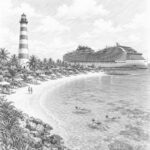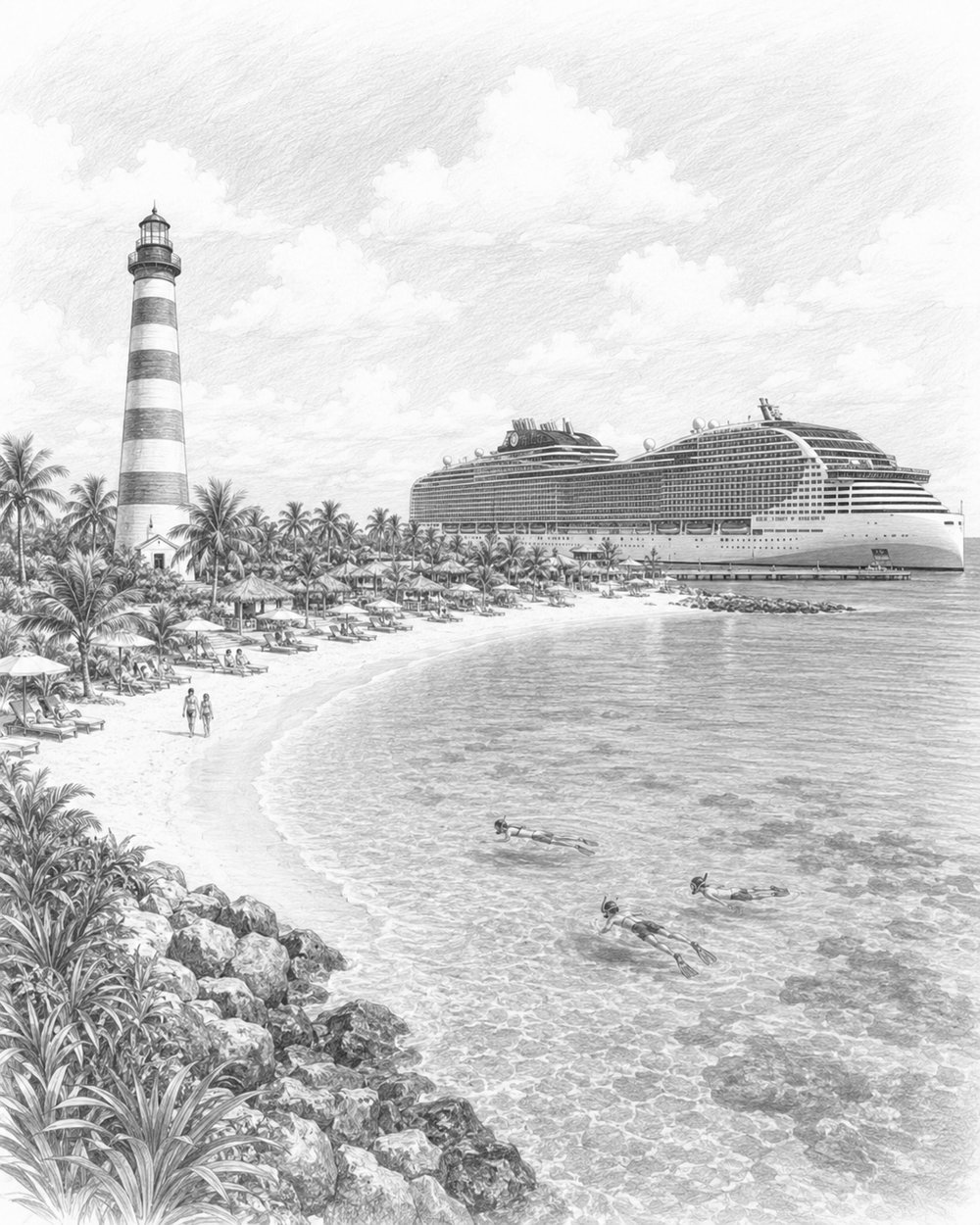
Ocean Cay MSC Marine Reserve is MSC Cruises’ private island in the Bahamas, and the best way to spend a day here is simple: walk off the ship onto a real pier, pick a beach, and settle in for a long, slow day by the water. There is no tender and no queue for a boat. Ships tie up alongside a proper berth, so you step off whenever you like and can come and go all day. What makes Ocean Cay different from most private islands is its story — it was an industrial sand-dredging site that MSC cleaned up and rebuilt into a protected marine reserve, and that conservation ethos runs through everything from the reef to the lighthouse light show at night.
This guide covers where your ship docks, the beaches, the snorkeling, the lighthouse, the premium areas, cabanas, and what to bring.
Where your ship docks
Ocean Cay is a berthing port, not a tender port. Ships pull alongside a pier and secure to the island itself, so you walk straight off the gangway onto dry land — no small boats, no tender ticket, no bobbing transfer. This is one of the island’s biggest practical advantages, especially for families with strollers, anyone with limited mobility, and people who like the freedom to pop back to the cabin and head ashore again.
The island is compact and walkable. From the pier, pathways and a land tram loop connect the arrival area to the beaches, the central lagoon, food venues, and the lighthouse. Distances are short. Bring your cruise card ashore; on Ocean Cay it is your ID for getting back on the ship, and it is what you tap for any extras rather than carrying cash. Check your ship’s app on the morning of the call for exact gangway times and the all-aboard time, because Ocean Cay is a place where schedules vary.
Top things to do on a port day
Pick a beach and claim your spot
Ocean Cay has several beaches spread around the island, each with a slightly different character. Some face the open water with a bit more breeze and small surf; others are tucked along the calmer central lagoon where the water is shallow, clear, and almost still. Because the beaches ring the island, you can usually find a busier or quieter stretch depending on which way you walk from the pier. Loungers are widely available, and the earlier you come ashore the easier it is to grab a front-row spot on the popular strands. If your first beach feels crowded, walk a few minutes — the far ends tend to thin out.
The lighthouse at the island’s heart
The tall lighthouse is Ocean Cay’s landmark and its orientation point — you can see it from most of the island, so it is hard to get lost. It sits near the central lagoon and the main gathering area, and the walk out to it is easy. By day it is a good marker for meeting your group. At night it becomes the centerpiece of the island’s signature event: a choreographed light-and-color show around the lighthouse, and one of the main reasons ships linger into the evening.
Snorkeling and the marine reserve
The whole island is a marine reserve, and the reef and seagrass around it are the reason. Because Ocean Cay was rehabilitated from an industrial site into protected habitat, the conservation rules are taken seriously: reef-safe sunscreen is encouraged, and you are asked not to touch or stand on coral or take anything from the water. Snorkeling here can be genuinely rewarding — clear water, patches of reef, and the chance to see fish, rays, and other marine life close to shore. Some sailings offer organized snorkeling and marine excursions. If you have your own mask and fins, bring them; rental gear may be available but availability varies, so confirm in the MSC for Me app. The snorkeling is only good because the ecosystem is protected, so following the reef-safe rules is part of the experience.
Ocean House, the Yacht Club area, and premium zones
Ocean Cay has exclusive zones set aside for guests in higher-tier experiences. The Yacht Club area gives MSC Yacht Club guests their own reserved stretch of beach with a quieter, more secluded feel, and Ocean House is a premium beachfront venue with an upscale food-and-drink setting. If you booked one of these, you will have a calmer, less crowded base; if you did not, the island’s plentiful public beaches are still yours. Whether a particular area is included or an add-on depends on your booking tier, so check what your experience covers before assuming access.
Cabanas and what’s included versus extra
A lot of what makes Ocean Cay pleasant is already covered by your fare. The beaches, loungers, swimming areas, the island tram, and general facilities are part of the day. Basic dining is typically provided, often at buffet-style venues, and drinks follow whatever beverage arrangement you already have on your ship.
What costs extra tends to be the upgrades. Private cabanas — shaded, semi-enclosed beach retreats with more comfort and privacy — are bookable for a fee and limited in number, so they sell out on busy sailings. Specialty food and drinks, certain premium venues, organized excursions, and gear rentals are generally add-ons too. A simple way to think about it:
- Included: beach access, loungers, swimming areas, the tram, standard island dining, and the evening lighthouse show.
- Usually extra: private cabanas, specialty dining and premium venues, organized excursions, and equipment rental.
- Depends on your fare: access to exclusive zones like the Yacht Club beach and certain premium areas.
If you want a cabana, book it early through the MSC for Me app or before you sail. Prices vary by sailing and season, so confirm the current rate rather than relying on what someone paid last time.
Families and the calmer beaches
Ocean Cay is an easy island for families. The walk-off pier removes the biggest hassle of a beach day with kids — no tender to wrangle — and the calmer lagoon-side beaches have shallow, gentle water for younger swimmers. Because the island is small and the lighthouse is visible from nearly everywhere, it is easy to set a meeting point. The tram helps when little legs get tired, and being able to walk back to the ship for a rest or lunch is a real advantage. Aim for a lagoon beach for the quietest water.
How much time you need, and staying late
Ocean Cay is unusual because ships often stay late into the evening, and some itineraries include an overnight. That changes how you plan. Rather than a rushed morning-only stop, you can have a full beach day, head back to the ship to clean up, and come ashore again for the evening — including the lighthouse light show, which is timed for after dark. If your sailing stays late, do not burn all your energy by noon; the island has a different, quieter mood once the day crowds thin out.
Even with a long call, keep all-aboard discipline. Because you can wander back and forth freely, it is easy to lose track of time; check the exact all-aboard in your app. Pair a beach day here with a livelier stop like Nassau, and if you enjoy the private-island format, another nearby example is Great Stirrup Cay.
What to skip and what to watch out for
The main thing to watch is the sun and heat. Ocean Cay is flat and open, with limited natural shade away from the venues, so bring your own protection and reapply through the day. This is a beach-and-water island, not a sightseeing one, so the biggest mistake is over-scheduling — pick a beach, maybe a snorkel, stay for the light show, and let the rest go. Weather can occasionally affect the call or in-water activities, and organized excursions can fill up, so book anything time-sensitive early through the app.
What to bring
- Your cruise card — your way back onto the ship and how you pay for extras.
- Reef-safe sunscreen, a hat, and sunglasses for the open, low-shade beaches.
- Water shoes if you plan to snorkel or wade over rocky areas.
- Your own snorkel mask and fins if you have them, since rental availability varies.
- A light layer for the evening if your ship stays late for the light show.
- A refillable water bottle and a beach towel from your ship.
Cruise ships that visit Ocean Cay MSC Marine Reserve
Ocean Cay is a private island, so the ships that call here are MSC’s. If your ship is listed below, its own guide has the detail to help you plan the rest of your cruise around this stop.
Frequently asked questions
Is Ocean Cay a tender port?
No. Ships berth at a pier and you walk directly off the gangway onto the island. There is no tender boat, which makes coming and going through the day easy — a real advantage for families and anyone who likes returning to the ship at will.
Whose private island is Ocean Cay?
Ocean Cay MSC Marine Reserve is MSC Cruises’ private island in the Bahamas. It was created by restoring a former industrial sand-dredging site into a protected marine reserve, which is why conservation is such a strong theme here.
What is included versus what costs extra?
Beach access, loungers, swimming areas, the island tram, standard dining, and the evening lighthouse show are generally included in your fare. Private cabanas, specialty dining, organized excursions, and gear rentals typically cost extra, and access to exclusive zones depends on your booking tier. Confirm details in the MSC for Me app.
Can you snorkel at Ocean Cay?
Yes. The island is a marine reserve with reef and seagrass close to shore, and snorkeling can be very good. Bring your own mask and fins if you have them, use reef-safe sunscreen, and avoid touching the coral. Some sailings offer organized snorkeling excursions through the app.
Why do ships stay late or overnight at Ocean Cay?
Many calls run into the evening, and some are overnights, so guests can enjoy the beach by day and the after-dark atmosphere — including the lighthouse light-and-color show. Save some energy for the evening, and always check your exact all-aboard time in the app.
Is Ocean Cay good for families with young children?
Very much so. The walk-off pier, the calm shallow lagoon beaches, the short distances, and the tram all make it easy with kids. Because the lighthouse is visible from almost everywhere, it is simple to keep your bearings.
What should I bring ashore?
Your cruise card, reef-safe sunscreen, a hat and sunglasses, water shoes, any snorkel gear you own, and a beach towel. There is limited natural shade, so sun protection matters most.

Meet Leo: The Heartbeat Behind ‘A Country A Month’
Journeying through the pages of A Country A Month, you might often feel the rhythm of a storyteller’s heartbeat, pulsating through each line, each image, and each adventure shared. That heartbeat belongs to none other than our remarkable website editor, Leo.
With a lens in one hand and a pen in the other, Leo seamlessly marries his passions for photography and writing. His eye captures moments that words can barely describe, yet his eloquence brings those images to life, transcending borders and connecting us all through shared stories. An avid traveler, every country he’s visited has added another chapter to his expansive tale, and through our platform, he generously shares these chapters with us.