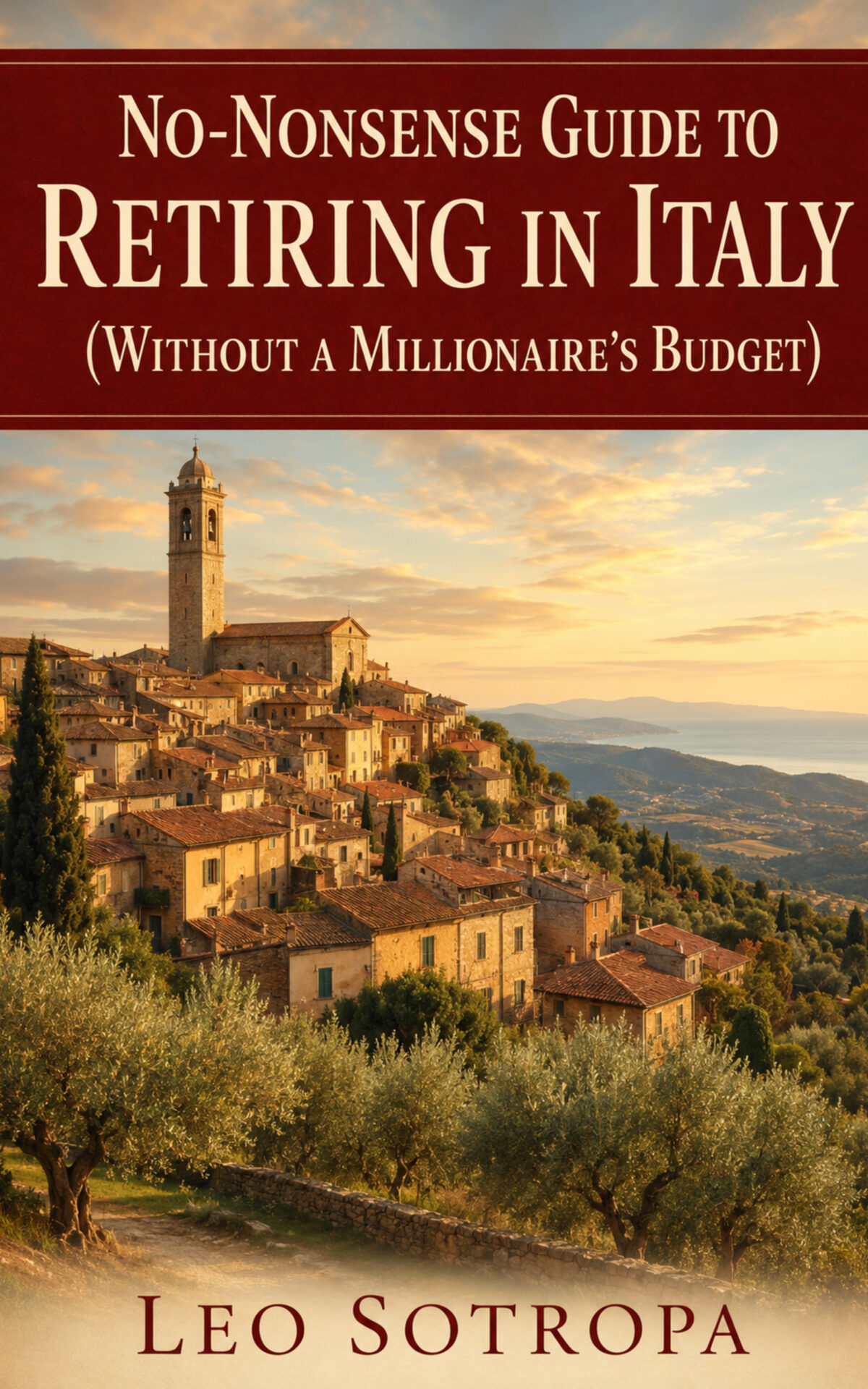
Is there a retirement guide to Italy written for someone who has an ordinary Social Security check rather than a seven-figure portfolio? Yes. No-Nonsense Guide to Retiring in Italy by Leo Sotropa is a practical, numbers-first handbook for Americans who want to understand whether life in Italy can work on a modest retirement income.
This is not a collection of beautiful villages followed by vague advice to “follow your dream.” It begins with the questions that decide whether the dream survives contact with real life. How much monthly income do you have? How much can you use from savings without making yourself vulnerable later? Can you qualify for the Elective Residency Visa? What happens to Medicare? Which regions offer a good daily life without the housing costs of Rome, Florence, or the famous coastal towns? How will taxes, exchange rates, healthcare, and bureaucracy affect the plan?
The short version is encouraging but important: living well in many parts of Italy can cost less than living in much of the United States. The harder part is qualifying to live there legally. Italy’s retirement route is built around stable passive income, and the standard applied by a consulate can be more demanding than a typical single Social Security benefit. The book treats that problem as something to plan around rather than something to hide in a footnote.
That combination is the point of the series. You get the piazza, the market, the evening walk, and the slower rhythm. You also get the documents, the budget, the healthcare choices, the tax questions, and a plan for what happens if your needs change.
What this book actually is
No-Nonsense Guide to Retiring in Italy is an independent retirement-planning handbook organized around the way a real person makes this decision.
It is not a general travel guide. It will not tell you which museum ticket to buy in Florence or where to stand for the best photograph of the Colosseum. Travel books assume that you are visiting temporarily. This book assumes that you may need to rent a home, obtain residency, open accounts, arrange medical care, buy groceries, understand a utility bill, make friends, handle paperwork in Italian, and build a life that still works on an unremarkable Tuesday in February.
It is also not a promise that Italy is right for everyone. The book is frank about the Elective Residency Visa, regional variation, language, administrative delays, taxes, currency risk, and the difference between enjoying a place for two weeks and depending on it every day.
Each chapter ends with action steps. The intention is to turn reading into a sequence of decisions: calculate your floor budget, identify candidate regions, gather income documentation, price health coverage, schedule a scouting trip, and decide what would make you walk away.
The book is available in Kindle and illustrated paperback formats. Both contain the same planning guidance. The Kindle edition is convenient for searching and carrying during a scouting trip. The paperback is easier to annotate at the kitchen table and gives the project the physical seriousness of a plan rather than a browser tab you may never revisit.
Why Italy is more affordable than its reputation
Italy has two completely different cost stories.
The first is the Italy most visitors know: Rome near the historic center, Florence during high season, Venice, Lake Como, the Amalfi Coast, and a handful of internationally famous towns. Housing in these places can strain even a comfortable retirement budget.
The second is the Italy where most Italians live. It includes provincial cities, inland towns, unfashionable coastlines, and large parts of Abruzzo, Puglia, Calabria, Sicily, Le Marche, Umbria, and other regions where rent can be far more manageable. Some northern cities also offer a better balance than their famous neighbors.
The book teaches you to evaluate Italy as a set of local markets rather than one national price tag. A retiree choosing between Bologna, Sulmona, Lecce, and a smaller Sicilian town is not choosing between four versions of the same budget. Housing, transport, climate, medical access, international connections, and the amount of English spoken can differ substantially.
That regional approach matters because cheap rent by itself does not make a place affordable. A remote village may require a car. An island may add travel costs and complicate specialist care. A low-cost house may be expensive to heat. A beach town may be inexpensive in winter but difficult to rent year-round. A small municipality may offer the quiet life you want while also making every administrative task slower.
The useful question is not “Is Italy cheap?” It is “Which version of Italy fits my income, health, temperament, and need for connection?”
Three retirees, three budgets
The book opens with three representative retirees because abstract averages hide the choices that shape a real monthly budget.
The first is a solo retiree in Sulmona, Abruzzo. She relies mainly on Social Security and lives carefully rather than austerely. Her lower rent makes the plan possible. She shops locally, walks often, uses public transport when it works, and keeps a meaningful emergency reserve. The trade-off is that she does not have the convenience or English-language ecosystem of a major expat center.
The second is a couple in Puglia. Their combined retirement income gives them more flexibility with rent, healthcare, travel, and the occasional administrative surprise. They can enjoy the social rhythm of southern Italy while spreading fixed household costs across two incomes. Their challenge is choosing a town that remains lively outside summer and gives them acceptable access to airports and hospitals.
The third is a comfortable single retiree in Bologna. He pays more for housing but gains excellent rail connections, stronger medical access, a year-round cultural life, and an easier base for exploring the rest of Europe. His case demonstrates that a higher-cost Italian city can still be rational if it reduces car dependence and gives you the services you will actually use.
These are planning models, not claims that every reader will spend the same amount. Their purpose is to show how the same country produces very different retirements. They also reveal which costs are genuinely flexible. Rent and location dominate. Groceries can be reasonable when you shop like a resident. Imported habits, frequent flights, a car, private insurance at an older age, and an apartment in a tourist market can quickly change the picture.
The visa truth the glossy guides often soften
Italy does not offer a simple “retirement visa” with one universal number and automatic approval. The common route for financially independent retirees is the Elective Residency Visa.
The central idea is straightforward: you must demonstrate stable, recurring resources that allow you to live in Italy without working there. In practice, the documentation and the judgment applied by the Italian consulate serving your U.S. residence matter enormously. Applicants should not assume that a savings balance alone will be treated the same as dependable pension or investment income. They should also expect to document housing, insurance, background information, and the rest of the application carefully.
This is why the book separates two questions that are often confused:
- Can you afford everyday life in the Italian location you chose?
- Can you satisfy the legal and documentary standard required for residency?
A person may have enough resources to live comfortably in Abruzzo and still need a stronger visa file. Conversely, someone who qualifies easily may choose a city that consumes too much of the monthly budget.
The guide helps you build a document checklist, think about the income-versus-assets problem, choose the correct consulate, plan for timing, and avoid making irreversible moving decisions before the visa is secured.
Visa rules and consular practices change. This book gives you the planning logic and shows you what to verify, but the consulate and official Italian government sources remain the final authority for your application.
Where the book helps you look
The strongest chapters are not lists of “ten best towns.” They teach you how to compare places.
Abruzzo
Abruzzo offers mountains, historic towns, access to the Adriatic, and prices that can be gentler than nearby Rome or Tuscany. Towns such as Sulmona can appeal to retirees who want a walkable daily life and a strong sense of place. The questions are winter climate, transport, language, and access to specialist care.
Puglia
Puglia combines attractive towns, long coastlines, food culture, and lower costs than Italy’s most famous regions. It can work beautifully for a retiree who chooses a genuine year-round community rather than a seasonal resort. Summer heat, transport, and the distance to major international connections deserve attention.
Sicily and Calabria
Parts of Sicily and Calabria offer some of the country’s lowest housing costs and may fall within the geography associated with Italy’s special tax regime for qualifying foreign pensioners. The rewards can be substantial: climate, food, community, and value. So can the trade-offs: bureaucracy, infrastructure, heat, and uneven medical access.
Affordable central regions
Le Marche, Umbria, and less-famous parts of Tuscany can provide a central-Italian landscape without the most inflated tourist pricing. The danger is assuming that every beautiful hill town is practical. A car, steep streets, limited rentals, and winter quiet may matter more at age seventy-five than at sixty-two.
Northern and university cities
The north is generally more expensive, but cities such as Bologna illustrate why cost should be compared with convenience. Rail, hospitals, airports, culture, and a large year-round population can justify a higher rent. The book helps you place a value on those services rather than treating the cheapest town as the automatic winner.
Healthcare: excellent care, but not one simple system
Italy’s healthcare is one of its attractions, but a retiree’s experience depends on residency status, region, age, and how public and private care are combined.
Medicare generally does not provide routine coverage in Italy. That fact needs to be part of the plan from the beginning, not discovered after a move. Depending on your stage in the residency process, you may need private coverage, may later qualify to enroll in the national system under applicable rules, or may use private care alongside public access.
The book explains the practical questions to ask:
- What insurance is required for the visa and initial residency period?
- Can the policy exclude pre-existing conditions?
- What happens to premiums as you age?
- What is the current cost and eligibility rule for voluntary enrollment in the Italian national health service?
- How does regional administration affect access?
- How close is the candidate town to emergency care and the specialists you use?
- Should you maintain Medicare in the United States as part of a return-home contingency?
Healthcare planning is not only about price. It is also about language, travel time, continuity, and what happens if one spouse becomes less mobile.
The 7 percent tax regime, without the sales pitch
Italy’s special flat-tax regime for qualifying foreign pensioners is a genuine planning opportunity. It is also narrower than casual summaries often suggest.
Eligibility depends on the type of income, prior tax residence, the municipality selected, its population, and its location in a qualifying southern region. Moving to southern Italy does not automatically mean every retiree receives a 7 percent tax rate. Nor does the regime remove the need to understand U.S. filing obligations, the tax treaty, foreign account reporting, and the treatment of different income categories.
The book explains what the regime is designed to do, who may benefit, what must be confirmed with a cross-border tax professional, and why choosing a town only for a tax rate can be a mistake.
Taxes should be evaluated together with housing, healthcare, family access, and quality of life. Saving tax in a place that does not suit you is not a successful retirement plan.
Banking, currency, and bureaucracy
Italy uses the euro, while many American retirees receive income and hold savings in dollars. A plan that works only at one favorable exchange rate is fragile. The guide encourages readers to test the budget under less favorable currency conditions and keep a reserve for transfer costs, deposits, furnishing, and administrative delays.
Banking can involve U.S. compliance rules, identification requirements, and practical differences between institutions. Renting can require more documentation or a larger upfront commitment than an American expects. Government processes may involve appointments, stamps, copies, and local interpretations.
The book does not pretend that bureaucracy becomes charming because it happens in a beautiful building. Instead, it treats patience, document organization, professional help, and language preparation as budget items.
Who this book is for
The guide is particularly useful for:
- Americans approaching retirement who are testing Italy against a realistic fixed income
- Social Security retirees who need to understand the difference between affordability and visa qualification
- Couples deciding whether their combined income and savings create enough margin
- Solo retirees who need to evaluate healthcare access, community, and contingency planning carefully
- Readers comparing Italy with Portugal, Spain, Greece, or Latin American alternatives
- Adult children helping a parent evaluate the practical risks of an overseas move
- Dreamers who would rather discover a deal-breaker during planning than after shipping their belongings
It is less useful for someone seeking luxury-property advice, citizenship-by-investment shortcuts, or a promise that the move will be effortless.
What makes it a no-nonsense guide
The phrase “no-nonsense” is not there to make the book sound tough. It describes the editorial rule behind it: every attractive claim must be paired with its practical consequence.
Italy may offer lower rent. The town may require a car.
Healthcare may be excellent. Enrollment and access may be regional.
The 7 percent tax regime may be valuable. Eligibility is specific.
The pace may be slower. Administrative work may also be slower.
A beautiful village may be peaceful. It may also be isolating in winter.
You may be able to afford the life. You still need to qualify for the visa.
That habit of pairing the dream with the operational truth is what makes the book useful.
About Leo Sotropa and the series
Leo Sotropa writes practical travel and retirement guides for readers who want enough detail to act. The No-Nonsense Guide to Retiring in… series evaluates each country through the same framework: three retiree budgets, value by region, residency, healthcare, taxes, banking, safety, culture, settling in, and a plan for changing needs.
Using the same framework makes country comparisons more meaningful. Portugal’s visa may be more accessible but its housing market tighter. Greece and Italy may offer special tax regimes but present a higher residency hurdle. Mexico is closer to the United States but requires a more local approach to safety. Panama and Ecuador remove dollar exchange-rate risk but create different healthcare and location decisions.
The goal is not to name one universal winner. It is to help you identify the country whose trade-offs fit you.
Get No-Nonsense Guide to Retiring in Italy
No-Nonsense Guide to Retiring in Italy: Without a Millionaire’s Budget by Leo Sotropa is a practical handbook for building an Italian retirement around real income, real paperwork, and real life. It covers budgets, regions, the Elective Residency Visa, healthcare, taxes, banking, culture, and the contingency plan every international retiree should make before moving.
Your piazza table may be waiting. This book helps you determine whether you can afford the chair, qualify to stay, and still feel secure ten years from now.
Frequently asked questions
Can an American retire in Italy on Social Security?
It may be possible to afford everyday life in a lower-cost Italian region on Social Security, especially for a couple with two benefits. The more difficult issue can be qualifying for the Elective Residency Visa, which focuses on stable passive resources and is evaluated by the applicable consulate. Treat affordability and visa qualification as two separate tests.
What is the Elective Residency Visa?
It is the common Italian visa route for financially independent non-EU residents who want to live in Italy without working. Applicants generally need substantial documented passive resources, suitable housing, insurance, and a complete application. Current requirements and consular practices must be verified directly with the responsible Italian consulate.
Is southern Italy cheaper for retirees?
Often, but not universally. Many towns in Abruzzo, Puglia, Calabria, Sicily, and other southern or inland areas have lower housing costs than Italy’s most famous cities and tourist coasts. Transport, healthcare access, summer heat, seasonal rentals, and the need for a car should be included in the comparison.
Does Italy have a 7 percent tax for foreign retirees?
Italy has a special tax regime that may allow qualifying foreign pensioners who move to certain smaller municipalities in designated southern regions to pay a 7 percent substitute tax on qualifying foreign income for a limited period. Eligibility is detailed and should be reviewed with an Italian-U.S. tax professional before relying on it.
Does Medicare work in Italy?
Medicare generally does not cover routine healthcare received in Italy. Retirees need a plan for private coverage, Italian healthcare access where eligible, out-of-pocket care, and whether maintaining Medicare enrollment supports a future return to the United States.
Is the Kindle or paperback edition better?
The guidance is the same. Kindle is easier to search and carry during a scouting trip. The illustrated paperback is more convenient for joint planning, notes, checklists, and use as a gift.
Is this an official Italian government guide?
No. It is an independent planning guide. Government agencies, consulates, healthcare authorities, and qualified tax professionals remain the final sources for rules that affect an individual application or financial decision.

Meet Leo: The Heartbeat Behind ‘A Country A Month’
Journeying through the pages of A Country A Month, you might often feel the rhythm of a storyteller’s heartbeat, pulsating through each line, each image, and each adventure shared. That heartbeat belongs to none other than our remarkable website editor, Leo.
With a lens in one hand and a pen in the other, Leo seamlessly marries his passions for photography and writing. His eye captures moments that words can barely describe, yet his eloquence brings those images to life, transcending borders and connecting us all through shared stories. An avid traveler, every country he’s visited has added another chapter to his expansive tale, and through our platform, he generously shares these chapters with us.