Can an American retire in Greece without a millionaire’s budget? No-Nonsense Guide to Retiring in Greece by Leo Sotropa answers that question with realistic budgets, location comparisons, and a practical path through residency, healthcare, taxes, housing, and daily life.
Greece offers much more than postcard islands. It has regional cities with universities and hospitals, affordable mainland towns, lively neighborhoods, long growing seasons, deep history, and a culture in which food, family, and public life remain visible. A retiree can consider Kalamata, Thessaloniki, Crete, Athens, the Peloponnese, or selected islands, each with a different combination of cost, climate, transport, and medical access.
The challenge is that an affordable daily life does not automatically mean an easy residency application. Greece’s financially independent person route can require more income than some Social Security retirees receive, although savings and other resources may be relevant under current rules. Island living can magnify healthcare and transport problems. Bureaucracy rewards preparation and patience. Tax results require advice from someone who understands both Greek and U.S. obligations.
The guide’s message is neither romantic nor discouraging: Greece can be a rewarding retirement for people who match the location to their budget, qualify for legal residence, plan healthcare before moving, and keep enough reserve for change.
What this book actually is
No-Nonsense Guide to Retiring in Greece is an independent retirement-planning handbook. It is not an official immigration guide, a property brochure, or a collection of island photographs.
A travel guide helps you choose a holiday. This book helps you decide whether Greece can support ordinary life through every season.
It addresses practical questions:
- Does your income or savings support both residency and the lifestyle you want?
- Which regions combine affordable housing with healthcare and transport?
- How does the financially independent person visa generally work?
- Could Greece’s special tax regime for qualifying foreign pensioners apply?
- How do public and private healthcare fit together?
- What happens to Medicare?
- Should you live on an island, in Athens, or in a mainland regional city?
- How should you handle euros, banking, leases, and U.S. reporting?
- What happens when mobility, health, family needs, or the exchange rate changes?
The book follows a usable sequence: define priorities, compare regions, build budgets, evaluate residence, plan healthcare and taxes, scout, rent, move, adapt, and create a later-life contingency plan. Each chapter closes with action steps.
Why Greece attracts retirees
Greece offers a distinctive combination of quality of life and geographic variety.
The Peloponnese provides productive towns, mountains, beaches, and road access to Athens. Crete is large enough to support multiple cities and major hospitals while retaining island character. Thessaloniki offers an urban cultural life and medical depth at prices often below central Athens. Athens provides the country’s widest range of services and international connections but requires more budget and careful neighborhood selection. Smaller islands deliver beauty and community at the cost of seasonal transport and limited specialist care.
Retirees are drawn by:
- Mediterranean food and a strong market culture
- Mild winters in many southern and coastal areas
- Walkable town centers and active public life
- Access to both mainland and island landscapes
- Housing costs below many U.S. and Western European markets in selected regions
- Private medical care that may be reasonably priced
- A possible residence route for financially independent people
- A special tax regime that may benefit qualifying foreign pensioners
- Connections to the rest of Europe
The book treats these as starting points, not guarantees. Sunny summers can include dangerous heat. A lovely village may require a car. An island ferry may be delayed when a specialist appointment cannot. A low rent may come with poor insulation and high winter energy use.
Three retirees, three versions of Greek life
The book begins with three composite retirees because the phrase “cost of living in Greece” conceals the choices that determine whether a plan succeeds.
A solo retiree in Kalamata
The first retiree lives in Kalamata on Social Security supplemented by savings. She chooses a modest apartment, walks to daily services, uses the city’s markets, and maintains a reserve for private medical appointments and travel.
Kalamata offers a regional hospital, an airport with seasonal service, coastal access, and a year-round Greek population. It is less expensive than prime Athens districts or celebrated islands, while still providing enough urban life to avoid isolation.
Her case also exposes the residency issue. A monthly budget may be workable even when current visa qualification requires stronger documented resources. She treats eligibility as the first gate, not an administrative detail to solve after signing a lease.
A couple on Crete
The second household is a couple with two retirement incomes and moderate savings. They compare Chania, Rethymno, and Heraklion rather than treating Crete as a single market.
Chania offers beauty, international appeal, and airport access, but demand can raise housing costs. Heraklion provides greater medical depth and a working-city economy. Rethymno offers a smaller scale between them. The couple rents first to experience wind, heat, winter damp, traffic, and the distance to healthcare.
Their budget includes a car because many attractive Cretan locations are not practical without one. It also includes flights and ferries, private appointments, home heating and cooling, and periodic travel to the United States.
A single retiree in Thessaloniki
The third retiree chooses Thessaloniki for hospitals, university life, transit, culture, and a large year-round population. He gives up the image of a quiet island in exchange for easier specialist care and less dependence on a car.
His housing costs depend heavily on neighborhood and building quality. He investigates elevators, heating systems, summer cooling, hills, and access to groceries rather than judging an apartment by its renovated kitchen.
His case demonstrates that urban Greece may be the more resilient retirement choice. Medical access, transport, and social opportunities can be worth more than a sea view when living alone.
The honest cost-of-living discussion
Greece can be affordable, particularly outside prestigious islands and central Athens, but no national monthly number describes every household.
Housing remains the largest variable. Seasonal tourism can remove properties from the long-term market. Older buildings may be poorly insulated. Electricity, heating oil, air-conditioning, a car, private healthcare, and trips home can change the budget more than inexpensive produce or café prices.
The guide builds costs by category:
- Rent, deposits, and agent fees
- Electricity, heating, water, internet, and mobile service
- Food and household goods
- Public transport, ferries, or a car
- Insurance and out-of-pocket medical care
- Residency renewals, translations, and professional assistance
- Flights to the United States
- Recreation and Greek-language study
- Euro-dollar exchange-rate movement
- Emergency and relocation reserves
Readers build a normal monthly budget, a first-year budget, and a stress test. The first year includes documents, temporary accommodation, deposits, household setup, insurance, and scouting. The stress test asks whether the plan survives a weaker dollar, higher housing cost, an extended heat wave, a medical trip to Athens, or an urgent visit home.
Choosing where to retire in Greece
The location chapters evaluate places by function.
Kalamata and the Peloponnese offer mainland access, productive towns, beaches, and potentially better value. Nafplio provides beauty and proximity to Athens, but popularity affects housing. Crete offers several viable cities and a substantial year-round population, though distances and island logistics matter. Thessaloniki provides urban services, hospitals, food, and culture with colder winters than southern Greece. Athens offers the deepest medical and administrative infrastructure but higher housing pressure, heat, congestion, and neighborhood variation.
The island chapter is deliberately cautious. A small island can provide extraordinary community and landscape. It can also depend on ferries, seasonal flights, limited pharmacies, and medical transfers. Some islands become quiet in winter; others struggle with water, staffing, or housing converted to holiday rentals.
The guide asks readers to score each place on:
- Long-term rental availability
- Hospital and specialist access
- Summer heat and winter damp
- Walkability, hills, and elevators
- Year-round transport
- Airport or ferry resilience
- Social life outside tourist season
- Language demands
- Wildfire, earthquake, and weather exposure
- Access to family in an emergency
A scouting trip should include ordinary errands, a clinic visit, public transportation, rental inspections, and time in the least appealing season whenever possible.
The financially independent person visa
For many non-EU retirees, the financially independent person visa is the relevant residence route. Applicants generally demonstrate stable resources, accommodation, insurance, and required documentation, then complete residence procedures in Greece.
The income standard, treatment of savings, documentation, and family additions must be checked against current official guidance. Consular practice and appointment procedures can change. A retiree should not assume that a monthly budget that works in Kalamata automatically satisfies the visa standard.
The book helps readers organize the process: identify the correct consulate, confirm current financial evidence, obtain official documents, arrange insurance, plan housing evidence, and prepare for post-arrival steps. It also discusses the difference between residence permission and tax residence.
Official Greek authorities and qualified professionals remain the final sources. The guide’s role is to help readers ask the right questions before spending money or making irreversible decisions.
Greece’s 7% tax regime for foreign pensioners
Greece has offered a special tax regime under which eligible foreign pensioners who transfer tax residence may pay a flat rate on qualifying foreign-source income for a limited period, subject to current law and application requirements.
The headline number is attractive, but eligibility and consequences are individual. The regime does not erase U.S. filing obligations, automatically cover every type of income, or eliminate reporting requirements. Treaty treatment, state ties, investment income, retirement-account withdrawals, and estate planning may all matter.
The book explains the questions to raise with a cross-border tax professional before moving:
- Do you meet the current eligibility conditions?
- Which income is covered?
- What application deadline and documents apply?
- How do Greek and U.S. rules interact?
- What happens when the special period ends?
- Would another tax outcome be better for your circumstances?
Tax planning belongs before residency and asset moves, not after.
Healthcare, public coverage, and Medicare
Greece provides public and private healthcare, with the widest specialist choice in Athens, Thessaloniki, and major regional centers. Many retirees use private doctors for speed or English access while developing eligibility for public services under their residence and insurance circumstances.
The guide asks readers to plan for:
- Insurance required for residence
- Private-policy exclusions and age limits
- Routine out-of-pocket appointments
- Prescription continuity and generic names
- Emergency treatment and ambulance response
- Specialist access outside major cities
- Travel or evacuation from an island
- Long-term care and home support
Medicare generally does not cover routine treatment in Greece. Some retirees retain it because they may return to the United States for treatment or later resettle. The decision should reflect premiums, late-enrollment risks, health, and the practical ability to travel.
Healthcare should help determine the location. A retiree who needs frequent specialists may be better served in Thessaloniki, Athens, Heraklion, or another substantial regional center than on a small island.
The island-healthcare trade-off
The book gives special attention to a problem that glamorous retirement articles often omit: islands introduce logistics.
On a large island such as Crete, major cities have hospitals and airports. Even there, mountain roads, distance, weather, and specialist concentration matter. On smaller islands, serious treatment may require a ferry, flight, or medical transfer to a larger center.
Readers are encouraged to ask concrete questions: Where is the nearest emergency department? Is it fully staffed year-round? How is a cardiac or stroke patient transferred? What happens during high winds? Can prescriptions be filled locally? Who helps if you live alone?
The answers may not rule out island life. They may lead to choosing a larger island, living near the main town, or enjoying islands for extended stays while maintaining a mainland base.
Housing: rent before buying
Renting first is central to the plan.
A full year teaches the retiree about building insulation, heating, cooling, noise, stairs, elevators, parking, water, neighborhood life, and seasonal rental pressure. It also prevents the emotional purchase of a holiday property before the buyer understands Greek ownership costs and administration.
Those who later buy should obtain independent legal and technical review. Title, permits, boundaries, shared-building obligations, energy efficiency, earthquake resilience, and tax consequences deserve careful attention.
The guide also discusses practical renting issues: inventory, deposits, utility transfers, lease registration, and the difference between a long-term home and a furnished seasonal listing.
Banking, euros, and bureaucracy
Retirees often keep a U.S. account while opening a Greek account when practical. More than one transfer route and payment card provides resilience. Exchange rates should be treated as a budget variable, not a permanent bargain.
Greek administration has modernized in many areas, but processes may still require tax numbers, appointments, translated documents, certified copies, and visits to multiple offices. Name differences across U.S. documents can create delays.
The book recommends maintaining an organized digital and paper file, asking for receipts, confirming requirements in writing, and using qualified assistance where the stakes justify it. Patience is useful; preparation is better.
Language, culture, and belonging
English is common in tourism and among many professionals, but Greek language skills expand independence and relationships. The alphabet is learnable, and even modest progress improves shopping, transport, healthcare, and neighborly life.
The guide treats integration as a retirement task. Join a class, use local shops, attend community events, learn the rhythm of meals and holidays, and build relationships beyond an expatriate circle.
Greek social life can feel warm and direct, while bureaucracy, noise, smoking, driving, and slower service may frustrate newcomers. Culture shock does not mean the move failed. It means the retiree needs routines, language, and realistic expectations after the honeymoon period.
Planning for change
The plan must survive more than the first healthy years.
The book asks readers to prepare for bereavement, reduced mobility, cognitive decline, wildfire evacuation, an expensive medical event, rising rent, and a return to the United States. Essential tools include powers of attorney, beneficiary records, translated medical summaries, emergency contacts, accessible reserves, and written instructions family members can use.
For island and rural residents, the contingency plan should identify a mainland medical base and a point at which relocation becomes the wiser choice.
Planning for change protects independence. It turns Greece from an extended holiday into a retirement that can adapt.
Who this guide is for
The guide is especially useful for:
- Americans evaluating retirement in Greece on Social Security and savings
- Retirees comparing the FIP visa with routes in Portugal, Spain, or Italy
- Couples and solo retirees choosing between mainland cities and islands
- Readers interested in the 7% foreign-pensioner tax regime
- People who need healthcare access to shape their location decision
- Adult children helping a parent assess an overseas move
- Retirees willing to rent first and learn Greek
- Anyone seeking a practical sequence from scouting to long-term residence
It is not a promise that every island is inexpensive or that a favorable tax headline solves the whole plan.
What makes it no-nonsense
Every benefit is paired with its practical question.
Daily life may be affordable. Do your resources meet the residence standard?
An island may be beautiful. Can you reach advanced care in February during bad weather?
The 7% regime may be attractive. Are you eligible, and how does it interact with U.S. tax?
A village may be peaceful. Will you be able to drive, shop, and socialize as you age?
Private care may be reasonably priced. How will you fund a major event?
This balance is not pessimism. It is the foundation for confidence.
About Leo Sotropa and the series
Leo Sotropa writes practical travel and retirement guides for readers who want enough detail to act. The No-Nonsense Guide to Retiring Abroad series uses a consistent framework: representative budgets, location comparisons, residency, healthcare, taxes, banking, safety, language, moving logistics, adaptation, and contingency planning.
That framework helps readers compare destinations honestly. Greece offers culture, regional variety, and potentially favorable tax treatment, but its residency hurdle and island logistics may be more demanding for some. Portugal, Spain, Italy, and Mexico present different balances of access, healthcare, tax, proximity, and cost.
There is no universal winner. There is a country whose trade-offs fit your resources, health, and priorities.
Get No-Nonsense Guide to Retiring in Greece
No-Nonsense Guide to Retiring in Greece: Without a Millionaire’s Budget by Leo Sotropa is a practical handbook for building a Greek retirement around real income, legal residence, healthcare, taxes, housing, banking, location, and a contingency plan.
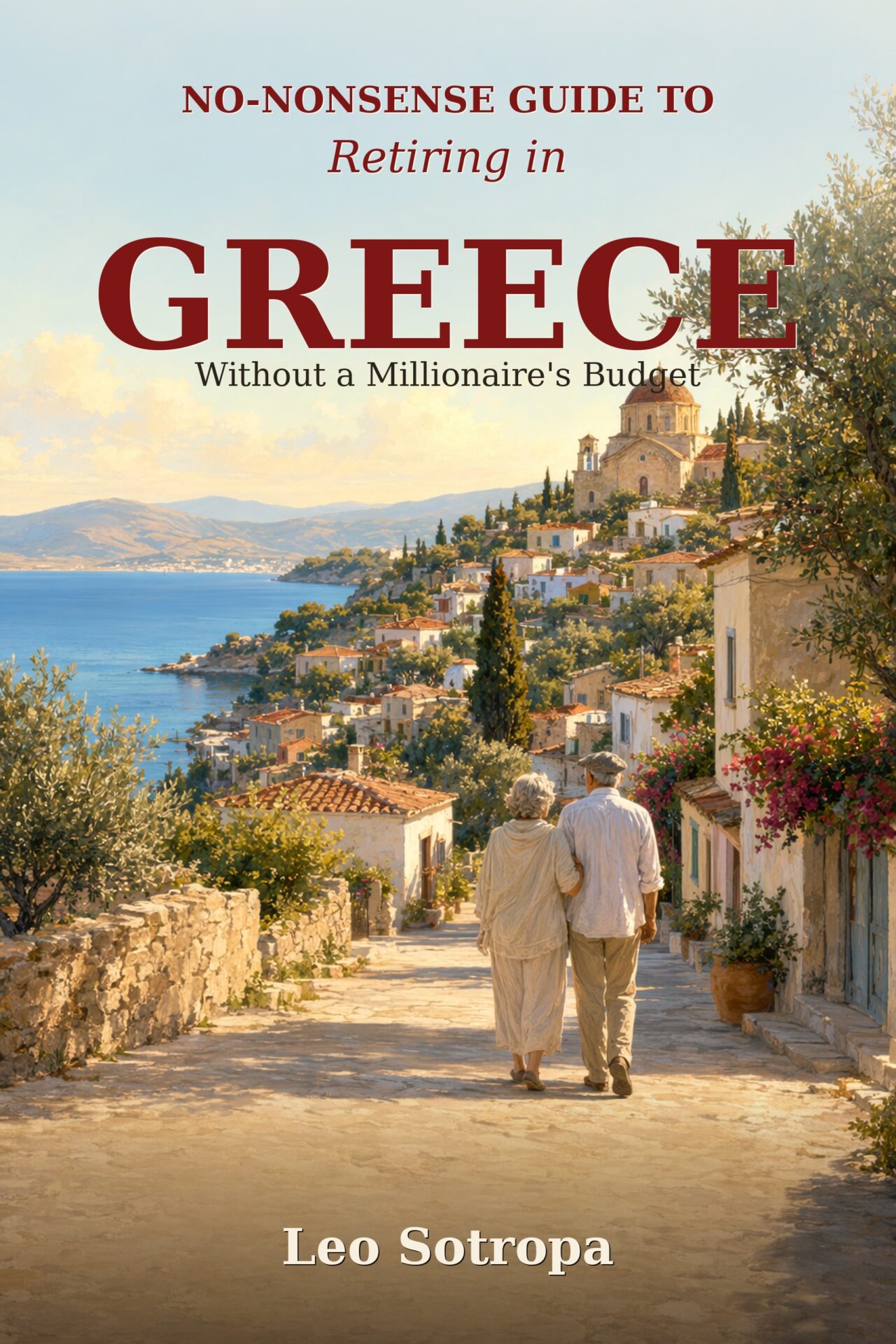
No-Nonsense Guide to Retiring in Greece by Leo Sotropa is available on Amazon.
Your Greek retirement should rest on more than a beautiful view. This book helps you determine where the life works and how to protect it.
Frequently asked questions
Can an American retire in Greece on Social Security?
Daily life may be affordable in selected mainland and regional locations, but the current residence requirement can be the harder test. Retirees should evaluate their income, savings, household size, healthcare, and visa eligibility separately.
What is Greece’s financially independent person visa?
It is a residence route commonly considered by non-EU retirees who can demonstrate sufficient resources and meet current documentation, housing, and insurance requirements. Official Greek guidance controls.
What is Greece’s 7% tax regime for foreign pensioners?
It is a special regime that may allow eligible foreign pensioners who transfer tax residence to pay a flat rate on qualifying foreign-source income for a limited period. Eligibility and interaction with U.S. obligations require professional advice.
Does Medicare work in Greece?
Medicare generally does not cover routine care in Greece. Retirees need a Greek healthcare strategy and should separately decide whether retaining Medicare supports future U.S. treatment or return.
Is a Greek island a good place to retire?
It can be, especially on a larger island with year-round services. Retirees should examine winter transport, hospital capability, specialist access, housing supply, heat, water, and emergency-transfer procedures.
Is Athens the best place for healthcare?
Athens has the country’s deepest range of specialists and major hospitals, but Thessaloniki and larger regional centers may provide strong care with different housing costs and lifestyles.
Should I rent or buy first?
Rent first. A year reveals building quality, climate, seasonal crowds, transport, healthcare access, and neighborhood fit before capital is committed.
Is this an official Greek government guide?
No. It is an independent planning guide. Greek authorities and qualified immigration, legal, medical, and tax professionals remain the final sources for decisions affecting an individual case.

Meet Leo: The Heartbeat Behind ‘A Country A Month’
Journeying through the pages of A Country A Month, you might often feel the rhythm of a storyteller’s heartbeat, pulsating through each line, each image, and each adventure shared. That heartbeat belongs to none other than our remarkable website editor, Leo.
With a lens in one hand and a pen in the other, Leo seamlessly marries his passions for photography and writing. His eye captures moments that words can barely describe, yet his eloquence brings those images to life, transcending borders and connecting us all through shared stories. An avid traveler, every country he’s visited has added another chapter to his expansive tale, and through our platform, he generously shares these chapters with us.