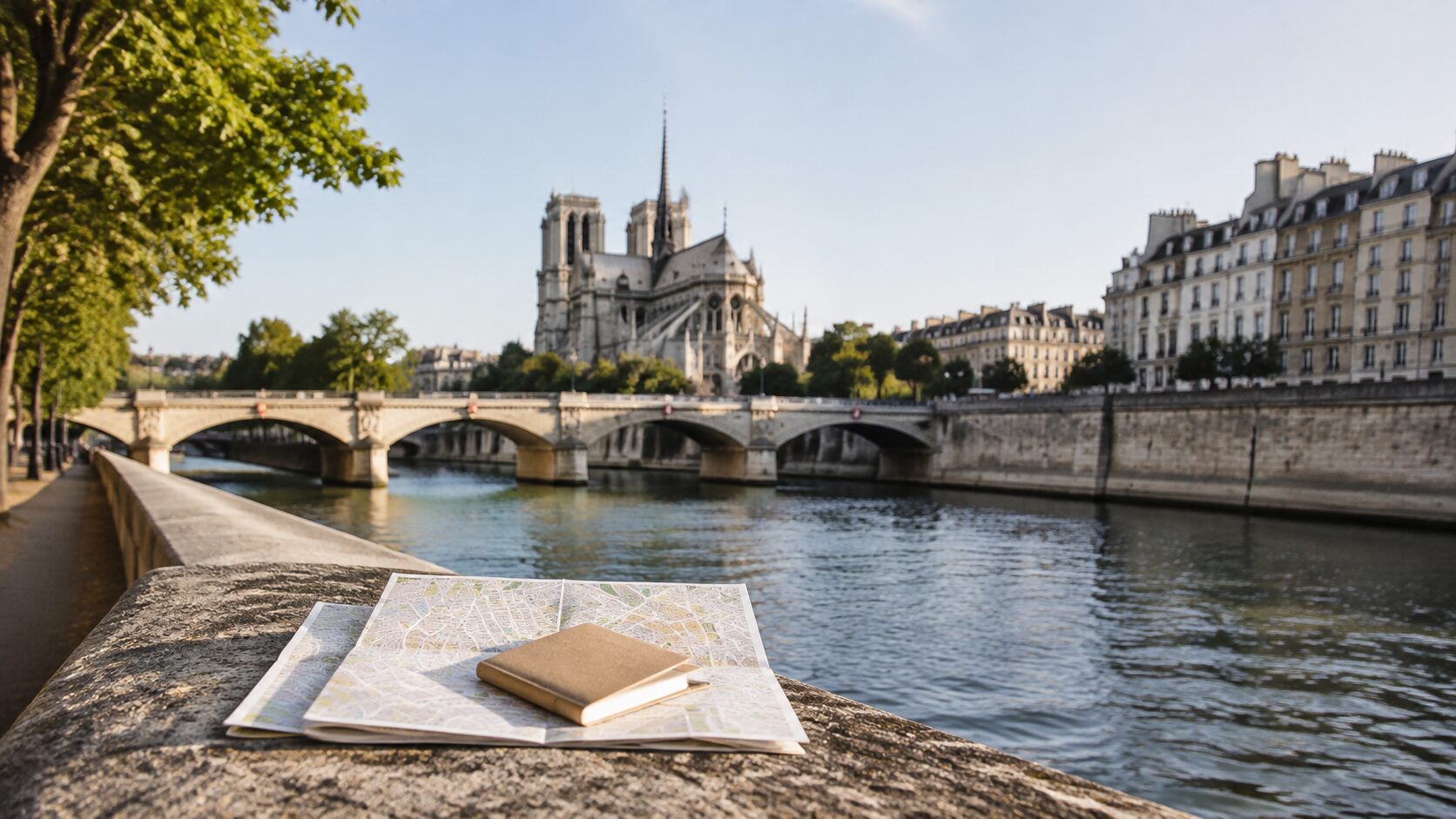
Three days in Paris is enough to see the landmarks that brought you here and still experience the city beyond a checklist. The key is geography: each day below concentrates on one part of Paris, with one major reservation and room for walking.
Before your three days in Paris
Reserve only the experiences you would be genuinely disappointed to miss. Check official opening days—most importantly, the Louvre is normally closed Tuesday—and allow travel time from your airport or station. Wear shoes already proven comfortable. This route works best when you stay near a Metro station; compare bases in our Paris neighborhood guide.
Day 1: Notre-Dame, the Latin Quarter, and the Seine
Morning: begin on Île de la Cité
Start at Notre-Dame before the central streets become busiest. Cathedral entry is free, and an optional free reservation can reduce waiting when slots are available. Use only the official Notre-Dame website; the cathedral specifically warns that outside sellers cannot provide valid paid admission.
Afterward, walk around the island and cross to the Left Bank. If stained glass is a priority, consider a timed visit to Sainte-Chapelle. Otherwise, save your indoor energy and explore the riverbanks.
Afternoon: Latin Quarter to Luxembourg Gardens
Wander south through the Latin Quarter rather than following a rigid street-by-street route. The area rewards detours around the Panthéon, Sorbonne, bookshops, and quieter side streets. Pick up lunch from a bakery or market, then pause in Luxembourg Gardens. This is not filler: sitting in a Paris garden is part of understanding the city.
Evening: Saint-Germain and the river
Return toward Saint-Germain-des-Prés for dinner, then walk beside the Seine after dark. A river cruise can work well tonight because it gives you a visual overview without consuming prime daylight. Choose a departure point that fits your route rather than crossing Paris solely for a particular operator.
Day 2: the Louvre and the Eiffel Tower
Morning: visit one great museum well
Book the earliest practical Louvre time and decide in advance what you want to see. Two or three focused hours are more rewarding than an all-day march through galleries. Confirm hours and tickets on the official Louvre site. If Impressionist and Post-Impressionist art interests you more than the Louvre’s breadth, substitute Musée d’Orsay rather than squeezing both into one day.
Afternoon: Tuileries and the grand axis
Leave the museum through the Tuileries area, have lunch away from the most obvious tourist frontage, and continue west as energy allows. Place de la Concorde, the Champs-Élysées, and Arc de Triomphe form a monumental sequence, but you do not need to walk every meter. Use the Metro for the least interesting stretch if feet are fading.
Evening: Eiffel Tower
Time your visit for late afternoon or evening so you see changing light. Book an ascent only through the official Eiffel Tower site. If summit tickets are unavailable, a second-floor visit still provides excellent views. If you do not want to ascend, enjoy the surrounding gardens and viewpoints at ground level for free.
Day 3: Montmartre and the Marais
Morning: Montmartre before the crowds
Arrive early and approach Sacré-Cœur through the neighborhood rather than treating it as a single photo stop. Explore side streets, viewpoints, and traces of the area’s artistic history. The hill is real; use the funicular if stairs or steep slopes are a concern.
Afternoon: choose your Paris
After lunch, make a deliberate choice. Art lovers can add a smaller museum. Shoppers can explore covered passages or independent stores. Travelers wanting local atmosphere can walk Canal Saint-Martin. Do not use the last afternoon to chase every sight you skipped.
Evening: finish in the Marais
End around the Marais, combining historic streets, Place des Vosges, shops, and dinner. This is an easy area to explore without an agenda. Walk back toward the Seine afterward if you want a final view of central Paris.
How to adapt this itinerary
- With children: shorten museums, add gardens and playground time, and avoid late dinners every night.
- With limited mobility: verify accessibility directly with attractions, reduce Montmartre slopes, and allow more transfer time.
- In bad weather: protect timed bookings but substitute passages, markets, churches, or a smaller museum for long outdoor walks.
- For food lovers: reserve one special meal and use our Paris food guide for the rest.
Frequently asked questions
Can you see Paris in three days?
You can see its essential landmarks and several distinct neighborhoods. You cannot see everything, and trying will make the trip worse.
Is the Paris Museum Pass worthwhile for three days?
It depends on the attractions you will actually enter, their reservation requirements, and your eligibility for reduced or free admission. Add up your planned visits rather than assuming a pass saves money.
Where should a first-time visitor stay?
Central arrondissements minimize travel, but the 5th, 9th, and parts of the 11th can offer useful balances of atmosphere, transit, and price.
For transport, safety, costs, and planning details, continue with our complete Paris travel guide and first-time Paris tips.
Before the three days begin
Treat this itinerary as a geographic framework, not a race. In Paris, reserve only the attractions that would genuinely disappoint you, save confirmations offline, and check current opening days. Move the days to suit weather and reservations rather than forcing a famous sight into the wrong conditions.
On arrival, obtain the payment method or transit setup you intend to use, withdraw or organize a modest cash backup, and locate breakfast, a pharmacy, and the nearest useful station. A quiet first evening near the hotel is an investment in the three full days ahead.
How to pace each day
Start with the most time-sensitive or crowd-sensitive experience, then allow the afternoon to loosen. Include a seated meal or park break and avoid crossing the city for a single photograph. If the morning runs long, remove the least important stop rather than compressing everything that follows.
Use the Metro, RER, buses, trams, and walking; the right ticket depends on the exact zones and journeys rather than the most visible visitor product between major clusters. Within a district, walk deliberately and follow whatever looks interesting. Record the hotel address offline so fatigue or a lost connection does not become a crisis.
Detailed route notes for the essential stops
The Eiffel Tower area
Reserve an ascent only if it matters, then appreciate the structure from several public viewpoints and river approaches. Place this stop in the half-day already devoted to the surrounding area. Verify the entrance and current ticket rules, then identify one nearby cafe, park, or indoor alternative.
A purposeful Louvre visit
Choose a wing, collection, or small list of works instead of attempting to complete the museum. Place this stop in the half-day already devoted to the surrounding area. Verify the entrance and current ticket rules, then identify one nearby cafe, park, or indoor alternative.
The historic islands
Connect Notre-Dame, Île de la Cité, Île Saint-Louis, the quays, and the Latin Quarter on foot. Place this stop in the half-day already devoted to the surrounding area. Verify the entrance and current ticket rules, then identify one nearby cafe, park, or indoor alternative.
The Musée d’Orsay or another focused museum
Select collections by interest and give yourself permission to stop before museum fatigue. Place this stop in the half-day already devoted to the surrounding area. Verify the entrance and current ticket rules, then identify one nearby cafe, park, or indoor alternative.
Montmartre early
Arrive before the busiest period, then leave the main axis for quieter streets and a downhill walk. Place this stop in the half-day already devoted to the surrounding area. Verify the entrance and current ticket rules, then identify one nearby cafe, park, or indoor alternative.
A Seine evening
Walk the quays, use a bridge as a viewpoint, or choose a cruise after comparing route and timing. Place this stop in the half-day already devoted to the surrounding area. Verify the entrance and current ticket rules, then identify one nearby cafe, park, or indoor alternative.
A market morning
Browse as a customer, buy a picnic or snack, and respect the working rhythm of neighborhood vendors. Place this stop in the half-day already devoted to the surrounding area. Verify the entrance and current ticket rules, then identify one nearby cafe, park, or indoor alternative.
Covered passages
Use historic passages as an architectural and shopping walk, especially when the weather turns. Place this stop in the half-day already devoted to the surrounding area. Verify the entrance and current ticket rules, then identify one nearby cafe, park, or indoor alternative.
Breakfast, lunch, and dinner strategy
Use breakfast to begin near the first sight rather than commuting twice. For lunch, select one of the city’s characteristic options—such as a bakery breakfast, a market picnic, or a bistro lunch formula—in the district already being explored. Keep dinner flexible on the most tiring day.
Save two or three restaurants per neighborhood rather than one supposedly perfect choice. Check opening hours and reservation practices. If a line consumes the time needed for an important visit, choose the quieter alternative and return only if the restaurant itself is a priority.
If weather or energy changes the plan
Heavy rain, heat, cold, or jet lag should change the order without destroying the trip. Move outdoor panoramas to the clearest period, use a museum or food hall during the worst conditions, and shorten long exposed walks. Keep the geographic cluster intact even when individual stops move.
At the end of day two, decide whether day three needs simplification. The temptation is to add everything not yet seen; the better choice is often to protect one meaningful experience and an enjoyable final evening.
Departure and onward travel
Do not place a nonrefundable major attraction on departure morning. Confirm checkout, luggage storage, airport or station route, and the realistic time needed to collect bags. Keep the final activity in the hotel neighborhood or on the line toward departure.

Meet Leo: The Heartbeat Behind ‘A Country A Month’
Journeying through the pages of A Country A Month, you might often feel the rhythm of a storyteller’s heartbeat, pulsating through each line, each image, and each adventure shared. That heartbeat belongs to none other than our remarkable website editor, Leo.
With a lens in one hand and a pen in the other, Leo seamlessly marries his passions for photography and writing. His eye captures moments that words can barely describe, yet his eloquence brings those images to life, transcending borders and connecting us all through shared stories. An avid traveler, every country he’s visited has added another chapter to his expansive tale, and through our platform, he generously shares these chapters with us.