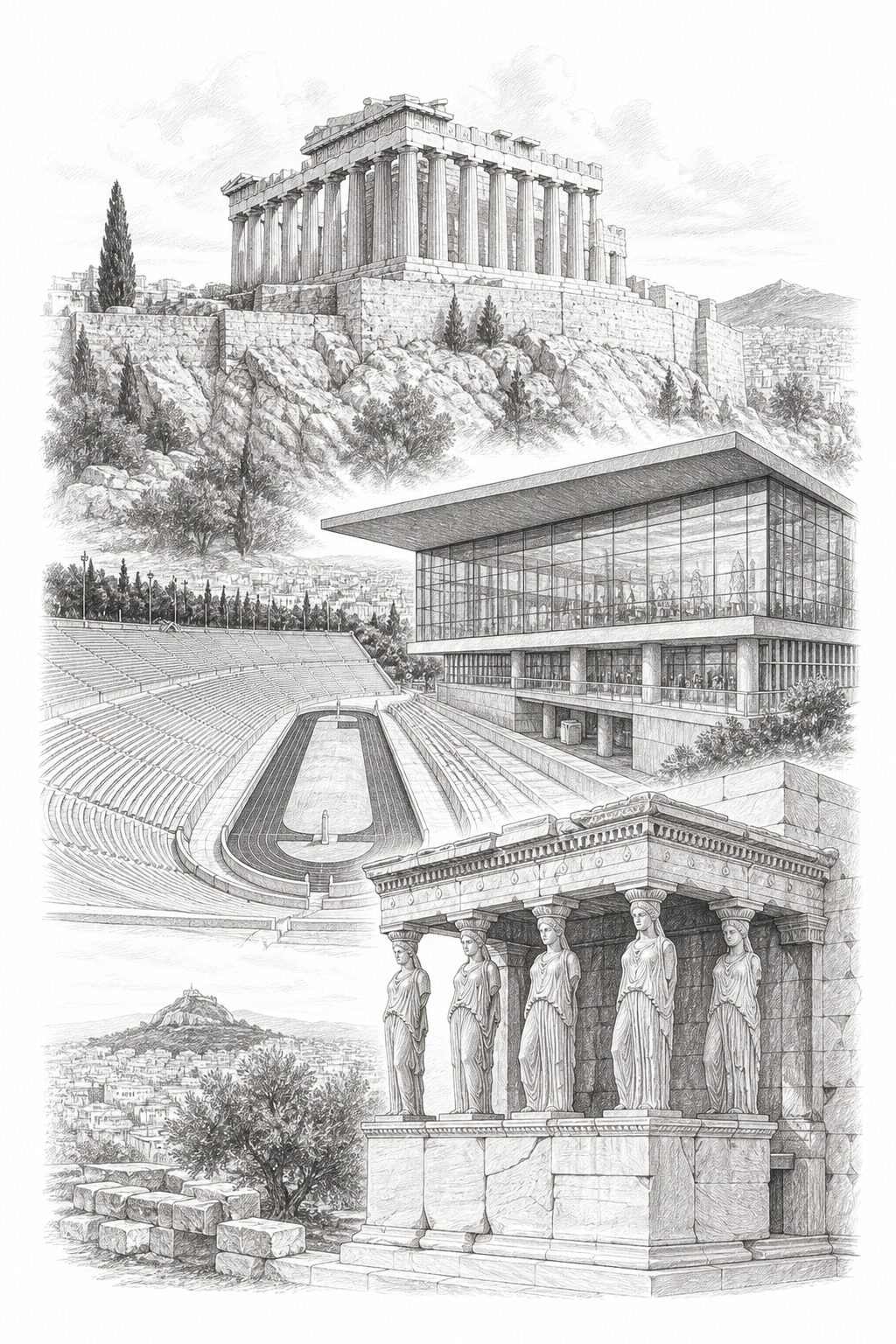
Where you stay in Athens shapes every day of the trip. The right base reduces repeated journeys, makes evenings more enjoyable, and can save money even when the nightly rate is not the absolute lowest. Use this neighborhood-by-neighborhood comparison before booking.
Use this article with the complete Athens travel guide, the three-day itinerary, and the where-to-stay guide.
Here is the sentence that will save your first hour in Athens: the metro is clean, frequent, air-conditioned, and doubles as a small archaeology museum, with excavated finds sitting behind glass at Syntagma and Acropolis stations while the trains that carried you there run on time beneath them. Visitors who arrive braced for the traffic-choked, horn-happy Athens of reputation are usually surprised by how easy the center actually is to move through once you are off the airport highway and onto the rails. This article gets you from the plane to your pillow, then teaches you the fares, the etiquette, and the walking routes that make the rest of the trip effortless.
From the airport to the city
Athens has one main international airport, roughly 33 kilometers (20 miles) southeast of the center, and the metro is the correct default answer for nearly everyone. Prices below are as of this writing; fares tick upward periodically, so confirm the current numbers on the OASA or Athens Transport sites before you fly.
Metro Line 3 runs directly from the airport into the city center, reaching Syntagma in about 40 minutes for a single fare of €9 (€4.50 reduced; a round trip runs €16). No transfers, no guessing, and the train arrives roughly every half hour outside the deepest overnight hours. It is the choice for anyone without a mountain of luggage and anyone who wants their first Athens experience to be effortless rather than adversarial with traffic.
The Express Bus X95 covers the same route to Syntagma for less money, €5.50 (€2.70 reduced), but takes longer, 50 to 60 minutes in light traffic and meaningfully more if you land during rush hour. It is a fine choice if your hotel sits closer to a stop along the route than to a metro station, or if you are simply travelling light on cash. Other express buses fan out to different landing spots: X93 runs to the Kifissos long-distance bus terminal (useful if you are heading straight out of the city, say toward Delphi), X96 runs to Piraeus port (useful if you are catching a same-day ferry), and X97 covers another corridor; all run a flat €5.50 fare and take 45 to 75 minutes depending on traffic. The suburban railway, the Proastiakos, also serves the airport and connects toward the Piraeus and Corinth direction, folded into the same metro and rail fare structure, a useful option if your route runs that way rather than into central Athens proper.
A taxi from the airport runs a flat daytime rate of roughly €38 to €40 into central Athens, taking 30 to 45 minutes off-peak and considerably longer in traffic; the flat rate rises for night trips, roughly midnight to 5am. Confirm the current flat fare before you get in, since airport flat rates are exactly the kind of number that drifts year to year, and insist the driver honors the posted flat-rate system rather than running the meter on an airport trip, which is one of the classic overcharge attempts covered in the complete guide. Unless you are traveling with a group and heavy bags, or your flight lands in the dead of night when the metro has stopped running, the train remains the better bet on time, cost, and stress.
The metro, and how fares actually work
Athens runs three metro lines. Line 1, the historic ISAP line, painted green on the map, connects Piraeus to the northern suburb of Kifissia and is the oldest of the three, opened well before the others and still recognizably vintage in places. Line 2, red, is the main north-south spine through the center, passing Syntagma and Omonia. Line 3, blue, runs east-west and is the one that reaches the airport. A tram, routes T6 and T7, links Syntagma with the Faliro coast and onward to Piraeus, a pleasant, slower alternative when you are in no hurry and want a sea view along the way. An extensive bus and trolleybus network fills in everywhere the rails do not reach.
The fare structure rewards simplicity. A single ticket costs €1.20 and is valid for 90 minutes across metro, bus, tram, and trolley in any combination (though it does not cover the airport routes, which are priced separately as shown above). A 24-hour ticket runs €4.10, useful the moment you plan more than three rides in a day, and a 5-day ticket costs €8.20 for a longer stay. The single best-value option for a short first visit is the 3-day tourist ticket at €20, which bundles one round-trip airport transfer into the price, effectively making your airport metro rides free once you do the math against buying them separately. Contactless bank card “tap to ride” now works directly at the gates on the metro, and on buses and trams, for Visa and Mastercard as of this writing (not yet Amex, Maestro, or JCB), with fares daily-capped at €4.10, a genuinely convenient option if your card qualifies and you would rather not fuss with paper tickets at all. Children under 6 ride free, and reduced fares, roughly half price, apply for ages 6 to 18, students, and seniors 65 and over with valid ID.
As of this writing, trains run from roughly 5:30am to midnight most days, with Lines 2 and 3 extending later on Friday nights into an all-night Saturday service, a useful fact if your evening runs long; confirm current operating hours on the OASA site before counting on a late ride. Peak crowding hits the usual weekday commuter windows, morning and evening; if your itinerary allows it, save the more claustrophobic connections for off-peak hours, which suits the early-and-late sightseeing strategy recommended throughout this book anyway. One safety note worth repeating here because it matters most on transit: pickpocketing risk is highest on crowded Line 2 and Line 3 cars and at the Monastiraki and Syntagma interchanges, so keep bags zipped and worn to the front, not slung casually behind you, in the crush of a rush-hour carriage.
Picture the first ride, because it sets the tone for the whole trip: you tap in at the airport, find a seat as the train rattles past suburban rooftops and pine-covered hillsides, and then, without ceremony, glide into Syntagma station to find yourself standing beside a glassed-in cross-section of the excavation the builders uncovered while digging the platform, ancient water channels and foundations lit from below like a diorama, commuters walking past it without a second glance because for them it is simply the station. That single moment, ordinary infrastructure doubling as a small museum, is as good an introduction to how Athens layers its past under its present as anything in the complete guide. Change trains at Syntagma or Monastiraki for the other lines; both interchanges are well signed, though they are also, as noted above, the two spots to be most deliberate about your bag.
Rush hour, ticket validation, and small courtesies
A ticket must be validated at the machine the moment you enter the system, whether you are boarding a metro platform, a bus, or a tram; inspectors do check periodically, and a stamped ticket is the only proof that counts. On buses and trolleys the same 90-minute single ticket covers your ride, tapped or stamped at boarding. Weekday rush hour, roughly 7:30 to 9:30am and again from about 2:30 to 3:30pm and 7 to 8:30pm, is when the center’s trains and buses run fullest; nothing about riding then is unsafe, but it is considerably less pleasant than the same journey an hour either side of it, one more reason the early-opening, late-afternoon rhythm recommended throughout this book pays off in transit comfort as well as crowd-beating.
Taxis and ride-hail
Athens’ taxis are the familiar yellow cars found across the city, and the golden rule is simple: insist the driver runs the meter. Fares combine a flag-fall charge with a per-kilometer rate, a higher tariff overnight (roughly midnight to 5am), and surcharges for luggage, airport runs, or port pickups; confirm current rates before you travel, since these numbers shift. For visitors uneasy about hailing on the street or negotiating in a language they don’t speak, the ride-hail apps Beat and FREENOW are the more predictable choice: you see the price and the route before you commit, and there is no ambiguity about the fare afterward.
Frequently asked questions
How many days are enough for Athens?
Three well-planned full days cover a strong first visit, while four or five allow slower neighborhoods, additional museums, or a day trip. Count usable sightseeing days rather than hotel nights.
What should be booked first?
Reserve the experience you would be most disappointed to miss, then secure lodging and any limited-entry sights. Verify current rules and opening information on the official operator’s website shortly before travel.
How do you avoid rushing?
Group each day geographically, allow time for security and transport, and treat extra stops as optional. One demanding reservation plus nearby flexible experiences usually produces a better day than a chain of timed entries.
Continue planning Athens
- Complete Athens travel guide
- 3 days in Athens: first-time itinerary
- Where to stay in Athens
- Best things to do in Athens
- Athens food guide
- Athens first-time tips
- Athens on a budget

Meet Leo: The Heartbeat Behind ‘A Country A Month’
Journeying through the pages of A Country A Month, you might often feel the rhythm of a storyteller’s heartbeat, pulsating through each line, each image, and each adventure shared. That heartbeat belongs to none other than our remarkable website editor, Leo.
With a lens in one hand and a pen in the other, Leo seamlessly marries his passions for photography and writing. His eye captures moments that words can barely describe, yet his eloquence brings those images to life, transcending borders and connecting us all through shared stories. An avid traveler, every country he’s visited has added another chapter to his expansive tale, and through our platform, he generously shares these chapters with us.