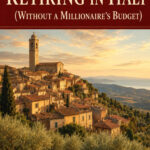
The short answer: The best-value regions for a budget retirement in Italy are Abruzzo (the tax-and-value champion), Puglia’s Salento, small-town Sicily, and coastal Calabria — all with one-bedroom rents from €300–550 and, in qualifying towns under 30,000 residents, a 7% flat tax on foreign income. If healthcare depth and fast rail matter more than cost, the north (Bologna, Florence, or the cheaper Turin and Genoa) wins, at roughly double the rent and no tax break. Match the place to your priorities, not a photo.
In Italy the region you pick decides your tax rate, your winter, your hospital, and how often you’ll hear English at the pharmacy counter. This is a guided tour of the places that actually work on a middle-class budget, with the real rents and the parts the glossy sites leave out. Rents are monthly, for a one-bedroom, from mid-2026 medians; dollars use €1 = $1.14. And remember the tax rule underneath all of it: southern regions offer the 7% flat tax in eligible towns under 30,000 residents; central regions qualify only in the tiny 2016-earthquake “crater” villages; the north doesn’t qualify at all.
This summarizes the regions, off-the-beaten-path, and comparison-toolkit chapters of No-Nonsense Guide to Retiring in Italy — every region profiled, plus a scoring method you can apply to any town.
Abruzzo: the value-and-tax champion
If I had to point a budget retiree at one region sight unseen, it would be Abruzzo. Sulmona, where the book’s Carol landed, is a handsome mountain-valley town of about 21,800 that now sits under the 30,000 cap and qualifies for the 7% tax. One-bedroom rents run about €300–550 ($342–627), it has its own hospital (with Pescara and L’Aquila within reach), and — crucially for a solo American — it has an organized English-speaking retiree pocket, as do nearby Lanciano and Penne. It’s very safe. The honest catch is the climate: Sulmona sits at 420 meters and winters are genuinely cold and snowy, so factor in real gas heating from November through March. Prefer the mild coast? Pescara itself is too big for the tax, but smaller qualifying coastal towns (Roseto degli Abruzzi, Giulianova, Ortona, Città Sant’Angelo) keep both the sea and the break.
Puglia and the Salento: warm, polished, low on English
Puglia is where southern Italy stops feeling like a compromise and starts feeling like a destination. Lecce, the “Florence of the South,” is honey-colored Baroque stone with center rents around €533 ($608) and outside-center around €423 ($482); it’s safe, and its Vito Fazzi hospital is a solid regional workhorse. Lecce itself is too big for the 7% tax, but the game is the ring of newly eligible towns around it: Galatina (about 25,300 people, where Jim and Nancy settled) and Copertino both qualify. Ostuni, the whitewashed hilltop town, is more upscale (€500–750) with the most foreign buyers in Puglia — more English, higher prices. The trade-off across the Salento is language: English proficiency is low, so this is immersion country.
Sicily: the cheapest big-city rents
Sicily gives you something unusual: genuinely cheap big-city rents, plus whole-island eligibility for the 7% tax in the small towns nearby. Catania, under Etna, has some of the lowest urban rents in Italy — around €540 in the center ($616), €338 outside ($385) — and its Cannizzaro hospital runs one of the south’s best emergency rooms. Palermo is bigger and more textured (center rents ~€658), with a real asset in ISMETT, a U.S.-affiliated center where English is spoken; here you must pick your zone deliberately — base yourself in Politeama-Libertà, the Kalsa, or seaside Mondello. The Ragusa and Modica corner is quiet, elegant, and very safe (rents ~€400–550), with nearby Noto, Scicli, and Comiso qualifying for the tax.
Calabria: the cheapest, with real caveats
Calabria is the least expensive and most authentically un-touristy region on this list. Cosenza has one-bedroom rents around €333–450 ($380–513), about as cheap as mainland Italy gets, and a string of coastal towns (Tropea, Pizzo, Paola, Scalea, Diamante) qualify for the tax. But hear the weak point clearly: healthcare. Calabria’s fifteen-year special administration ended in April 2026, yet the region stays under budget-recovery constraints and small mountain hospitals underperform. If you have significant medical needs, Calabria asks more of you than Abruzzo or Puglia does. (Two safety notes, because they get sensationalized: organized crime is an economic parasite a retiree essentially never encounters as a personal-safety matter; the genuinely bigger daily danger is the hazardous SS106 coastal road.)
Le Marche and Umbria: beauty with a tax asterisk
Le Marche is Tuscany’s quieter, cheaper cousin — Ascoli Piceno is its jewel, elegant and walkable, with center rents around €550 ($627) and highly rated healthcare. Umbria, the “green heart,” is very safe with some of the cheapest rents anywhere (Terni around €300, Spoleto €350–500). The asterisk for both: the 7% flat tax is effectively off the table, because the desirable cities are all over 30,000 and only tiny 2016-crater villages qualify. So these are “great life, ordinary tax” choices — closer in spirit to the north than to Puglia — with cold inland winters.
The north: healthcare and rail at a price
If your heart is set on the north, the affordable pair is Turin (center rents ~€746) and Genoa (~€778, with a mild coastal winter that keeps heating cheap) — 30–60% cheaper than Bologna or Florence while still offering strong healthcare. The pricey contrast shows what you pay for skipping the south: Bologna runs about €1,008 in the center ($1,149) and Florence about €1,196 ($1,363), both with best-in-country healthcare (Emilia-Romagna and Tuscany rank at the very top) and superb rail. Richard chose Bologna on purpose, trading the tax break for top hospitals and a station that puts him in Milan or a grandchild’s arrival gate in a couple of hours. None of the north qualifies for the 7% tax — that’s the tax price of a northern address.
The value regions at a glance
| Place | 1-BR rent | 7% tax? | Healthcare | English |
|---|---|---|---|---|
| Sulmona (Abruzzo) | €300–550 | Yes | Good (own hospital) | Small expat pocket |
| Galatina / Lecce (Puglia) | €423–533 | Yes (small towns) | Adequate | Low |
| Catania (Sicily) | €338–540 | Nearby towns | Strong ER | Low |
| Cosenza / coast (Calabria) | €333–450 | Yes (coast) | Weakest | Very low |
| Ascoli / Spoleto (Marche/Umbria) | €300–550 | Rarely | Strong | Some |
| Bologna / Florence (north) | €782–1,196 | No | Best-in-country | Higher |
The lever that stacks two savings at once
The single most powerful cost move is to go one town smaller, and in the south it does double duty. Galatina sits near Lecce but rents cheaper and, at about 25,000 residents, comes in under the 30,000 cap that unlocks the 7% flat tax. Move from Lecce proper out to Galatina and you cut your rent and your tax rate in the same decision. That’s not a coincidence; it’s the core financial logic of a budget retirement in Italy. Encouragingly, you won’t be the first pioneer: the fastest-growing American populations are in exactly these regions — Basilicata up 28% year over year, Sicily 26%, Abruzzo 18%.
The far edge: one-euro houses and tiny villages
Somewhere right now an American is watching a video about a house in Sicily that costs one euro, and the comments are full of people typing “packing my bags.” Here’s the honest version. The one-euro price is symbolic — a lure to get someone to fix up an abandoned building. What you actually sign up for is a forfeitable security deposit of €3,000–10,000, a restoration plan due within about a year, completion in two to three years, and a renovation that realistically runs €20,000–100,000+ (one documented American buyer landed at about €48,500 all-in). And buying a house — one-euro or otherwise — grants zero residency; the property and the visa are entirely separate problems. Beyond the schemes lie thousands of ordinary tiny borghi where you can simply rent for a song, and for the right temperament that deep affordability is a kind of wealth. But test it honestly first: rent on a short-term transitorio lease through a real winter, drive and time the route to the nearest hospital and airport, and be brutally honest about your Italian, because in a depopulating village you’ll conduct your entire life in it or not at all.
How to score your own shortlist
Don’t let a photo choose for you. The book scores every place on seven dimensions — Cost, Healthcare, Safety, English usability, Climate comfort, 7%-tax eligibility, and Expat community — each 1 to 5. You weight the dimensions by your priorities, multiply, and total. Run through Carol’s weights (cost and tax heavy) and Sulmona beats Bologna 101 to 58; run Richard’s (healthcare first) and Bologna wins for him. The number is a servant, not a master: identify any threshold factor — a need so absolute it overrides the math, like Richard’s requirement for a top hospital nearby — and cross off every town that fails it before you trust the totals. For fresh data, pull real listings on Idealista.it, confirm the town’s population against the 30,000 cap on the Agenzia delle Entrate list, and look up the actual anchor hospital.
Want every region profiled in full, the master comparison table across all seven dimensions, and the scoring worksheet? It’s all in No-Nonsense Guide to Retiring in Italy.
FAQ
Where is the cheapest place to retire in Italy?
Calabria (Cosenza and its coast) has the lowest rents on the mainland, €333–450 for a one-bedroom, plus the 7% tax on the coast — but the weakest healthcare of the value regions, so weigh your medical needs honestly.
Which region is best for the 7% flat tax?
Abruzzo is the strongest all-rounder — low rent, the 7% tax in qualifying towns like Sulmona, a real English-speaking community, and its own hospital. Puglia’s Salento and small-town Sicily and Calabria also qualify.
Where should I retire in Italy if healthcare matters most?
The north — Bologna or Florence for best-in-country hospitals, or the cheaper Turin and Genoa. You give up the 7% tax and pay roughly double the rent, but you get the deepest, fastest care.
Keep reading: Cost of living in Italy for retirees · How to retire abroad on a budget · The complete guide to retiring in Italy

Meet Leo: The Heartbeat Behind ‘A Country A Month’
Journeying through the pages of A Country A Month, you might often feel the rhythm of a storyteller’s heartbeat, pulsating through each line, each image, and each adventure shared. That heartbeat belongs to none other than our remarkable website editor, Leo.
With a lens in one hand and a pen in the other, Leo seamlessly marries his passions for photography and writing. His eye captures moments that words can barely describe, yet his eloquence brings those images to life, transcending borders and connecting us all through shared stories. An avid traveler, every country he’s visited has added another chapter to his expansive tale, and through our platform, he generously shares these chapters with us.