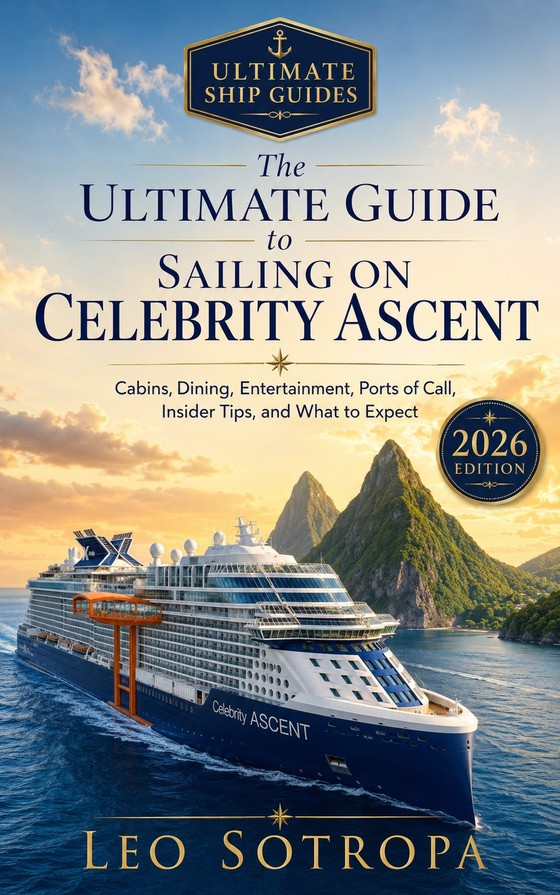
Is The Ultimate Guide to Sailing on Celebrity Ascent the book that will actually help you get the most out of a long Southern Caribbean or Panama Canal voyage? If you have booked a ten-, eleven-, or fourteen-night sailing on Celebrity Ascent and you want to arrive knowing exactly how the ship works, which cabin to book, how to handle a full day in the Gatún locks, and how to see the ABC islands without paying for a tour you did not need, then yes. This is an independent, ship-specific handbook by Leo Sotropa, written for the person who chose Ascent for the destinations and is not in a hurry to rush through them.
It is not a glossy brochure and it is not a generic cruise primer. It is a practical guide to one ship and the long itineraries she actually sails, built so you can read it before you pack and reach for it again on a sea day. Every chapter ends with concrete Action Steps, so the advice turns into decisions rather than good intentions.
What this book is
The Ultimate Guide to Sailing on Celebrity Ascent is part of the Ultimate Ship Guides series by Leo Sotropa. Each title in the series does one thing: it covers a single ship in enough depth that you stop guessing. This one is about Celebrity Ascent, the fourth Edge-Class ship in Celebrity Cruises’ fleet and one of the stretched sisters — about twenty metres longer than the original Edge, at roughly 140,600 gross tons, carrying around 3,260 guests at double occupancy. The book is independent and unofficial. It is not published by the cruise line, which is exactly why it can be honest about what is worth your money and what is not.
You can read it on Kindle or hold the 6×9 illustrated paperback. The format is deliberate: short enough to finish before you sail, structured enough to use as a reference once you are aboard. Because the series is written to stay useful over time rather than chase a single season, the guidance is about how the ship and her ports work — not a menu that changes every few months. The book tells you plainly to confirm the current venues, itineraries, and prices in the Celebrity app before you commit, because those are the details that move.
What makes Ascent worth a dedicated guide is that she is not a seven-night ship pretending to sail long routes. She was built for the long game, and the book is organized around that. Instead of trying to compress a fortnight at sea into a checklist, it slows down to match the pace of the voyages Ascent actually runs.
The hook: long Southern Caribbean and the Panama Canal
Celebrity Ascent sails from Fort Lauderdale — Port Everglades — on ten-, eleven-, and fourteen-night voyages. These are the routes the seven-night ships never reach, and they are the whole reason to choose this ship. The book treats the itinerary itself as the main attraction, not a backdrop to the pool deck.
The canal day
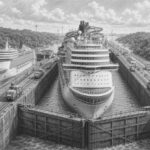
The Panama Canal partial transit is, for most people, the day they booked the cruise for, and the book gives it the attention it deserves. Ascent comes in from the Caribbean side, is lifted roughly 85 feet through the Gatún locks by fresh water and gravity, crosses Gatún Lake, and comes back out — most of a day spent watching a piece of engineering that still feels improbable up close. The guide explains what is happening while it happens, so the lift through the locks reads as more than a slow morning at the rail.
It also solves the practical question of where to stand. You can watch from the Magic Carpet, the cantilevered platform that rides the outside of the hull; from the glass-roofed Solarium; or from your own Infinite Veranda if you booked the right cabin. The book walks through the trade-offs of each vantage point — where the shade is, where the crowds gather, and why the cabin you choose months earlier can quietly decide how you experience the single best day of the trip.
The ABC islands
Aruba, Bonaire, and Curaçao — the ABC islands — are the part of the itinerary the book is most enthusiastic about, and for good reason. They sit outside the hurricane belt, so the sailing season for them is long and settled. They are dry desert rather than rainforest, which surprises first-time visitors expecting jungle. And they are Dutch, which makes them among the easiest islands anywhere for independent travel. The book makes a frank, money-saving case: on the Dutch islands you can do a great deal on your own for almost nothing, and it tells you where that works and where you are genuinely better off spending on an excursion.
Bonaire gets a special mention because it earns one — it has the finest shore diving on earth, fed by a marine park that has been protected for decades. Curaçao and Aruba each get their own treatment, with the emphasis on seeing them independently rather than following a tour bus you did not need. For travelers who like to explore on their own terms, these three islands are the strongest argument for sailing Ascent instead of a shorter, busier route.
The Windwards and the fourteen-night routes
Longer voyages fold in the Windward Islands. St. Lucia is best met from the water, where the Pitons rise straight out of the sea, and the book explains why that matters when you decide how to spend your day there. Barbados brings coral, the open Atlantic, and the island that invented rum — history you can taste. The fourteen-night sailings add Antigua, St. Kitts, or Grenada, and are usually paired with Cartagena, Colombia, a walled colonial city that rewards a slow afternoon on foot.
The rhythm of these long routes is distinctive, and the book names it clearly: sea days out, a cluster of demanding ports in the middle, and sea days home. Understanding that shape ahead of time changes how you plan your energy, when you book the busiest excursions, and how you use the quiet days on either end. That is the kind of framing a generic cruise book cannot give you, because it does not know which ship or which route you are on.
What’s inside
The signature spaces, and how to use them on a canal day
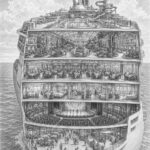
Ascent’s design is unusual, so the book starts by touring the spaces that make an Edge-Class ship feel different — and, importantly, tells you how to use them rather than just admiring them. The Magic Carpet, the platform that moves up and down the outside of the hull, changes character depending on which deck it is parked at; the book explains what it becomes at each level. Eden spreads three decks of glass and greenery across the stern and works differently by day and after dark. The Infinite Veranda, where the whole cabin wall opens to the sea, is a feature you either book on purpose or miss entirely.
Because Ascent is a stretched ship, she carries additions her shorter siblings do not: a two-level Retreat sundeck, an enlarged Rooftop Garden, the tiered Sunset Bar at the stern, and Le Voyage by Daniel Boulud — the chef’s first signature restaurant at sea. The guide covers each of these, with a running focus on how they play on the big set-piece day in the canal, when everyone wants the best view at once.
The cabin guide
Choosing a cabin is the decision you make earliest and change least, so the book gives it a full chapter. It covers the categories aboard Ascent, which locations reward the money and which quietly disappoint, and how the Infinite Veranda actually feels to live in for two weeks. It takes on the question a lot of guests wrestle with directly: whether the enlarged Retreat — Celebrity’s ship-within-a-ship, with its two-level sundeck and suite-only Luminae dining — is worth the premium on a fourteen-night voyage, or whether the money is better spent elsewhere. The answer is honest rather than promotional, which is the point of an independent guide.
The dining guide
Ascent gives you a lot of choice, and the book maps it so you are not deciding on an empty stomach. There are four included main dining rooms — Cosmopolitan, Cyprus, Normandie, and Tuscan — each with its own character, plus the Oceanview Café and Eden Café, all complimentary. On the specialty side, at an extra charge, there is Le Voyage by Daniel Boulud, Fine Cut Steakhouse, Raw on 5, the Eden Restaurant, and Rooftop Garden Grill. Suite guests dine at Luminae. The guide explains what each room does best and where a specialty booking genuinely earns its cost on a long sailing, so you spend on the meals that matter to you and skip the ones that do not.
It also sets expectations around Always Included, Celebrity’s bundle that folds drinks, Wi-Fi, and gratuities into the fare. Knowing what is already covered changes how you budget the extras, and the book keeps that math in front of you.
Eight in-depth destination chapters
The heart of the book is eight destination chapters, one each for Fort Lauderdale, Aruba, Curaçao, Bonaire, Cartagena, the Panama Canal, St. Lucia, and Barbados. These are not thumbnail summaries. They go deep enough to help you decide, port by port, whether to book something through the ship, arrange your own day, or simply walk off and explore — with particular attention to doing the Dutch islands independently for almost nothing, and where your money is actually well spent instead.
The honest case for sea days
One of the most useful sections is the one that argues, plainly, for sea days — and explains why long itineraries suit Ascent better than short ones. A ship this size, built for a fortnight, is meant to be enjoyed at anchor as much as in port. The book makes the case that the days between islands are not filler; they are when the ship’s design pays off. If you have only ever sailed seven-night routes, this reframes how you think about a long voyage.
Money, value, and embarkation
Throughout, the advice on value is specific and relative rather than a list of prices that would be out of date before you sailed. It shows where to save — often by going independent on the Dutch islands — and where spending genuinely improves the trip. It carries you through the practical start of the cruise as well, so embarkation at Port Everglades feels like a plan rather than a scramble. And, as with every title in the series, each chapter closes with Action Steps: short, concrete things to do next, so reading turns into a booked cabin, a dinner reservation, and a plan for the canal.
Who it’s for
This book is written first for experienced cruisers who came for the destinations and are not in a hurry — the couples and independent travelers who chose a long Southern Caribbean or Panama Canal route on purpose. If that is you, the guide meets you where you are and helps you go deeper on the ports and the canal day.
It also works for people newer to this kind of sailing:
- First-timers on Celebrity, who want to understand modern luxury, the Magic Carpet, the Infinite Veranda, and what Always Included really covers before they board.
- Independent travelers who would rather explore the ABC islands on their own than follow a group, and want to know where that is easy and where it is not.
- Seasoned cruisers who know ships well but have not sailed an Edge-Class stretched sister, or have not done a Panama Canal partial transit before.
- Anyone booking a fourteen-night voyage who is trying to decide whether the Retreat is worth it.
It also makes a genuinely useful gift. If someone you know has an Ascent sailing coming up, a focused guide to their exact ship and route is more thoughtful — and more used — than another generic travel book.
Why a ship-specific guide beats a generic cruise primer
A general cruise book has to hedge. It cannot tell you which deck the Magic Carpet is best parked at, because it does not know your ship. It cannot tell you whether the enlarged Retreat is worth it on a fourteen-night route, because it does not know you are sailing one. It cannot walk you through the Gatún locks or through a self-guided day on Bonaire, because those belong to a specific itinerary. Everything that actually reduces uncertainty is ship- and route-specific, and that is precisely what this book is built to deliver.
The practical payoff is less pre-cruise stress. Most of the anxiety before a big trip comes from small unanswered questions stacking up: which cabin, which dining room, whether to book the tour or go on your own, where to watch the canal, how embarkation works. When those are answered in advance for your ship, the trip feels handled before it starts. You spend the money you meant to spend, skip what you would have regretted, and arrive knowing how the days will flow.
Because the guide stays practical and does not chase a single season, it works alongside the Celebrity app rather than against it. The book gives you judgment — what is worth doing and why — while the app gives you the current details. The two together are stronger than either alone, and the book says so plainly.
About the author and the series
Leo Sotropa writes the Ultimate Ship Guides series, a set of independent, ship-specific handbooks for people who would rather understand their cruise than be surprised by it. Each guide takes a single ship and covers it in depth — the layout and signature spaces, the cabins to book and the ones to avoid, the dining, the ports, the money advice, and the practical steps that turn all of it into a plan. The writing aims to be honest and specific rather than promotional, which is what an independent guide can afford to be.
The series lives at acountryamonth.com, where the focus is on real, usable travel advice. The Ultimate Guide to Sailing on Celebrity Ascent applies that approach to one of Celebrity’s stretched Edge-Class ships and the long voyages that make her worth sailing.
Get The Ultimate Guide to Sailing on Celebrity Ascent
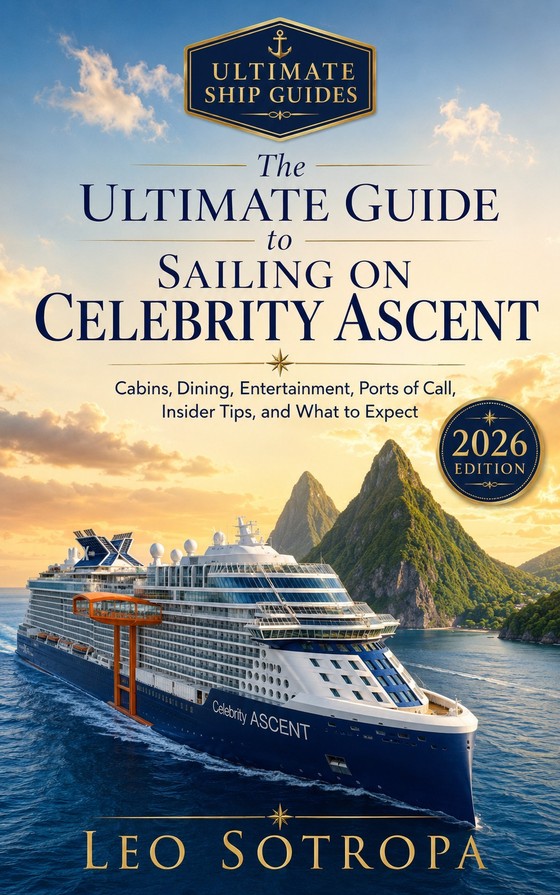
The Ultimate Guide to Sailing on Celebrity Ascent by Leo Sotropa, part of the Ultimate Ship Guides series, is an independent handbook to the ship and her long Southern Caribbean and Panama Canal voyages — available on Kindle and paperback, with clear Action Steps in every chapter.
Frequently asked questions
Is this an official Celebrity Cruises book?
No. It is an independent, unofficial guide written by Leo Sotropa for the Ultimate Ship Guides series. It is not published by or affiliated with Celebrity Cruises, and that independence is the point — it can be honest about which cabins, meals, and excursions are worth your money and which are not.
Should I get the Kindle or the paperback?
Either works — it comes down to how you like to read. The Kindle version is easy to search and carry on your phone or tablet while you are aboard, which is handy on a canal day or in port. The 6×9 illustrated paperback is nice to flip through while planning and to keep as a reference. Some readers use the ebook to plan and the paperback as a keepsake.
Is the book up to date?
It is written to stay useful rather than to match a single season, so it focuses on how the ship and her ports work instead of details that change often. For current venues, itineraries, and prices, the book tells you to confirm in the Celebrity app before you sail. Use the book for judgment and the app for the live specifics.
Does it cover Ascent’s specific ports and the Panama Canal?
Yes. There are eight in-depth destination chapters — Fort Lauderdale, Aruba, Curaçao, Bonaire, Cartagena, the Panama Canal, St. Lucia, and Barbados — plus dedicated coverage of the canal partial transit through the Gatún locks and where to watch it from. Doing the Dutch ABC islands independently is a recurring theme.
Is it good for first-time Celebrity cruisers?
Yes, though its natural home is with travelers who came for the destinations. First-timers get plain explanations of modern luxury, the Magic Carpet, the Infinite Veranda, Eden, and what Always Included covers, so nothing about the ship feels unfamiliar when you board. The Action Steps at the end of each chapter make it easy to act on the advice.
Would it make a good gift?
It does. For anyone with a Celebrity Ascent sailing booked, a guide to their exact ship and route is more personal and more useful than a general travel book. The paperback in particular makes a thoughtful present ahead of a long Southern Caribbean or Panama Canal cruise.
Does it replace the Celebrity app?
No, and it is not meant to. The app handles the live details — daily schedules, current menus, reservations, and pricing. The book handles the judgment — which cabin to book, where to spend and where to save, how to plan the canal day, and how to see the ports well. They are strongest used together.

Meet Leo: The Heartbeat Behind ‘A Country A Month’
Journeying through the pages of A Country A Month, you might often feel the rhythm of a storyteller’s heartbeat, pulsating through each line, each image, and each adventure shared. That heartbeat belongs to none other than our remarkable website editor, Leo.
With a lens in one hand and a pen in the other, Leo seamlessly marries his passions for photography and writing. His eye captures moments that words can barely describe, yet his eloquence brings those images to life, transcending borders and connecting us all through shared stories. An avid traveler, every country he’s visited has added another chapter to his expansive tale, and through our platform, he generously shares these chapters with us.