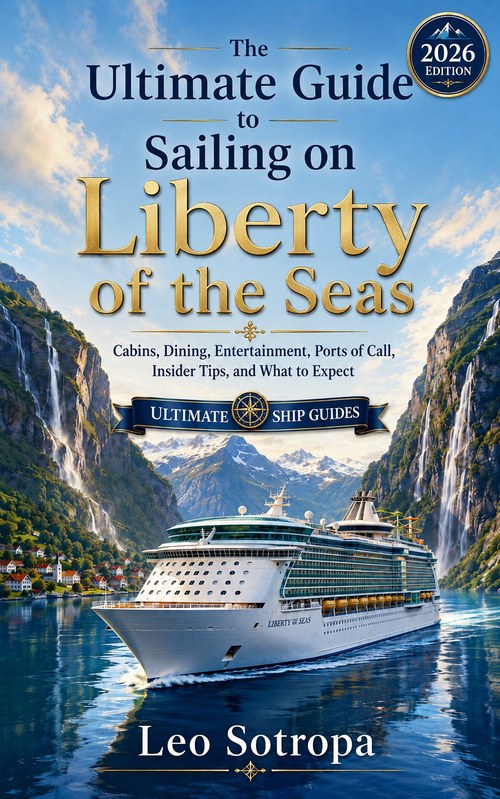
Is The Ultimate Guide to Sailing on Liberty of the Seas the right book for your cruise, and will it actually make your trip easier? If you have a sailing booked on Royal Caribbean’s Liberty of the Seas and you want to walk aboard already knowing where to go, what to reserve, and which mistakes to skip, then yes — this Liberty of the Seas book is written for exactly that. It is an independent, ship-specific handbook by Leo Sotropa, part of the Ultimate Ship Guides series, and it treats Liberty as its own subject rather than folding her into a one-size-fits-all cruise primer.
This page explains what the book is, what is inside it, who it helps, and why a guide built around a single ship saves you time and stress. If you would rather read a little before you buy, the free companion articles for Liberty of the Seas on this site are linked throughout, so you can sample the same approach at no cost.
What this Liberty of the Seas book actually is
This is an independent, unofficial handbook to one ship: Liberty of the Seas. It is not published by Royal Caribbean and it is not a general “how to cruise” title that mentions a dozen vessels in passing. Every chapter is about this ship — her decks, her cabins, her dining rooms, her thrills, and the ports she visits. That focus is the whole point. Liberty is Royal Caribbean’s freshly amplified Freedom-Class ship, a direct sister to Freedom of the Seas and Independence of the Seas, and she carries the classic features the line made famous, brought up to date by a recent Royal Amplified refit. A book that tries to cover the entire fleet cannot tell you which specific stateroom sits under the pool deck or which slide is worth the wait. This one can, because it only has one ship to describe.
The book comes in two formats: a Kindle ebook you can carry on your phone, and a 6×9 paperback you can pack or leave on the coffee table. It is illustrated with graphite chapter illustrations, and — the detail that makes it genuinely useful — every chapter closes with a short set of “Action Steps.” Those are not filler. They turn each chapter’s advice into a few concrete things to do before or during your sailing, so reading the book leaves you with a plan rather than a vague sense of having learned something.
Because cruise details change, the book is honest about its own limits. It tells you to confirm current venues, itineraries, and prices in the Royal Caribbean app, which is where the live information lives. The book gives you the judgment and the shortlist; the app gives you today’s schedule. Used together, they cover almost everything you need. If you want a broader orientation first, the free Liberty of the Seas cruise guide on this site introduces the same ship in the same practical spirit.
What’s inside the book
The book follows the structure of the Ultimate Ship Guides series, which means it moves through the whole cruise in a logical order: the ship first, then where you sleep, then where you eat, then what you do, then where you go ashore, then how you spend money wisely. Here is what each part gives you.
The ship, deck by deck
The opening chapters tour Liberty’s layout and decks so you can find your way without burning vacation time getting lost. She is a big ship — around 155,000-plus gross tons, roughly fifteen guest decks, and about 4,375 guests at double occupancy, up to nearly 4,960 when she is full — so knowing the geography matters more than most first-timers expect. The book walks you through the four-deck Royal Promenade, the ship’s indoor social boulevard of shops, bars and cafés, and it explains how the pool decks, the Solarium, the theater, Studio B ice rink, and the sports areas fit together. The goal is simple: after the first evening you should already know where things are, instead of spending day two still hunting for the buffet.
The cabin guide: which to book, which to avoid
This is the chapter many readers open first, and it may be the one that pays for the book on its own. It runs through the full range of staterooms — Interior rooms, including the Promenade-view Interiors that overlook the Royal Promenade, Ocean View cabins, Balconies, and suites up to the top categories — and it tells you which ones are smart value and which ones to avoid. For a fjords sailing, it explains why a Balcony earns its keep here more than it would on a warm-weather cruise: the scenery is the point, and having it from your own room changes the trip. It also points you toward the best all-round choice, a midship Balcony on the mid-decks, for light, space, and the steadiest ride when the ship is on open water like the North Sea.
Just as valuable is the list of cabins to avoid, always with the advice to confirm on the current deck plan: rooms directly under the pool deck or the Windjammer that catch early-morning noise, rooms over the Promenade venues or near the nightlife, forward high-deck cabins for anyone prone to motion, and lower-deck balconies with lifeboat-obstructed views. Knowing this before you book is the difference between a room you love and a room you tolerate. If cabins are your main question, the free best cabins on Liberty of the Seas guide covers the highlights.
The dining guide
Liberty has a long list of places to eat, and the book sorts them into what is included in your fare and what costs extra, so you can plan without surprises. On the included side you have the Main Dining Room, the Windjammer Marketplace buffet, Sorrento’s pizza, Café Promenade, and more. On the specialty side, the book weighs which splurges are worth it — Chops Grille, Giovanni’s Italian or its current equivalent, and the newer additions the Royal Amplified refit brought aboard, including Izumi Teppanyaki for Japanese hibachi and sushi, El Loco Fresh for tacos and Mexican, and a new-to-ship Starbucks. Playmakers sports bar and the Schooner Bar round out the social spots. Crucially, it tells you what to reserve before you board, because the best tables and times go early and the app makes booking simple once you know what you actually want.
Entertainment and the signature thrills
Liberty is built for people who want to do things, and the book maps the entertainment with an eye on timing so you spend less of your day standing in line. The headline attraction from the refit is The Perfect Storm waterslides, including Tidal Wave, the first-ever boomerang slide at sea — a steep drop that propels riders up a near-vertical wall — alongside a reimagined pool deck. The Freedom-Class signatures are all here too: the FlowRider surf-and-bodyboard simulator that the class first brought to sea, the rock-climbing wall, mini-golf, the sports court, and Studio B, a real ice-skating rink with ice shows and open skating, plus a full theater for production shows. The Observatorium adds a Royal Escape Room adventure, and the pool scene gained The Lime and Coconut, a Caribbean-themed pool bar with new poolside casitas. The book’s insider timing advice — when to hit the slides, when the lines thin out — is the kind of thing you only learn by sailing, unless someone writes it down for you.
Ports of call
This is where a ship-specific book really separates itself, because Liberty’s itineraries are unusual. Her headline season is Northern Europe, based in Southampton, England, sailing to the Norwegian Fjords, and she repositions to Galveston, Texas for Western Caribbean sailings in another season. The ports chapter gives you destination guides, top excursions, and must-do shortlists for the calls she actually makes. On the fjords side that means Stavanger, with the old town, Pulpit Rock and the Lysefjord; Haugesund, in the Viking heartland near the Åkrafjord and the Langfoss waterfall; Olden, gateway to the Briksdal and Nordfjord glaciers and turquoise glacial lakes; and Skjolden on the Sognefjord, Norway’s deepest and longest fjord, near the Jotunheimen mountains. The scenic cruising itself — waterfalls, cliffs and villages gliding past — is a centerpiece, and the book tells you where to watch from. On the Northern Europe side, itineraries call at Bruges via Zeebrugge in Belgium, with the medieval old town, canals, and Belgian chocolate and beer, and Copenhagen in Denmark, with Nyhavn, the Little Mermaid, and Tivoli Gardens. Southampton itself rewards arriving a day early, with maritime and Titanic heritage and day trips to London, Winchester, Stonehenge, and the New Forest.
Because tours sell out early, the book advises confirming and booking ahead, and it flags the practical catch that ports like Zeebrugge are a transfer from the city you actually came to see. For the full port picture, the free Liberty of the Seas Norwegian Fjords and Liberty of the Seas Northern Europe ports guides go deeper on the destinations.
Honest money advice
The money chapter is refreshingly plain about what is already included in your fare, when add-on packages pay off, and how to avoid the small upcharges that quietly add up. It explains how the SeaPass card works as your cashless onboard account, that daily gratuities are added, and that Wi-Fi is a paid plan. It also handles the specific challenge of a Northern Europe sailing: multiple currencies across the itinerary — British pounds in Southampton, euros in Belgium, Danish kroner in Copenhagen, and Norwegian kroner in Norway — in a region where Scandinavia is largely cashless, so a contactless card usually covers you. And it does not sugar-coat the fact that Norway and Scandinavia are among the most expensive destinations in the world, so you can budget for food, drinks, and excursions before the shock lands at the till. All prices in the book are kept relative rather than pinned to a number, which is the honest way to write about a moving target.
Family, adults-only, and embarkation day
The book covers the whole party. For families there is Adventure Ocean kids’ programming and the practical rhythm of keeping children happy on a big ship. For adults who want quiet, there is the grown-ups-only Solarium and the Vitality Spa. And there is a dedicated embarkation-day strategy, because the first few hours set the tone for the week — knowing what to carry, what to do first, and what can wait keeps day one calm instead of chaotic. A closing chapter gathers pro tips, common pitfalls, and FAQs, and, as everywhere in the book, each chapter ends with Action Steps that turn the reading into a checklist. The free Royal Caribbean Liberty of the Seas tips article shares a handful of these in the same voice.
Packing and practicalities for a northern sailing
One more thing a Caribbean-focused guide would get wrong: this is not a beach-cruise packing list. Liberty’s fjord season is a cool northern-European summer with very long daylight hours, changeable and often wet weather, and mild temperatures. The book steers you toward layered clothing and a waterproof shell, and reminds you to bring binoculars and a camera for scenery that genuinely deserves them. Passports are required across ports spanning the UK, the Schengen Area, and Norway, and the book tells you to check current entry rules for your nationality. These are small details, but getting them right is the difference between comfortable days on deck and a soggy afternoon spent shivering.
Who the book is for
First-timers get the most obvious benefit. A first cruise on a ship this size can feel overwhelming, and the book removes the guesswork by answering the questions you do not yet know to ask — how dining works, which cabin to pick, what embarkation day looks like, and how not to overpay. You board already oriented.
Families get a plan that keeps everyone happy, from the kids who want the FlowRider and the slides to the adults who want an afternoon in the Solarium. Seasoned cruisers get the ship-specific edge — the particular quirks of Liberty and the specifics of a Southampton-based fjords itinerary, which are quite different from a familiar Caribbean sailing out of a US port, right down to the stronger British and European guest base that gives these voyages their own feel.
It also makes a genuinely thoughtful gift. If someone you know has a Liberty of the Seas sailing booked, the paperback is an easy, personal present that shows you paid attention, and it will get used. Slipping it into a card or a bon-voyage package is a nice touch that beats another generic travel gadget.
Why a ship-specific guide beats a generic cruise book
A general cruise book teaches you the concept of cruising. A ship-specific book teaches you your actual trip. Those are different jobs. When you are standing on deck five trying to decide whether to book Chops Grille or save the money, or looking at a deck plan wondering if that aft cabin will be loud, a generic primer has nothing to say. This book was written to answer precisely those questions for Liberty of the Seas.
The real payoff is less stress before you sail. Most pre-cruise anxiety comes from not knowing what to expect, and the book replaces that uncertainty with specifics — a shortlist of what to reserve, a clear sense of the ship’s geography, a cabin decision you can trust, and a budget that will not blindside you. The Action Steps mean you are not just reading; you are quietly ticking off preparation, so by the time you reach the terminal the planning is done and you can simply enjoy the ship. It does not promise to remove every decision or to be exhaustive about a ship that changes with each refit — it points you to the app for live details — but as a way to arrive prepared and confident, that focus is hard to beat.
About the author and the series
The book is written by Leo Sotropa as part of the Ultimate Ship Guides series, a growing collection of independent, ship-by-ship handbooks that all share the same practical structure: tour the ship, choose the right cabin, eat well, do the best things at the right times, get the most from each port, and spend wisely — with Action Steps closing every chapter. The series has a companion website, acountryamonth.com, where free articles for each ship live alongside the books. Those free guides, several of which are linked throughout this page, let you sample the approach and read a bit before deciding whether the full handbook is worth it for your sailing. If you like how the free Liberty articles read, the book gives you the whole thing in one organized place, structured to follow your trip from booking to disembarkation.
Get The Ultimate Guide to Sailing on Liberty of the Seas
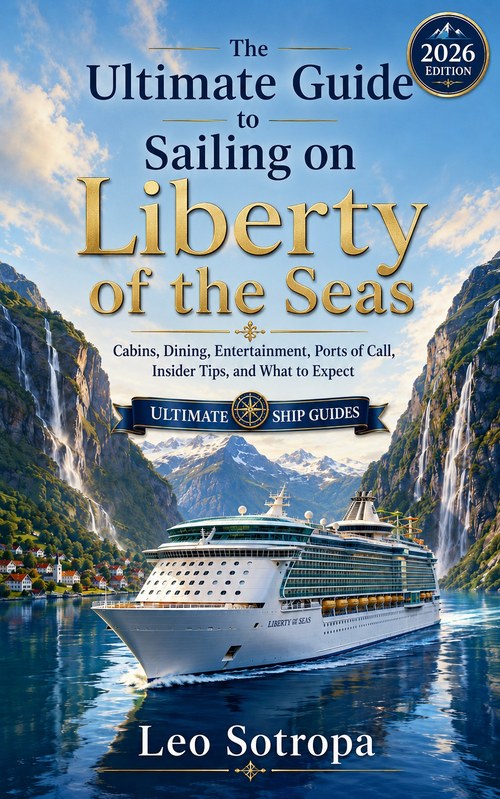
The Ultimate Guide to Sailing on Liberty of the Seas by Leo Sotropa, part of the Ultimate Ship Guides series, is an independent, ship-specific handbook available on Kindle and paperback, with clear Action Steps in every chapter so you board already knowing where to go, what to reserve, and how to make the most of your Liberty sailing.
Frequently asked questions
Is this an official Royal Caribbean book?
No. It is an independent, unofficial handbook written by Leo Sotropa. That independence is a feature: it means the book can give honest, direct advice about which cabins to avoid, which specialty restaurants are worth the extra cost, and where the value really is, without any obligation to promote a product. It is written for you, the traveler, not for the cruise line.
Should I get the Kindle or the paperback?
Both cover the same content, so it comes down to how you like to use it. The Kindle ebook lives on your phone, which is handy for looking things up on board and for reading on the plane. The 6×9 paperback is easy to flag, annotate, and pack, and it makes a nicer gift. Plenty of readers keep the paperback for planning at home and the ebook for quick reference during the sailing.
Is the book up to date?
The latest edition reflects Liberty of the Seas as she is now, including the venues and thrills added by her recent Royal Amplified refit. Because itineraries, restaurant lineups, and prices do change, the book deliberately keeps prices relative and tells you to confirm the current details — venues, schedules, and costs — in the Royal Caribbean app, which always shows today’s information. The book gives you the strategy; the app gives you the live specifics.
Does it cover Liberty’s specific ports?
Yes. The ports chapter is built around the sailings Liberty actually makes, with a strong emphasis on her Northern Europe and Norwegian Fjords season out of Southampton — Stavanger, Haugesund, Olden, and Skjolden, plus Bruges via Zeebrugge and Copenhagen — as well as the Western Caribbean itineraries she runs when she repositions to Galveston. You get destination guides, top excursions, and must-do shortlists for those calls, not generic port advice that could apply to any ship anywhere.
Is it good for first-time cruisers?
Especially so. A ship carrying more than four thousand guests can feel like a lot on your first sailing, and the book is designed to remove that overwhelm. It explains how dining, the SeaPass card, gratuities, Wi-Fi, and embarkation day all work, walks you through choosing a cabin, and ends each chapter with Action Steps so you arrive with a clear plan instead of a pile of questions.
Would it make a good gift?
Yes, it is one of the easier thoughtful gifts to give someone with a Liberty of the Seas cruise booked. The paperback is affordable, personal, and genuinely useful, and it signals that you paid attention to their trip. It works well tucked into a bon-voyage card or a small going-away package for first-timers and experienced cruisers alike.
Does the book replace the Royal Caribbean app?
No, and it does not try to. The app is where you find today’s live details — current schedules, menus, and prices — and the book tells you to rely on it for exactly that. What the book adds is judgment and preparation: which cabin to book, what to reserve before you board, how to time the thrills, how to budget for expensive northern ports, and what to do first on embarkation day. Use the two together and you have both the plan and the live information.

Meet Leo: The Heartbeat Behind ‘A Country A Month’
Journeying through the pages of A Country A Month, you might often feel the rhythm of a storyteller’s heartbeat, pulsating through each line, each image, and each adventure shared. That heartbeat belongs to none other than our remarkable website editor, Leo.
With a lens in one hand and a pen in the other, Leo seamlessly marries his passions for photography and writing. His eye captures moments that words can barely describe, yet his eloquence brings those images to life, transcending borders and connecting us all through shared stories. An avid traveler, every country he’s visited has added another chapter to his expansive tale, and through our platform, he generously shares these chapters with us.