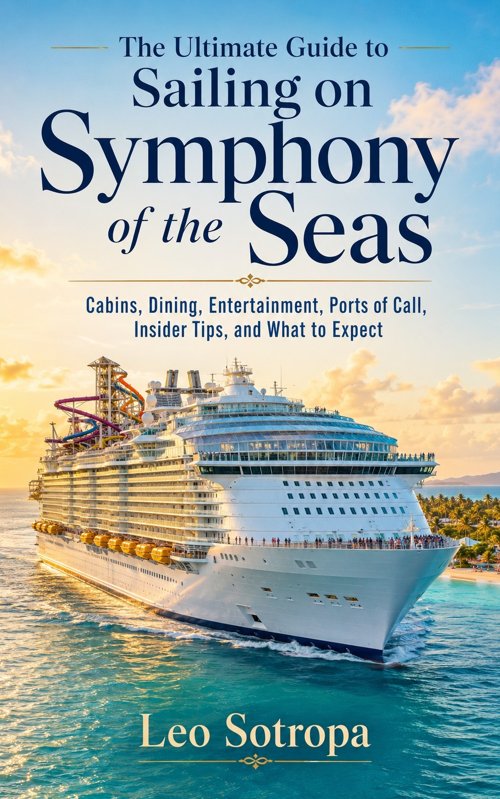
Is The Ultimate Guide to Sailing on Symphony of the Seas the right book for your cruise? If you have a sailing booked on Symphony of the Seas, Royal Caribbean’s giant family-focused Oasis-class ship, and you want one clear, practical handbook that tells you exactly which cabin to book, which restaurants to reserve, and how to plan a day at each port, then yes. This is a Symphony of the Seas book written for real trips, not a glossy brochure. Leo Sotropa wrote it as part of the Ultimate Ship Guides series, and it does one job well: it gets you ready for this specific ship so you spend your vacation enjoying it instead of figuring it out.
Below is a plain description of what the book is, what is inside it, who it helps, and why a guide built around a single ship beats a generic cruise primer. If you would rather read before you buy, the free companion articles on this site cover much of the same ground, and they are linked throughout.
What this book actually is
This is an independent, unofficial handbook to one ship: Symphony of the Seas. It is not published by Royal Caribbean, and it is not a general “how to cruise” book that mentions a dozen ships in passing. Every page is about the vessel you are actually boarding. Symphony is an Oasis-class ship of roughly 228,081 gross tons, with about eighteen guest decks and room for more than 5,500 guests, rising to around 6,700 when she sails completely full. She was once the largest cruise ship in the world, and she is still marketed as Royal Caribbean’s ultimate family Oasis ship. A vessel that size is wonderful and genuinely confusing on day one, and that is the problem this book solves.
The book is available as a Kindle ebook and as a 6×9 paperback, so you can carry it on your phone or keep a printed copy in your carry-on. It is illustrated with graphite chapter illustrations, and, more usefully, every chapter ends with a short set of clear Action Steps. Those Action Steps are the difference between reading about a ship and actually preparing for it. You finish a chapter, you do three or four concrete things, and you move on. For a broader overview of the vessel itself, the free Symphony of the Seas cruise guide on this site pairs naturally with the book.
One thing the book is honest about from the start: a ship this large changes. Venues get refreshed, itineraries shift, and prices move. So the guide teaches you how the ship works and how to think about your choices, then tells you to confirm the current specifics, such as venues, hours, and pricing, in the Royal Caribbean app. That combination, durable strategy in the book plus live details in the app, is how you avoid both outdated advice and information overload.
What is inside the book
The guide follows the shape of a real trip, from the moment you start planning to the last port day. Here is what each part covers.
The ship’s layout and neighborhoods
Symphony is organized into seven neighborhoods, and understanding them is the fastest way to stop feeling lost. The book walks you through Central Park, an open-air garden with more than 20,000 live plants and the quieter sit-down restaurants; the Boardwalk, the family zone at the stern with a handcrafted carousel and the open-air AquaTheater; the Royal Promenade, the indoor main street where shops, bars, and casual food cluster; the Pool and Sports Zone; the Vitality Spa and Fitness area; Entertainment Place; and the Youth Zone. Once you can picture where these sit relative to your cabin, you stop wasting vacation time crossing the ship the long way. The guide explains how the decks stack up and how to move between neighborhoods efficiently, and the free article on what to expect on Symphony of the Seas gives you a taste of that layout before you open the book.
The cabin guide: which to book and which to avoid
This is the chapter most readers open first, because the cabin decision is the one you cannot change once you sail. The book covers every category on Symphony: interior rooms, including the ones with a Virtual Balcony; ocean view; ocean view balcony; the inward-facing Central Park-view and Boardwalk-view balconies unique to Oasis-class ships; and suites all the way up to the Royal Loft and the Ultimate Family Suite.
More importantly, it tells you how to choose. An interior, or a Virtual Balcony interior, is the best value if you are trying to keep the fare down. A midship ocean view balcony is the best all-round pick for space, natural light, and the steadiest ride. Central Park balconies are quiet and green but have no sea view. Boardwalk balconies are fun for families because you can watch the AquaTheater from your own rail, but they get noisy during shows. The guide is equally clear about which cabins to avoid: rooms directly under the pool deck, rooms above or below the AquaTheater and Boardwalk where show noise carries, cabins beside elevator banks, and far-forward high-deck rooms where you feel the most motion. It tells you to confirm each of these against the current deck plan before you commit. If you want a preview of that thinking, the free guide to the best cabins on Symphony of the Seas mirrors the logic in the book.
The dining guide
Symphony has more places to eat than you can visit in a week, and the book sorts them into what is already included and what costs extra. Included venues cover the Main Dining Room, the Windjammer buffet, Café Promenade, Park Café, and Sorrento’s for pizza. The specialty restaurants, which carry an extra charge, include Jamie’s Italian, Chops Grille, Izumi, Hooked Seafood, the upscale 150 Central Park, Playmakers sports bar, El Loco Fresh, and Johnny Rockets. There is even a Bionic Bar where robot arms mix your drink.
The guide’s real value here is telling you what to reserve before you board and which splurges are genuinely worth it, rather than listing menus. It helps you decide whether a dining package makes sense for your group and how to build a week where you are not paying for food you did not need. Prices and menus change, so the book points you to the app for current details while giving you the framework to make good calls.
Entertainment and the signature thrills
Symphony’s entertainment is a headline reason people book her, and the book covers both the shows and the outdoor thrills with an eye on timing. The marquee productions include Hairspray, a full Broadway musical staged in the Royal Theater; HiRo, the acrobatic and diving show in the open-air AquaTheater; and “1977,” the ice-skating show in Studio B. These book up, and the guide explains how to reserve them and when to arrive.
Then there are the thrills, and Symphony has an unusually deep set. The Ultimate Abyss is a ten-story dry slide, the tallest slide at sea. The Perfect Storm is a trio of waterslides. There are two FlowRider surf simulators, a rock wall, a zip line that runs over the Boardwalk, an ice rink, and an adults-only Solarium for when you want quiet. The book gives you insider timing to beat the lines on the busiest attractions, which matters more than any single tip when thousands of guests want the same slide at the same hour.
Family know-how and adults-only escapes
Symphony is built for families, and the book leans into that without ignoring the adults who need a break. On the family side it covers the showpiece Ultimate Family Suite, a two-story loft with an in-cabin slide, a LEGO wall, a game room, a private cinema-style space, and a wraparound balcony that sleeps up to eight. It also covers the everyday family draws: “Battle for Planet Z” laser tag, a submarine-and-observatory-themed escape room, the Adventure Ocean youth program, the handcrafted carousel, and Splashaway Bay for the youngest kids.
For grown-ups, the guide points you to the adults-only Solarium and the quieter corners of Central Park, and it helps you plan a week where kids and parents both get what they came for. This balance is a whole chapter’s worth of practical scheduling, and it is expanded in the free Symphony of the Seas family cruise guide on this site.
Ports of call and excursions
Symphony sails seven-night Caribbean voyages, and the book devotes a full chapter to the ports. This is where a lot of cruisers under-plan, then either overpay for an excursion at the pier or miss the one thing they most wanted to see. The guide covers the destinations Symphony typically visits with a short must-do list and top excursions for each.
Depending on the departure port and date, a typical week might include Perfect Day at CocoCay, Royal Caribbean’s private island, with included beaches and the Oasis Lagoon pool alongside the paid Thrill Waterpark and adults-only Hideaway Beach; Nassau, with Atlantis on Paradise Island, the Queen’s Staircase, and Junkanoo Beach; Falmouth in Jamaica, near Dunn’s River Falls and Martha Brae river rafting; and Labadee, Royal Caribbean’s private peninsula in Haiti, with a zip line and an alpine coaster. Other itineraries lean toward the Gulf, with Cozumel and its reef snorkeling, Costa Maya with the Chacchoben and Kohunlich Mayan ruins, and Roatan with West Bay Beach. Eastern routes reach San Juan and Old San Juan’s forts, St. Thomas and Magens Bay, and St. Maarten with Maho Beach.
One caution the book repeats, and it matters: Symphony’s home port has shifted over time. She has sailed from Miami and Cape Liberty and has been moving toward Galveston, Texas, so your exact ports depend on your specific sailing. The guide tells you to confirm your departure port and itinerary in the app rather than assuming. The free Symphony of the Seas ports and excursions article covers this in more depth if you want to plan port days before you buy.
Money, value, and avoiding upcharges
The book is honest about cost, which is refreshing for a ship where the extras add up quickly. It explains what is already included in your fare, when add-on packages actually pay off, and how to sidestep the upcharges that catch first-timers. It covers how the SeaPass cashless system works, that daily gratuities are automatically added, and that there is no free ship-wide Wi-Fi, so a connectivity plan is a real line item to think about. Prices are kept relative throughout, because a specific number would be out of date before you sail; the point is teaching you when spending more is worth it and when it is not.
Embarkation strategy, pro tips, and Action Steps
Embarkation day sets the tone for the whole week, and the book gives you a plan for it: how to use the app as your boarding pass, what to do in the first few hours before your cabin is ready, and how to knock out reservations early. A dedicated chapter of pro tips gathers the common pitfalls and the questions new cruisers always ask. And because every chapter closes with Action Steps, you are never left with a pile of information and no idea what to do next. You read, you act, you are ready.
Who the book is for
First-timers get the most obvious benefit. If you have never sailed, or never sailed a ship this large, the guide removes the guesswork and the low-grade anxiety that comes with not knowing how any of it works. You learn the vocabulary, the systems, and the choices that matter before you ever step aboard.
Families get a planning partner. With so many attractions competing for attention and different ages wanting different things, a little structure goes a long way, and the book is organized to help a family agree on a week that works for everyone.
Seasoned cruisers get the ship-specific detail they cannot get from general experience. Knowing how to cruise is not the same as knowing Symphony’s quirks: which balcony types are unique to her class, where the noise pockets are, which specialty venues are worth it on this particular ship. The book fills that gap.
And it makes a genuinely thoughtful gift. If someone you know has a Symphony sailing booked, a focused guide to their exact ship is more useful, and more personal, than a generic travel present. The paperback in particular reads well as a gift.
Why a ship-specific guide beats a generic cruise primer
General cruise books have to hedge. They describe “a cruise ship” and “a balcony cabin” and “a specialty restaurant” in the abstract, because they are trying to cover an entire industry in one volume. That is fine for deciding whether to cruise at all, but it does not help you make the dozen concrete decisions that shape your actual week on Symphony of the Seas.
A ship-specific guide can be exact. It can tell you that the Ultimate Abyss is worth doing early before the queue builds, that a Boardwalk balcony trades quiet for a free AquaTheater view, that Central Park has the calmest dinners on board, and that your home port might not be the one you assumed. That precision is what lowers pre-cruise stress. Instead of arriving with a vague sense that Symphony is “big and has a lot going on,” you arrive with a plan you already trust, which frees you to relax and enjoy the parts you cannot plan. The book aims to do the worrying in advance so you do not have to do it on vacation.
About the author and the series
The book is written by Leo Sotropa as part of the Ultimate Ship Guides series, a growing collection of independent, ship-by-ship handbooks. Each title takes a single vessel and covers it in the same practical, honest way, with Action Steps at the end of every chapter. The series has a companion website, acountryamonth.com, where you will find the free articles linked throughout this page. Those free guides are a good way to get a feel for the approach before you buy the full book, and they complement it once you have it. The guides are independent and unofficial, written from the reader’s side of the rail rather than the cruise line’s.
Get The Ultimate Guide to Sailing on Symphony of the Seas
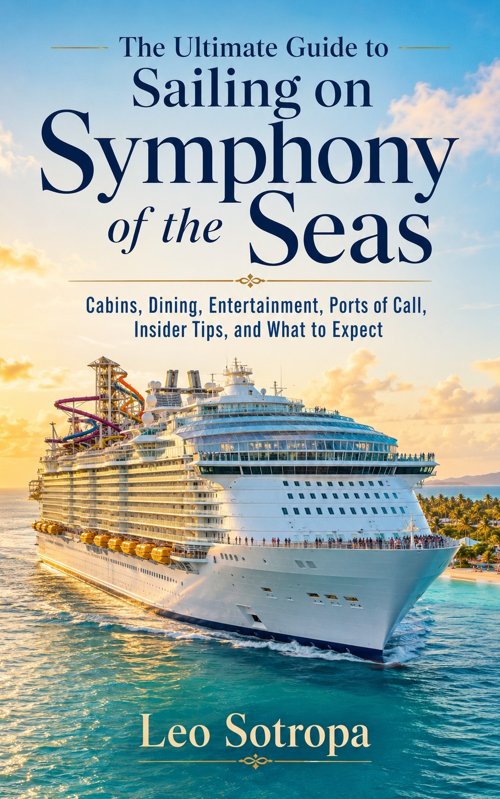
The Ultimate Guide to Sailing on Symphony of the Seas by Leo Sotropa, part of the Ultimate Ship Guides series, is a practical, independent handbook to Royal Caribbean’s giant family Oasis ship, available on Kindle and paperback with clear Action Steps in every chapter. Get it before you sail and turn a huge, overwhelming ship into a week you already know how to enjoy.
Frequently asked questions
Is this an official Royal Caribbean book?
No. It is an independent, unofficial guide written by Leo Sotropa for the Ultimate Ship Guides series. That independence is the point: it can be candid about which cabins to avoid, which upcharges to skip, and which splurges are actually worth it, in a way a promotional brochure never would be.
Should I get the Kindle version or the paperback?
Either works, and it comes down to preference. The Kindle ebook is convenient to search and always in your pocket on your phone while you are aboard. The 6×9 paperback is easy to flag and hand around a family planning session, and it makes a nicer gift. Some readers keep both, using the paperback to plan at home and the ebook to reference on the ship.
Is the book up to date?
The guide is kept current with the latest edition, and it is deliberately built to stay useful. Rather than printing prices and schedules that expire, it teaches you how the ship works and how to make good choices, then tells you to confirm the current venues, hours, itineraries, and prices in the Royal Caribbean app. That way the strategy holds even as specific details change.
Does it cover Symphony’s specific ports?
Yes. There is a full ports of call chapter covering the destinations Symphony typically visits on her seven-night Caribbean routes, with must-do shortlists and top excursions. Because her home port has shifted over time, between Miami, Cape Liberty, and Galveston, the book stresses confirming your exact departure port and itinerary for your specific sailing rather than assuming.
Is it good for first-time cruisers?
It is especially good for first-timers. Symphony is enormous, and the book explains the systems, the vocabulary, and the choices that matter before you board, so you arrive confident instead of overwhelmed. The Action Steps at the end of each chapter turn all of that reading into a short, doable checklist.
Would it make a good gift?
Yes. For anyone with a Symphony of the Seas sailing already booked, a guide to their exact ship is more thoughtful and more useful than a generic travel gift. The paperback is the natural choice for gifting, and the recipient can start planning the moment they open it.
Does the book replace the Royal Caribbean app?
No, and it does not try to. The app is your live tool on board: boarding pass, deck maps, daily schedule, reservations, and check-in. The book is your planning brain, the strategy and context that tell you what to do with what the app shows you. They work together, with the book teaching you the ship and the app handling the day-to-day details that change from sailing to sailing.

Meet Leo: The Heartbeat Behind ‘A Country A Month’
Journeying through the pages of A Country A Month, you might often feel the rhythm of a storyteller’s heartbeat, pulsating through each line, each image, and each adventure shared. That heartbeat belongs to none other than our remarkable website editor, Leo.
With a lens in one hand and a pen in the other, Leo seamlessly marries his passions for photography and writing. His eye captures moments that words can barely describe, yet his eloquence brings those images to life, transcending borders and connecting us all through shared stories. An avid traveler, every country he’s visited has added another chapter to his expansive tale, and through our platform, he generously shares these chapters with us.