A Glacier Bay cruise guide comes down to one idea: this is a day you spend on the ship, not off it. Your vessel sails deep into Glacier Bay National Park, spends hours in front of enormous tidewater glaciers, then cruises back out — no port, no pier, no getting off. Treat the ship as the excursion: dress warm, stake out a viewing spot early, and give yourself the whole day on deck.
What a Glacier Bay day is (there’s no port)
Glacier Bay is a scenic-cruising day, not a stop. Unlike Juneau, Skagway, or Ketchikan, there’s no town, dock, or tender. The ship enters the park, cruises for the day, and everyone stays aboard, so you don’t need shore excursions or an all-aboard time to sweat over. Your only job is to be outside, warm, and looking in the right direction at the right time.
Glacier Bay National Park sits in Southeast Alaska near the top of the Inside Passage. It protects a vast landscape of tidewater glaciers, deep fjords, temperate rainforest, and marine waters where whales feed, and it’s part of a UNESCO World Heritage Site. It’s also a place of fast change: much of what is now open water was buried under ice not long ago, and the glaciers have retreated dozens of miles, so cruising in feels like sailing into a record of that change.
The permit system: why not every ship gets in
Here’s the part that surprises a lot of first-time Alaska cruisers: getting into Glacier Bay is not automatic. To protect the wildlife and the quiet of the park, the National Park Service strictly limits how many cruise ships may enter each day. Access runs on a limited-entry permit system, and those permits are allocated among the cruise lines — only a set number of ships get in on any given day.
Because the permits are limited, they’ve become one of the most coveted assets in Alaska cruising. Holland America and Princess have historically held the largest share, which is why so many of their itineraries feature the park by name. Other lines get in too, but with fewer slots. So if Glacier Bay specifically matters to you, read the itinerary carefully: a sailing that visits “a glacier” or “Endicott Arm” is not the same as one that enters Glacier Bay National Park. Confirm the exact wording in your cruise line’s app before you book.
The rangers who board at dawn
Part of what makes a Glacier Bay day special is that you don’t experience it alone. National Park Service rangers board in the early morning, brought out by a small boat near the mouth of the bay, and ride along all day. They narrate the passage over the ship’s PA, point out glaciers and wildlife as they appear, and often bring cultural interpreters connected to the Huna Tlingit, whose homeland this is.
They run informal talks and staff a small display with park stamps and junior ranger materials for kids. It’s worth listening rather than tuning it out — they know when the ship is approaching the best viewing and will flag a whale spout or a shoreline bear before you’d spot it. At day’s end they climb back onto their boat as the ship exits the park.
The marquee glaciers: Margerie and Grand Pacific
The centerpiece of the day is the head of the bay, where the ship noses up toward Margerie Glacier and, beside it, Grand Pacific Glacier, holding position and rotating slowly so both sides get a long look.
Margerie Glacier
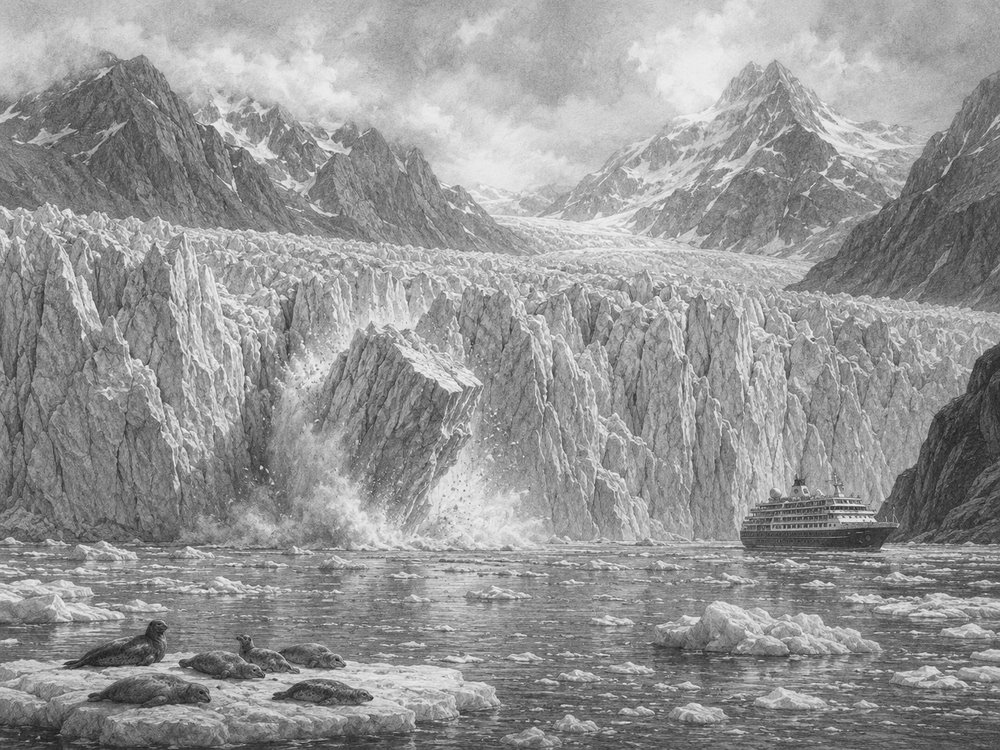
Margerie is the star: a tall, active tidewater glacier with a striking blue-and-white face high above the waterline. Because it’s active, it calves — chunks of ice break off and crash into the sea, sometimes with a boom rangers call “white thunder.” Keep your eyes on the face and your camera ready; calving happens without warning.
Grand Pacific Glacier
Right next to Margerie, Grand Pacific is broader and much darker, streaked with rock and sediment it has scraped up over its long journey. It looks less like a postcard and more like a working river of ice, and it’s one of the glaciers whose retreat opened up the bay you’re now sailing in. Together, the bright face of Margerie and the muddy sprawl of Grand Pacific tell the park’s whole story in one view.
Best viewing spots and how the day runs
A Glacier Bay day is long: ships enter in the morning and spend most of a full day inside the park, with the glaciers at the head of the bay as the midday highlight. That gives you time to try different vantage points.
- Forward observation decks: the best seat for sailing straight toward a glacier. They fill up fast at the head of the bay, so claim a spot early.
- Your own balcony: a private, wind-sheltered viewpoint — and because the ship rotates, the glacier usually swings into view for both sides. Step outside rather than watching through the glass.
- Top and upper decks: the widest panoramas for taking in the scale of the mountains and ice and spotting shoreline wildlife.
- Promenade and lower open decks: closer to the waterline, a fine perspective for calving splashes and floating ice.
Wildlife to watch for
Glacier Bay is as much a wildlife day as a glacier day, and the ranger narration helps a lot here. Watch for:
- Whales: humpbacks feed in these waters and orcas pass through — look for spouts, flukes, and the dark curve of a back breaking the surface.
- Seals: harbor seals rest on floating ice near the glaciers in surprising numbers, one of the classic Glacier Bay sights.
- Bears: black and brown bears roam the shorelines, sometimes foraging along the beaches at the water’s edge.
- Eagles and seabirds: bald eagles perch in the shoreline trees, and the bay is thick with gulls, kittiwakes, puffins, and more.
Dressing warm and shooting photos
It’s cold at the glaciers, colder than you expect. The air off that much ice is chilly even on a sunny day, and standing still on an open deck makes it bite. Dress in layers: a warm base, a fleece or sweater, and a wind-and-water-resistant jacket on top, plus a hat and gloves you can shed later. If it’s raining, a hood beats an umbrella on a windy deck.
For photography, include something for scale — the ship’s rail, a kayak, a bird — so the glacier’s size reads in the frame. Keep shooting during the hold at the glacier face, since you can’t predict a calving, and a zoom lens helps with distant wildlife. But put the camera down for a while: the sound of calving ice doesn’t come through a screen.
How Glacier Bay compares to Endicott Arm and Tracy Arm
Alaska itineraries often substitute a different glacier day. Endicott Arm, with Dawes Glacier at its head, and neighboring Tracy Arm are steep-walled fjords near Juneau — narrower and more intimate than Glacier Bay, with sheer granite walls, waterfalls close enough to feel the spray, and thick floating ice. If your ship visits one instead, read our Endicott Arm and Dawes Glacier cruise guide.
The key differences: Glacier Bay is far larger, offers more open water and wildlife variety, requires the permit, and comes with rangers narrating aboard — none of which happens in the fjords, which instead deliver a closer, more dramatic ice-and-rock experience in tighter quarters. The permit is why a Glacier Bay day is the one people specifically seek out.
What can change the day
A scenic-cruising day is at the mercy of nature, so hold expectations loosely. Low cloud, fog, or heavy rain can hide the peaks and mute the glaciers, while a clear day is spectacular. How close the ship can get depends on ice conditions and the captain’s judgment, so the exact position and how long you linger vary sailing to sailing. Wildlife is never guaranteed, and ice or weather can occasionally alter the route within the park.
Because the day runs on the ship’s schedule, keep an eye on the daily program and announcements so you’re outside when the ship approaches the glaciers. Many people pair Glacier Bay with a busy port day in Juneau elsewhere on the same itinerary, a nice contrast between an active shore day and a slow day of watching ice.
Cruise ships that visit Glacier Bay
Several ships hold Glacier Bay on their Alaska itineraries. If you’re sailing on one, our ship guides walk you through the day aboard.
Frequently asked questions
Do you get off the ship at Glacier Bay?
No. Glacier Bay is a full day of scenic cruising inside a national park, with no port, pier, or tender. Everyone stays aboard, so plan to spend the day on deck.
Why doesn’t my Alaska cruise stop at Glacier Bay?
Access is capped by a strict National Park Service permit system, and only a set number of ships enter each day. Holland America and Princess hold the largest allocations. Many other itineraries substitute a different glacier day, such as Endicott Arm, so check the exact wording of yours.
Which glaciers will I see?
The marquee stop is the head of the bay, where Margerie Glacier — a tall, active, blue-and-white face that calves ice into the sea — sits beside the broad, sediment-darkened Grand Pacific Glacier. The ship holds position and rotates so both sides can view them.
Do park rangers really come aboard?
Yes. National Park Service rangers board in the early morning and ride along all day, narrating over the PA and staffing a small display, often with Huna Tlingit cultural interpreters. Their narration is one of the best parts of the day, since they flag wildlife before most passengers spot it.
What wildlife might I see?
Common sightings include humpback whales and occasionally orcas, harbor seals resting on floating ice, black and brown bears along the shorelines, and bald eagles and seabirds. Nothing is guaranteed, but binoculars improve your odds.
How should I dress and how long does the day last?
Dress in warm layers with a windproof, water-resistant jacket, plus a hat and gloves — the air off the ice is cold even in sunshine. The day is long, most of a full day inside the park, so you’ll have time to move between the forward decks, top deck, and your balcony to find the best views.
How is Glacier Bay different from Endicott Arm or Tracy Arm?
Glacier Bay is much larger, has more open water and wildlife variety, requires the permit, and comes with rangers aboard. Endicott Arm (with Dawes Glacier) and Tracy Arm are narrower, more dramatic fjords near Juneau with sheer walls and close-up ice, but no permit and no rangers. Both are excellent, just different in scale.

Meet Leo: The Heartbeat Behind ‘A Country A Month’
Journeying through the pages of A Country A Month, you might often feel the rhythm of a storyteller’s heartbeat, pulsating through each line, each image, and each adventure shared. That heartbeat belongs to none other than our remarkable website editor, Leo.
With a lens in one hand and a pen in the other, Leo seamlessly marries his passions for photography and writing. His eye captures moments that words can barely describe, yet his eloquence brings those images to life, transcending borders and connecting us all through shared stories. An avid traveler, every country he’s visited has added another chapter to his expansive tale, and through our platform, he generously shares these chapters with us.