Is there a Portugal retirement guide written for someone who expects to live mostly on Social Security and a modest nest egg? Yes. No-Nonsense Guide to Retiring in Portugal by Leo Sotropa is a practical, numbers-first handbook for Americans who want to determine whether Portugal fits their real retirement rather than an imaginary one.
Portugal has become one of the world’s most discussed retirement destinations. The appeal is understandable: mild weather, attractive towns, Atlantic beaches, generally low violent crime, a well-established residency route for people with passive income, and daily costs that can still compare favorably with many parts of the United States.
The difficult part is that Portugal’s reputation has traveled faster than its housing supply. Lisbon, Porto, and many sections of the Algarve no longer fit the “cheap European retirement” story repeated in older articles. The former Non-Habitual Resident tax regime that attracted many earlier retirees is not a benefit new applicants should casually assume they will receive. Healthcare is strong, but access, insurance, and language still require planning. The D7 visa is approachable for many retirees, yet the application process, housing evidence, consular requirements, and post-arrival administration can be frustrating.
This book is built around that complete picture.
The short version is encouraging: Portugal can work well on an ordinary retirement income when you choose the location carefully, maintain a savings cushion, and prepare the residency, healthcare, tax, and housing pieces in the correct order. It becomes much harder when the plan depends on a bargain apartment near the coast, an outdated tax promise, or the assumption that every government process will happen on schedule.
What this book actually is
No-Nonsense Guide to Retiring in Portugal is an independent retirement-planning handbook. It is not an official government guide, a real-estate brochure, or a list of pretty places copied from travel media.
A travel guide helps you visit Portugal. This book helps you evaluate living there.
That means it focuses on questions such as:
- Can your monthly income support the town and lifestyle you want?
- Does your passive income meet the current residency standard?
- How much cash is needed for deposits, insurance, documents, and the first year?
- Which places provide value without isolating you from healthcare and transport?
- How do the public SNS and private medical systems fit together?
- What happens to Medicare?
- How might Portuguese tax residence affect Social Security, pensions, investments, and reporting?
- How should you prepare for rent increases and exchange-rate movement?
- What happens if one spouse dies, mobility changes, or you need to return home?
The book follows the way a real retirement decision unfolds. It begins with three representative retirees living on different budgets. It then helps you define priorities, compare regions, understand the D7 route, price healthcare, consider taxes and banking, plan a scouting trip, downsize, arrive, adapt, and prepare for changing needs.
Every chapter ends with action steps. The purpose is not to make you feel informed for an afternoon. It is to help you complete the decisions and preparation that turn interest in Portugal into a workable plan.
The book is available through Amazon in formats suited to planning at home or carrying during a scouting trip. The content is practical rather than decorative, and the illustrated print edition is designed to be marked up, discussed, and used as a working guide.
Why Portugal still attracts retirees
Portugal’s strongest advantage is balance.
It may not be the cheapest retirement country in Europe or the Americas. It may not offer the easiest bureaucracy, the lowest tax, or the largest English-speaking community. But it combines several qualities many retirees want in one place:
- A mild climate, especially in coastal and southern regions
- A generally safe daily environment
- Good food and strong local markets
- Walkable historic towns
- Public transport between major population centers
- Access to public and private healthcare
- A passive-income residency route
- A path toward long-term residence, subject to current law
- A large enough international community to ease the transition
- Geographic access to the rest of Europe
The danger is treating “Portugal” as one uniform retirement product. Lisbon, Porto, the Silver Coast, inland central Portugal, the Alentejo, the Algarve, Madeira, and the Azores differ in housing, climate, transport, medical access, tourism, English use, and community.
The book’s job is not to announce the best place. It is to help you choose the set of trade-offs that fits your health, income, temperament, and family situation.
Three retirees, three budgets
The book opens with three representative retirement lives because national averages conceal the decisions that determine success.
A solo retiree in Viseu
The first retiree lives primarily on one Social Security benefit in Viseu, a regional city in central Portugal. Her plan works because she avoids the most expensive coastal housing, rents modestly, walks for daily needs, and keeps discretionary travel under control.
Viseu gives her ordinary city services and a year-round Portuguese population without the rent of Lisbon or the tourist pressure of the central Algarve. The trade-offs include a cooler, wetter winter than southern Portugal, less international air access, and the need to function in a more Portuguese environment.
Her case illustrates the central fixed-income rule: housing creates the margin. A lower rent gives her room for private medical appointments, document costs, a trip home, and an emergency reserve.
A couple in Tavira
The second household is a couple living on two combined retirement benefits in Tavira in the eastern Algarve. They enjoy a warmer climate, a walkable center, access to the coast, and an established international community.
Their shared rent and utilities make the household budget more efficient than two separate solo budgets. Their challenge is the Algarve housing market. The region is popular, and long-term rentals compete with tourism and seasonal demand. They need to choose the neighborhood and lease carefully rather than treating the entire Algarve as inexpensive.
Their case shows why “Can we afford Portugal?” is the wrong question. A better question is “Can we afford the Portugal we have chosen after including healthcare, travel, and rising rent?”
A comfortable solo retiree near the coast
The third retiree has a larger monthly income and a stronger savings cushion. He chooses a coastal area with easier services, English-speaking professionals, and access to cultural life.
He pays more for housing but gains convenience. His budget can absorb private insurance, frequent travel, professional tax assistance, and a more comfortable apartment.
His case demonstrates that spending more can be rational when it reduces isolation, car dependence, and logistical friction. The cheapest town is not automatically the best value.
These three lives are not price promises. They are planning models. Each shows how rent, location, transport, healthcare, and expectations interact.
The cost-of-living truth
Portugal can still cost less than many parts of the United States, particularly when housing and healthcare are compared carefully. It is no longer safe to describe the country as uniformly cheap.
Housing is the decisive cost. Lisbon and central Porto can be difficult for a modest retirement income. Famous Algarve towns and highly promoted expat areas may also carry rents far above the national image. Better value often appears in smaller inland cities, less-famous sections of central Portugal, parts of the Alentejo, and towns that remain connected to hospitals and transport without being international hotspots.
The book teaches readers to build a complete budget rather than collecting isolated prices.
Include:
- Long-term rent
- Deposits and setup costs
- Utilities and heating
- Groceries and household supplies
- Healthcare and insurance
- Local transport or car ownership
- Phone and internet
- Tax and administrative help
- Flights to the United States
- Currency fluctuation
- Home maintenance or building charges
- Emergency and return-home reserves
Portugal’s café prices and fresh produce can feel inexpensive while its housing market consumes the budget. A successful plan begins with a realistic year-round lease, not the memory of an affordable vacation.
Where the book helps you look
The book compares types of locations rather than handing out a simplistic winner.
Central and inland cities
Places such as Viseu and other regional centers may offer lower rents, ordinary services, walkability, and a year-round community. They can be excellent for retirees willing to live more locally and learn Portuguese.
The trade-offs may include colder winters, fewer direct international connections, and a smaller English-speaking network.
The Silver Coast and central coast
The coast north of Lisbon attracts retirees who want ocean access without the full cost and intensity of the capital or central Algarve. Prices vary significantly by town and proximity to transport.
Winter weather, humidity, rental availability, and access to larger hospitals should be examined alongside beach appeal.
The Algarve
The Algarve offers warm weather, international communities, golf, beaches, and an easier transition for English speakers. It is also where the gap between Portugal’s old budget reputation and its current housing reality is especially visible.
Eastern and less-famous areas may provide better value than the most promoted resort zones, but the year-round rental market still requires careful research.
The Alentejo
The Alentejo can offer space, lower housing costs, historic towns, and a quieter pace. It may also bring extreme summer heat, car dependence, and greater distance from specialist care.
The right Alentejo town can be deeply satisfying for someone who wants calm and local life. The wrong one can become isolating.
Lisbon and Porto
The major cities provide airports, hospitals, culture, transport, and international services. They also have the highest housing pressure.
They may fit a comfortable budget or work in outer neighborhoods with good transit. They should not be used as the default cost benchmark for the whole country.
Islands
Madeira and the Azores offer distinctive climates and communities. Island life changes medical access, travel logistics, weather exposure, and the ease of seeing family in the United States. The attraction is real, and so is the need for a specific contingency plan.
The D7 visa, without the mythology
Portugal’s D7 route is often described as a retirement visa. More precisely, it is a residence-visa route commonly used by people with stable passive income, including retirees.
The published income benchmark can look approachable, especially compared with some European alternatives. That does not make the application automatic.
Applicants should expect to address:
- The current passive-income standard
- Additional amounts for household members
- Portuguese accommodation
- Financial records
- Criminal-record documents
- Health coverage
- A Portuguese tax number and practical banking arrangements where required
- Consular forms and jurisdiction
- The post-arrival residence process
The exact checklist and sequence must be verified with the official authorities and the consulate or visa center responsible for the applicant.
The book emphasizes a crucial point: meeting a stated income floor is not the same as having a resilient retirement budget. A person may clear the legal threshold and still be exposed to rent increases, insurance costs, exchange-rate movement, or a major trip home.
Portugal’s administrative system has also experienced delays and backlogs. A good plan includes time, document copies, patience, and enough money to absorb a process that does not move on the retiree’s preferred schedule.
Healthcare: public, private, and Medicare
Portugal’s healthcare system is one of its major attractions, but retirees need to understand access in phases.
The public Serviço Nacional de Saúde, usually called the SNS, provides broad healthcare coverage within the Portuguese system. Eligibility, registration, user experience, and access can depend on residence status, local administration, capacity, and the service needed.
Private healthcare is commonly used for speed, convenience, English-speaking providers, or services where public waiting times are long. Private insurance and direct-pay appointments may cost less than comparable U.S. care, but age, medical history, exclusions, and coverage limits matter.
Medicare generally does not provide routine healthcare coverage in Portugal. Retirees must decide whether to maintain U.S. Medicare enrollment as part of a future return strategy while separately funding their Portuguese care.
The book helps readers ask the right questions:
- What insurance is required during the visa and initial residency process?
- When and how can you register for the SNS?
- How close is the candidate town to a hospital?
- Can you access the specialists you use?
- What private policy is realistically available at your age?
- What does the policy exclude?
- How will prescriptions be transferred?
- What happens if one spouse develops more complex needs?
Healthcare should influence location before the lease is signed.
Taxes after the old NHR story
Many older Portugal retirement articles were built around the Non-Habitual Resident regime. New retirees should not assume that the same benefit remains available to them on the terms described in old books and blog posts.
Tax residence can affect Social Security, pensions, retirement-account withdrawals, investments, property, and reporting. U.S. citizens generally continue filing U.S. federal returns while abroad. Foreign accounts and assets can create additional reporting obligations.
The U.S.-Portugal tax treaty and foreign tax credits may help coordinate taxation, but they do not turn the issue into a universal one-line answer.
The book explains the categories and planning questions, while making clear that individualized cross-border advice is necessary before establishing Portuguese tax residence or taking a large retirement-account distribution.
The useful tax question is not “Is Portugal tax-free?” It is “What will our complete income picture look like after Portuguese tax, U.S. tax, treaty treatment, credits, professional fees, and reporting?”
Banking and currency
Portugal uses the euro. Many American retirees receive income and hold assets in dollars.
That creates currency risk. A retirement plan that works only at today’s exchange rate is not ready.
The book encourages readers to:
- Test the monthly budget at several exchange rates
- Keep an emergency reserve in accessible form
- Compare transfer costs and exchange spreads
- Maintain a practical U.S. banking setup
- Understand Portuguese account requirements
- Prepare for U.S. bank compliance or address complications
- Avoid transferring a lifetime of savings before systems are tested
Banking is an operational part of the move, not a final administrative detail.
Housing: the issue that can make or break Portugal
Portugal’s housing market deserves its own planning strategy.
Short-term tourism, international demand, limited supply, and local affordability pressures have changed many markets. Attractive listings may be seasonal, poorly heated, far from services, or unavailable under a stable long-term lease.
The book recommends renting before buying.
Renting gives you time to learn:
- Which neighborhoods are noisy or damp
- How winter feels
- Whether you need a car
- How long it takes to reach medical care
- What a year-round lease actually costs
- Whether the town remains socially alive outside summer
- Whether you can function without constant English support
Buying early can convert a location mistake into a financial problem.
Who this book is for
The guide is especially useful for:
- Americans approaching retirement who want to test Portugal against a real budget
- Social Security retirees who need a lower-cost location rather than Lisbon or a prime resort
- Couples comparing the D7 route with alternatives in Spain, Italy, or Greece
- Solo retirees evaluating safety, healthcare access, and community
- Readers who have encountered outdated NHR information
- Adult children helping a parent plan an overseas move
- Retirees who want a structured scouting and relocation sequence
- People willing to learn Portuguese and live in an ordinary community
It is not a luxury-property guide, a tax-avoidance promise, or a claim that every part of Portugal remains inexpensive.
What makes the guide “no-nonsense”
The editorial rule is simple: every attractive feature must be paired with the practical question it creates.
Portugal may be safer than many alternatives. You still need a healthcare and isolation plan.
The D7 income floor may be approachable. Housing and first-year costs require more margin.
The SNS may offer good care. Access and waiting times vary.
The Algarve may provide warmth and English-speaking services. Housing can be expensive.
An inland town may be affordable. You may need a car or stronger Portuguese.
Europe may feel close and connected. Family in the United States is still an ocean away.
That balance is not pessimism. It is what allows a reader to pursue Portugal with confidence instead of wishful thinking.
About Leo Sotropa and the series
Leo Sotropa writes practical travel and retirement guides for readers who want enough detail to act. The No-Nonsense Guide to Retiring in… series evaluates each destination through a consistent framework: representative budgets, value by region, residency, healthcare, taxes, banking, safety, culture, moving logistics, adaptation, and a plan for changing needs.
The same framework makes country comparisons more meaningful.
Portugal may offer a more approachable passive-income route than Italy or Greece while presenting a tighter housing market. Spain may offer larger regional variety while imposing its own visa, tax, and healthcare questions. Mexico may be closer to family in the United States but requires highly local safety research. Panama and Ecuador remove dollar exchange-rate risk but lead to different healthcare and location decisions.
There is no universal winner. There is a country whose trade-offs fit your resources and priorities better.
Get No-Nonsense Guide to Retiring in Portugal
No-Nonsense Guide to Retiring in Portugal: Without a Millionaire’s Budget by Leo Sotropa is a practical handbook for building a Portuguese retirement around real income, current residency planning, realistic housing, healthcare, taxes, banking, and a contingency plan.
The book begins with three retirees living on three different budgets and carries the reader from initial comparison through arrival and later-life decisions. Every chapter ends with clear action steps.
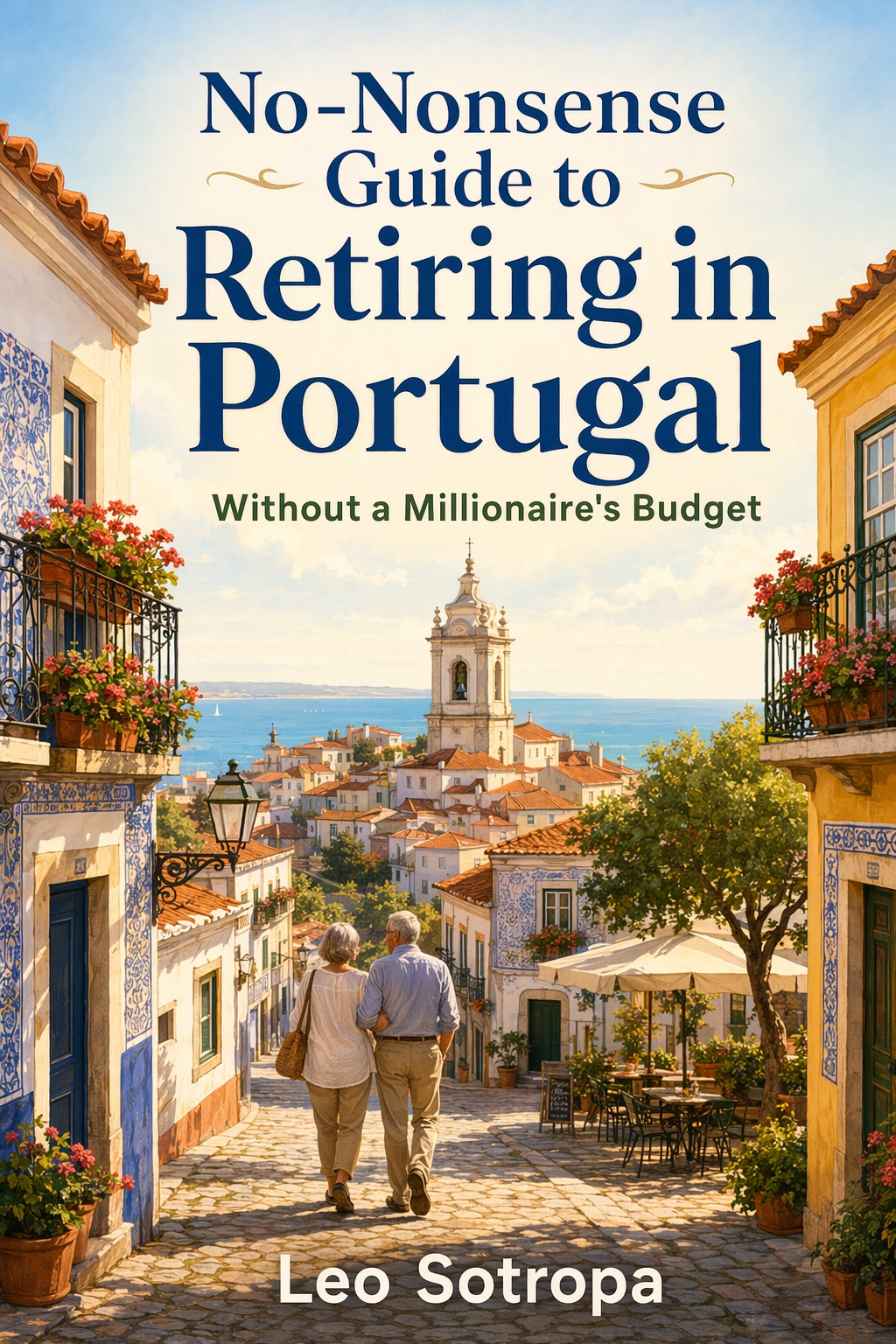
No-Nonsense Guide to Retiring in Portugal by Leo Sotropa is available on Amazon.
Your café table may be waiting. This book helps you determine whether you can afford the chair and still protect the retirement behind it.
Frequently asked questions
Can an American retire in Portugal on Social Security?
It may be possible, especially outside the most expensive parts of Lisbon, Porto, and the Algarve. The plan depends heavily on rent, household size, healthcare, transport, and savings. The D7 residency standard and the everyday living budget should be evaluated separately.
What is Portugal’s D7 visa?
It is a residence-visa route widely used by retirees and other people with stable passive income. Applicants must meet current requirements involving income, documentation, housing, background checks, insurance, and post-arrival residence procedures. Official sources are the final authority.
Is Portugal still inexpensive?
Some parts of Portugal remain good value relative to many U.S. locations and Western European capitals. Housing costs have risen sharply in highly demanded areas. Inland and less-famous regional cities may provide better fixed-income options.
Does Medicare work in Portugal?
Medicare generally does not cover routine care in Portugal. Retirees need a Portuguese healthcare plan and should decide separately whether maintaining Medicare supports a possible return to the United States.
Is Portugal tax-free for American retirees?
No general rule makes Portugal tax-free. Older NHR information may not apply to new retirees. Tax results depend on residence, income type, treaty treatment, and individual circumstances.
Should I choose Lisbon or the Algarve?
Both offer strong services and international communities, but both can strain a modest housing budget. They may fit a comfortable retirement or a carefully chosen outer location. Fixed-income retirees should also examine central and inland cities.
Should I rent or buy first?
Rent first. A year of renting gives you evidence about climate, neighborhoods, healthcare, transport, language, and the true long-term housing market before you commit capital.
Is the Kindle or print edition better?
The guidance is the same. A digital edition is easier to search and carry while scouting. A print edition is easier to annotate and use for joint planning.
Is this an official Portuguese government guide?
No. It is an independent planning guide. Portuguese authorities, consulates, healthcare agencies, and qualified legal and tax professionals remain the final sources for decisions that affect your personal case.

Meet Leo: The Heartbeat Behind ‘A Country A Month’
Journeying through the pages of A Country A Month, you might often feel the rhythm of a storyteller’s heartbeat, pulsating through each line, each image, and each adventure shared. That heartbeat belongs to none other than our remarkable website editor, Leo.
With a lens in one hand and a pen in the other, Leo seamlessly marries his passions for photography and writing. His eye captures moments that words can barely describe, yet his eloquence brings those images to life, transcending borders and connecting us all through shared stories. An avid traveler, every country he’s visited has added another chapter to his expansive tale, and through our platform, he generously shares these chapters with us.