Portugal’s D7 route is widely used by retirees and other applicants with dependable passive income. It can be more accessible than some European retirement routes, but it is not an automatic visa issued in exchange for one bank statement.
A credible application connects income, savings, housing, insurance, documents, and a realistic plan to establish residence in Portugal.
What the D7 is
The D7 is a residence-visa route associated with stable passive resources. Social Security, pensions, investment income, rental income, annuities, and other dependable sources may form part of a retiree’s financial evidence.
It is a residence process, not simply permission for a long vacation. Applicants should understand the expected physical presence, renewal, and post-arrival procedures before choosing it.
Why one published number is not enough
Online guides often focus on the minimum passive-income amount. That figure matters and must be current. It does not capture:
- Additional household requirements
- Housing evidence
- Insurance
- Criminal-record documents
- Consular jurisdiction and appointment rules
- Portuguese financial setup
- Post-arrival residence procedures
- Delays or backlogs
- The real budget required after approval
The official floor should never be mistaken for the amount needed to live comfortably in a pressured housing market.
The application sequence
A safer order is:
- Confirm the responsible consulate or visa center.
- Download the current official checklist.
- Assess passive income and savings conservatively.
- Obtain the necessary Portuguese tax and financial setup.
- Understand the current housing-evidence standard.
- Price acceptable insurance.
- Gather civil and criminal-record documents.
- Obtain apostilles and translations where required.
- Submit a complete, indexed application.
- Prepare the post-arrival residence checklist.
Do not make the relocation irreversible before the visa is secured.
Income and savings
Present the finances so a reviewer can understand them quickly:
- Guaranteed recurring income
- Other passive income
- Liquid reserves
- Long-term investments
- Monthly housing cost
- Insurance cost
- Household budget
Savings strengthen resilience but should not be assumed to replace recurring income in every context. Verify how the responsible authority treats your evidence.
Housing
Housing is often the most difficult practical requirement because applicants want flexibility while landlords want commitment.
Learn the current evidence standard before paying a large nonrefundable amount. Confirm whether the proposed lease is legally and practically suitable for the application. Qualified Portuguese assistance may be valuable.
Insurance and healthcare
Medicare generally does not provide routine coverage in Portugal. Applicants may need qualifying coverage for the visa and early residence period.
Review:
- Geographic coverage
- Limits and deductibles
- Pre-existing-condition exclusions
- Age restrictions
- Documentation the insurer provides
- Emergency and repatriation provisions
The cheapest travel policy is not automatically acceptable.
After arrival
The initial visa is not the final residence card. Post-arrival processes can involve appointments, biometrics, address evidence, and additional documents through Portugal’s responsible immigration authority.
Carry essential originals, keep copies of the complete application, and confirm deadlines before traveling.
Common mistakes
- Using an outdated income amount
- Applying through the wrong jurisdiction
- Treating the minimum as a complete budget
- Signing risky housing before understanding the requirement
- Underpricing insurance
- Assuming the process will follow an ideal timeline
- Failing to plan for Portuguese tax residence
- Shipping possessions before approval
For the financial context, see retiring in Portugal on Social Security. For the complete move, read No-Nonsense Guide to Retiring in Portugal.
Get the complete retirement guide
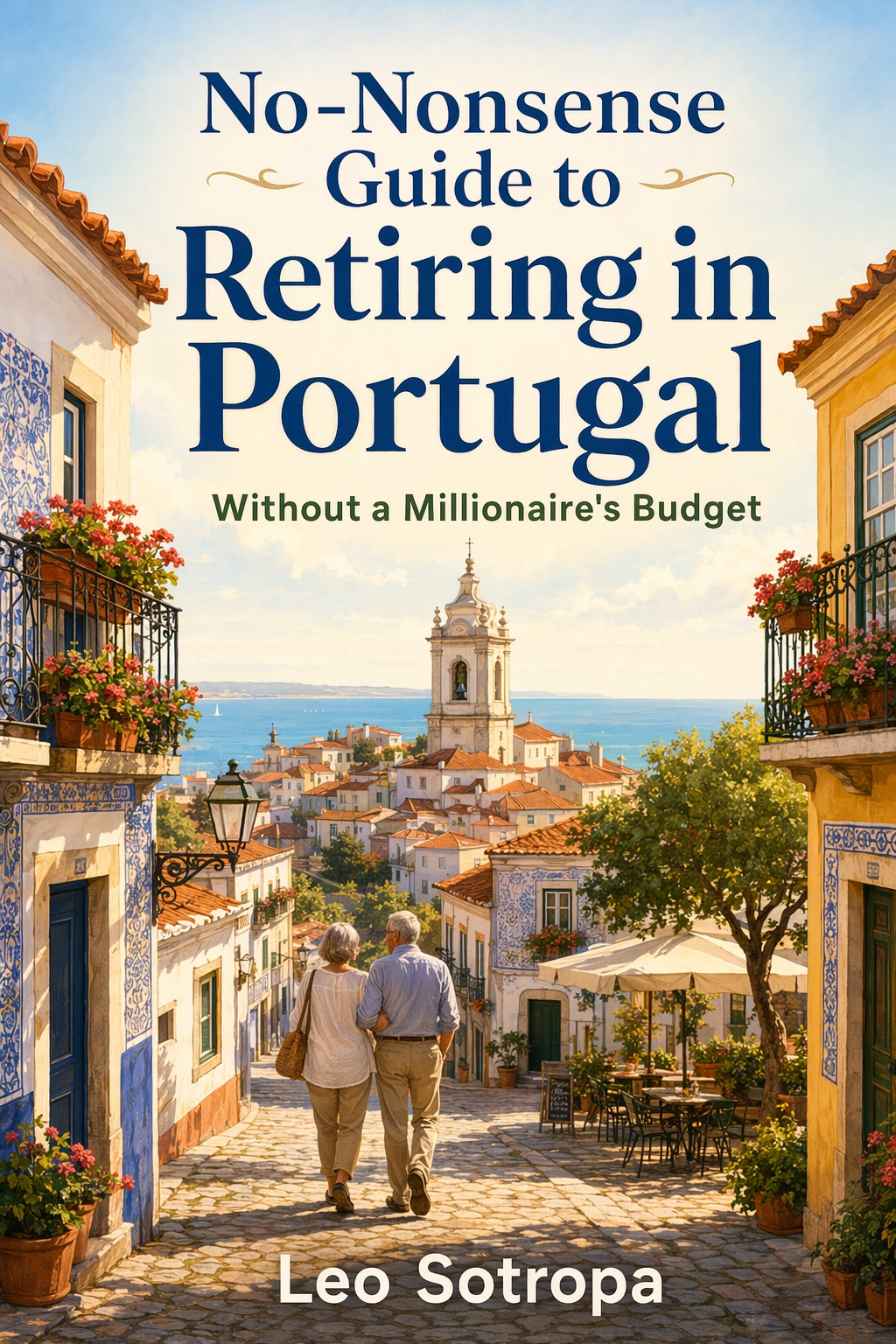
No-Nonsense Guide to Retiring in Portugal by Leo Sotropa brings the budget, residency, healthcare, housing, tax, and location decisions together in one practical plan.
Frequently asked questions
Is the D7 a retirement visa?
It is commonly used by retirees but is better understood as a passive-income residence route.
Can a couple apply?
Household applications are possible, subject to current requirements and additional-resource expectations. Verify the exact structure for the main applicant and dependents.
Does D7 approval make me a Portuguese tax resident?
Immigration residence and tax residence are related but not identical concepts. Physical presence and other facts can create Portuguese tax residence. Obtain individualized advice.

Meet Leo: The Heartbeat Behind ‘A Country A Month’
Journeying through the pages of A Country A Month, you might often feel the rhythm of a storyteller’s heartbeat, pulsating through each line, each image, and each adventure shared. That heartbeat belongs to none other than our remarkable website editor, Leo.
With a lens in one hand and a pen in the other, Leo seamlessly marries his passions for photography and writing. His eye captures moments that words can barely describe, yet his eloquence brings those images to life, transcending borders and connecting us all through shared stories. An avid traveler, every country he’s visited has added another chapter to his expansive tale, and through our platform, he generously shares these chapters with us.