A good Barcelona food plan is not a list of dishes detached from the trip. It accounts for when people eat, which neighborhoods suit different meals, where reservations matter, what prices mean, and how to recognize a place designed only for passing visitors.
Use this article with the complete Barcelona travel guide, the three-day itinerary, and the where-to-stay guide.
This is the chapter to dog-ear. Barcelona rewards a visitor who commits to one neighborhood at a time rather than sprinting between landmarks, and the difference between seeing Barcelona and truly knowing even a piece of it is spending a real half day inside a single district, at its own pace, on its own terms. Each section below works as a self-contained outing: a one-line identity, a walkable route with real street names, the food worth stopping for, the best time to go, and a quieter alternative when you want the same flavor without the crowd.
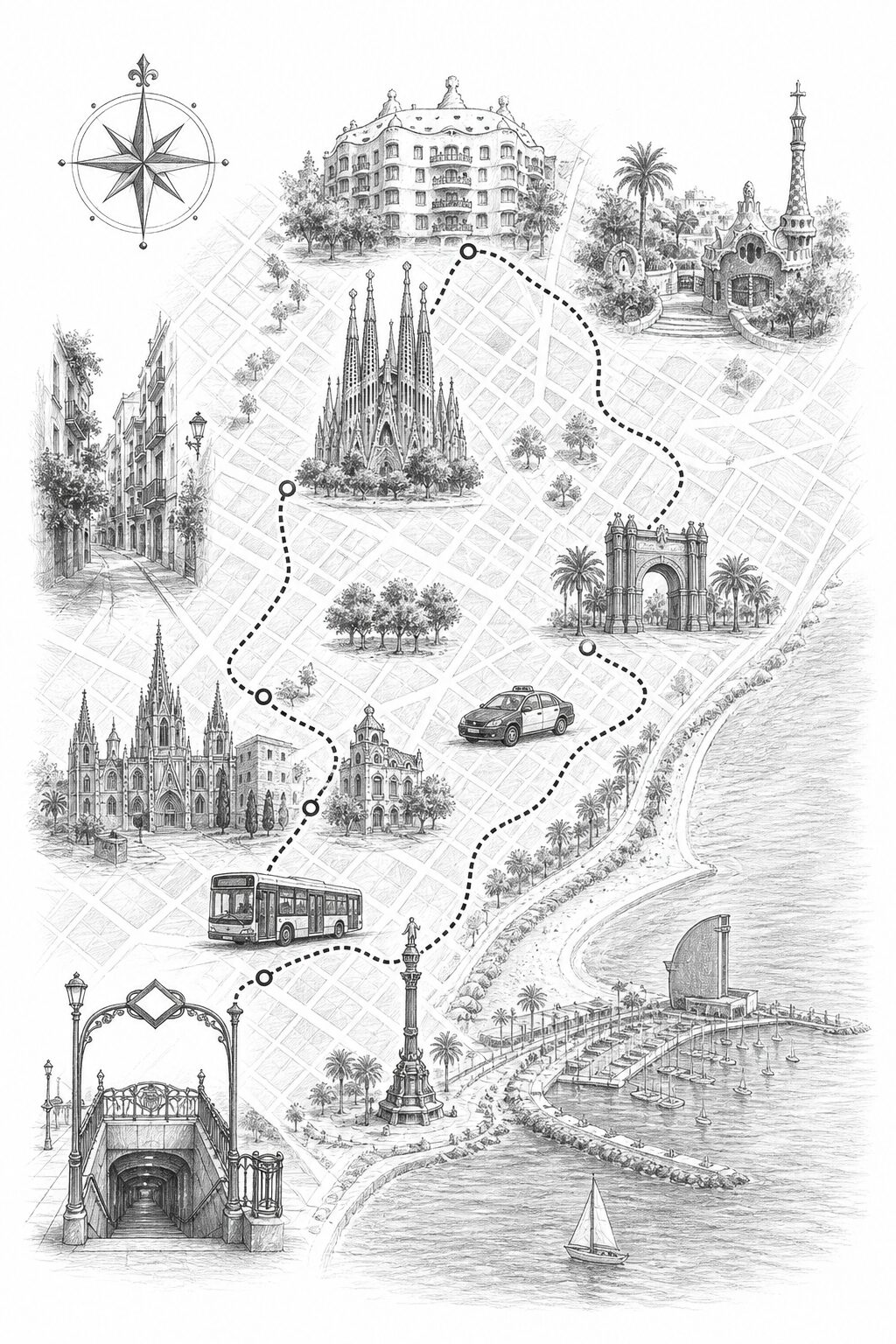
How the city fits together, in one paragraph: the sea sits at the bottom of every sloped street, so orientation in Barcelona is almost always downhill toward water. Ciutat Vella, the old town, splits into four pieces around La Rambla: Barri Gotic to the east of the boulevard toward the cathedral, El Born further east again toward the sea, El Raval to the west, and La Rambla itself running between them down to the harbor. North of the old town, the Eixample’s rational 19th-century grid climbs gently uphill, with Gracia, a former village in its own right, perched above it. Montjuic, the green hill of gardens and museums, anchors the southwest above the port, and the beachfront runs the full length of the city’s eastern edge from Barceloneta up toward Poblenou and the Forum.
Four habits make every walk in this article better. Go early wherever you can; Barcelona’s tourist tide rises after 10am and does not properly ebb until evening, so the same street at 8:30 and at noon are two different places. Carry water and expect the sun; even shoulder-season Barcelona gets more direct light than visitors from northern Europe or North America expect, and shade is a real planning factor by early afternoon in summer. Keep your bag zipped and worn to the front in every crowd described below, since the old town and its markets are exactly where the city’s well-documented pickpocketing risk concentrates (the complete guide has the full picture). And build in genuine stopping time: these routes are spines, not races, and the best moments in most of them happen in the plaza you were not planning to sit down in.
A friend of mine spent her first Barcelona morning doing exactly what every guidebook tells you not to do: she followed a printed checklist through the Gothic Quarter at a near jog, ticking off the cathedral, the Roman wall, and Placa Reial in under an hour, then wondered aloud why the city everyone raved about had left her cold. She went back the next morning at 8am with no list at all, sat for twenty minutes on the steps of Placa Sant Felip Neri watching a baker open his shutters, and came back that evening calling it one of the best mornings of her life. Nothing about the neighborhood had changed. She had simply stopped racing through it.
Barri Gotic, the Gothic Quarter: the Roman-and-medieval core
Who will love it: first-timers wanting the postcard, history readers, anyone happy to get pleasantly lost.
The route (about two to two and a half hours): Start at Placa Nova, where a fragment of the old Roman wall and its towers still stand at the edge of the square. Walk into the Barcelona Cathedral, its Gothic facade rising over a cloister where a small flock of resident geese has kept watch for centuries. Continue to Placa Sant Jaume, where city hall and the Catalan regional government face each other across the square, two seats of power staring each other down. Cross the Gothic bridge over Carrer del Bisbe, one of the most photographed corners in the old town, then duck into Placa Sant Felip Neri, a tiny, quiet square whose walls still carry bullet scars from the civil war era, a sobering pocket of calm just steps off the tourist flow. Continue to Placa del Rei, where the City History Museum sits atop excavated Roman streets you can walk beneath the modern city. Finish down Carrer Ferran, a shopping street that empties into Placa Reial, an arcaded, palm-lined square with lampposts designed by a young Gaudi.
Food and coffee: small tapas bars line the side streets off Carrer Ferran, easy to duck into between stops. Two enduring institutions anchor the neighborhood: Els Quatre Gats, where a young Picasso held his first exhibition, and Bar del Pi, on the square of the same name, both worth a coffee stop as much for the history as the menu.
When to go: before 9am or after 8pm. Midday is the most tour-group-dense window in the entire old town, and the difference in how the square feels is dramatic.
Quieter alternative: none of the Gothic Quarter is ever fully quiet in daylight, so treat an early-morning visit as the deep alternative to a midday one, and save Placa Sant Felip Neri as your reset when the crowds elsewhere feel like too much.
Worth knowing before you go: the Roman ruins beneath the City History Museum at Placa del Rei are more extensive than most visitors expect, entire excavated streets and the remains of a Roman wine-production complex sitting quietly under the modern square above, a genuinely underrated stop for anyone who thought they had already seen the Roman city at Placa Nova and moved on too soon.
El Born: the medieval trading quarter, now wine bars and boutiques
Who will love it: couples, food lovers, anyone who wants Barcelona’s history with a glass of cava in hand.
The route (about two hours): Begin at Santa Maria del Mar, the “people’s cathedral,” built largely by the neighborhood’s own dockworkers in an austere, powerful Catalan Gothic style that feels different from the cathedral proper. Step out onto Passeig del Born, once the site of medieval jousting tournaments and now a promenade of restaurant terraces. Walk Carrer Montcada, lined with Gothic merchant palaces, home to the Picasso Museum among others. Visit El Born Centre de Cultura i Memoria, a former market hall that now shows 1714-era ruins preserved beneath glass, a striking, quiet counterpoint to the boutiques outside. Finish in Parc de la Ciutadella, the former grounds of the 1888 World’s Fair, where a young Gaudi worked on the park’s cascade fountain; rent a rowboat on the lake or visit the zoo if you have children along.
Food and coffee: El Xampanyet has poured cava and served anchovies since the 1930s, a genuine institution rather than a tourist prop. Carrer del Rec carries a dense run of wine bars, and Mercat de Santa Caterina, with its rippling, colorful roof, has serious produce stalls worth a browse even if you are not cooking.
When to go: late morning through early evening for the walking route; the streets around the Picasso Museum get busiest at night.
Quieter alternative: skip Carrer Montcada’s museum queue entirely and spend that time instead in Parc de la Ciutadella, which absorbs crowds far more gracefully than the narrow lanes.
The park itself rewards lingering beyond its rowboats and zoo: the cascade fountain at its northern end, ornate and slightly theatrical, was partly the work of a young Gaudi decades before Sagrada Familia made his name, a formative project easy to miss if you treat the park as merely a place to rest your feet between museums.
El Raval: grittier, multicultural, the old town’s other half
Who will love it: contemporary art fans, anyone curious about the city’s immigrant history, adventurous eaters.
The route (about one and a half to two hours): Start at MACBA, the contemporary art museum whose plaza has become one of Europe’s best-known skateboarding spots, a genuinely unusual mix of gallery and street culture in one square. Pass the Filmoteca de Catalunya, then walk toward La Boqueria’s back entrance and the produce-and-spice streets behind it, a quieter approach to the market than the main Rambla-facing doors. Browse Carrer de la Riera Baixa’s vintage shops, then finish at Sant Pau del Camp, one of Barcelona’s oldest churches, a Romanesque survivor tucked into an otherwise modern block.
Food: El Raval carries a genuinely international food scene reflecting its immigrant history, Pakistani, Filipino, and West African kitchens sitting comfortably alongside Catalan ones. Late-night counters here serve biryani and adobo long after old-town kitchens have closed for the night.
When to go: daytime is straightforward, and the streets nearest MACBA have gentrified noticeably in recent years. Use normal caution after dark in the blocks furthest from La Rambla, less because of any specific incident than because the streets are quieter and less lit than the tourist core.
Frequently asked questions
How many days are enough for Barcelona?
Three well-planned full days cover a strong first visit, while four or five allow slower neighborhoods, additional museums, or a day trip. Count usable sightseeing days rather than hotel nights.
What should be booked first?
Reserve the experience you would be most disappointed to miss, then secure lodging and any limited-entry sights. Verify current rules and opening information on the official operator’s website shortly before travel.
How do you avoid rushing?
Group each day geographically, allow time for security and transport, and treat extra stops as optional. One demanding reservation plus nearby flexible experiences usually produces a better day than a chain of timed entries.
Continue planning Barcelona
- Complete Barcelona travel guide
- 3 days in Barcelona: first-time itinerary
- Where to stay in Barcelona
- Best things to do in Barcelona
- Barcelona food guide
- Barcelona first-time tips
- Barcelona on a budget

Meet Leo: The Heartbeat Behind ‘A Country A Month’
Journeying through the pages of A Country A Month, you might often feel the rhythm of a storyteller’s heartbeat, pulsating through each line, each image, and each adventure shared. That heartbeat belongs to none other than our remarkable website editor, Leo.
With a lens in one hand and a pen in the other, Leo seamlessly marries his passions for photography and writing. His eye captures moments that words can barely describe, yet his eloquence brings those images to life, transcending borders and connecting us all through shared stories. An avid traveler, every country he’s visited has added another chapter to his expansive tale, and through our platform, he generously shares these chapters with us.