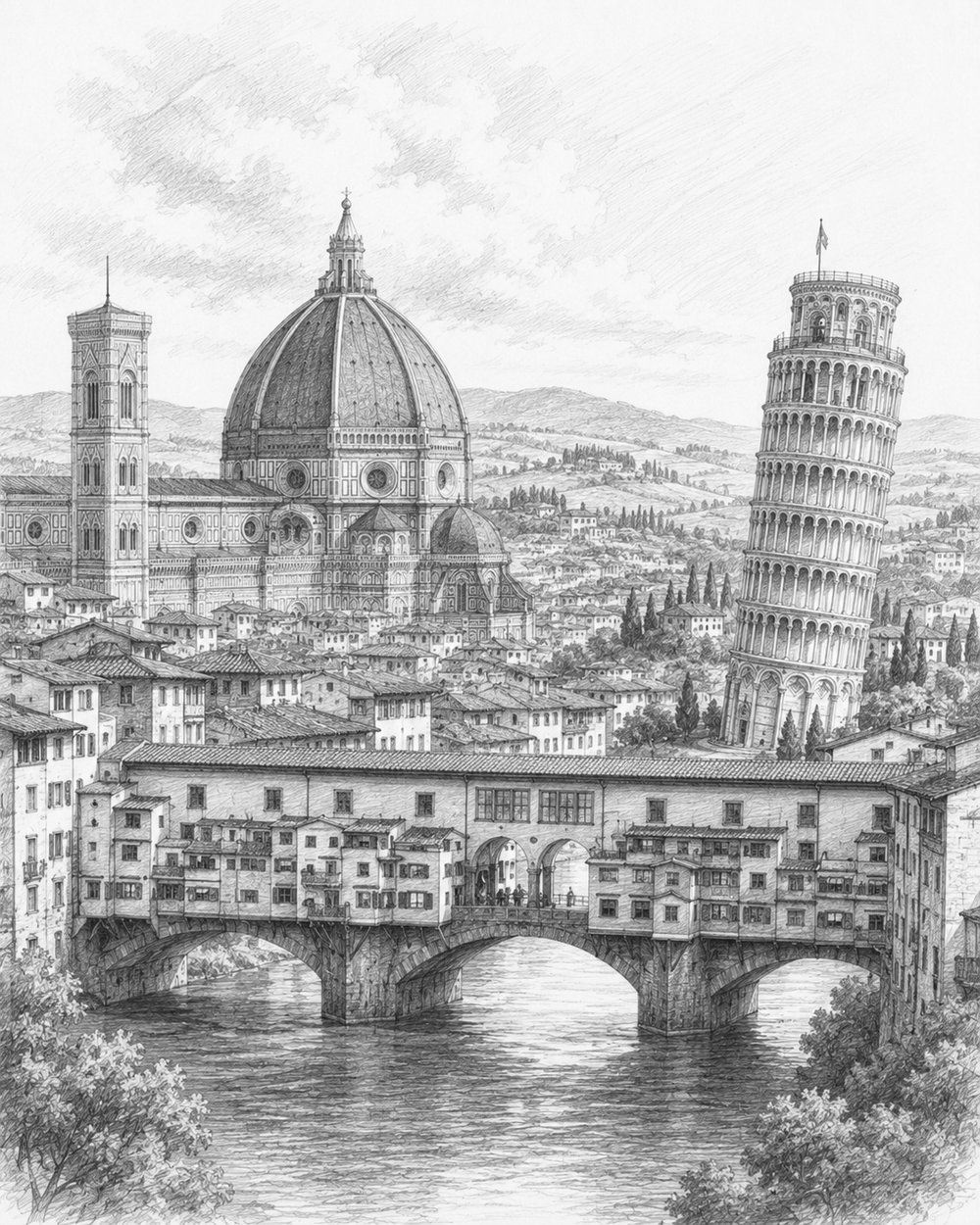
If your ship calls at Livorno, you are at the doorstep of Tuscany, and the single biggest question of your day is decided before you even step ashore: do you make the long run to Florence, or do you stay closer and see Pisa and Lucca? Livorno is a working industrial port, not a pretty seaside town, so almost everyone heads inland. Florence is roughly an hour and a half each way and holds the Uffizi, the Duomo and the Ponte Vecchio. Pisa and its Leaning Tower are much closer. This Florence Pisa cruise port guide walks through where you actually dock, how to get to each city, and how to spend a port day without missing the ship.
Where your ship docks
Most Tuscany calls use Livorno, one of the larger commercial ports on the Italian coast. It handles cargo, ferries and cruise ships together, so the area around the berths is functional rather than scenic — container cranes, gates and roadways, not cafes. Depending on your ship and the day, you may dock at a dedicated cruise berth or at a commercial quay farther out, and it is not a place you can simply wander out of on foot. Check your cruise line’s app for your exact berth and any shuttle details before you disembark.
Because the port is industrial, cruise lines and the port authority typically run a shuttle from the ship to a drop-off point near the edge of Livorno’s town center, often close to the Piazza del Municipio area. From there you can reach the train station, taxis and tour meeting points. If you have booked a ship excursion, your coach usually meets you right at the pier, which removes the shuttle step entirely. Independent travelers should plan on the shuttle-then-taxi-or-train sequence and build that time into the day.
A few sailings use La Spezia instead of Livorno, farther up the coast. La Spezia is the gateway to the Cinque Terre villages and still connects to Florence and Pisa by train, though Florence is a longer haul from there. If your itinerary lists La Spezia rather than Livorno, the coastal option below becomes much more attractive.
Top things to do on a port day
Florence: the Renaissance in a day
Florence is the reason most people book this port, and it rewards the effort — but respect the distance. It is around an hour and a half each way from Livorno by road or rail, so you are committing roughly three hours of travel to a single city. What you get in return is one of the great walkable historic centers in the world. The Duomo, with Brunelleschi’s dome and the marble façade, anchors everything; you can admire it from the piazza for free even if you don’t climb it. A short walk away, the Ponte Vecchio still carries its row of goldsmiths’ shops across the Arno, and the Piazza della Signoria is an open-air gallery of statues.
The Uffizi Gallery holds Botticelli, Leonardo and Michelangelo, and it is the one thing you must plan ahead for. Book a timed-entry ticket weeks in advance — walk-up lines can swallow much of a cruise day, and slots sell out in high season. The same discipline applies to climbing the dome and to seeing Michelangelo’s David at the Accademia; both need reservations. If you would rather not manage timed tickets and long transfers yourself, a ship excursion to Florence takes that risk off your plate, though you trade flexibility for the group’s pace.
Pisa: the Leaning Tower without the marathon
Pisa is far closer to Livorno than Florence is, which makes it the low-stress choice. The whole reason to go sits in the Piazza dei Miracoli: the Leaning Tower, the Duomo and the Baptistery, a cluster of white marble on a green lawn. Seeing the tower, taking the obligatory photo, and walking the cathedral square takes a couple of hours rather than most of a day. If you want to actually climb the tower, book that slot ahead, as entry is timed and limited. Beyond the famous square, Pisa is a pleasant university city, but the piazza is the draw.
Lucca: pair it with Pisa
Because Pisa is quick, many people combine it with Lucca, a walled town nearby that most cruisers have never heard of and end up loving. Lucca’s intact Renaissance walls are now a broad tree-lined path you can walk or cycle around the whole town, and the center is a maze of piazzas, towers and quiet cafes with almost none of Florence’s crowds. A Pisa-plus-Lucca day gives you two very different Tuscan experiences with far shorter transfers than a Florence run.
Staying near the coast
Not everyone wants a long inland day. If you have already seen Florence, or you simply want a slower pace, you can stay closer to the water. From La Spezia the Cinque Terre — five cliffside villages linked by a scenic local train — is the obvious signature outing. Even from Livorno, some travelers choose a shorter Tuscan coast or countryside experience over the big-city rush. There is no wrong answer here; the mistake is trying to do Florence, Pisa and the coast all in one call.
Train versus ship excursion
This is the decision that shapes your whole day. Doing it independently by train is cheaper and flexible: from Livorno you shuttle into town, take a train to Pisa Centrale, and change or continue to Florence’s Santa Maria Novella station. Trains are frequent and Florence and Pisa are both a short walk from their stations. The catch is that every connection is on you, and Italian regional trains can be delayed.
That matters because of the all-aboard time. On a transfer as long as Florence, a missed train or heavy traffic can turn a comfortable margin into a sprint. The great advantage of a ship-run excursion is simple insurance: if the tour is delayed, the ship waits for it. If you are traveling independently and the ship sails, catching up is your problem and your expense. If you go on your own, build in a large buffer, keep the last realistic return well before all-aboard, and note that all-aboard is usually earlier than the posted departure time. Confirm your ship’s all-aboard time in the app the night before.
How much time you need
Be honest about the clock. Florence realistically eats an entire port day: roughly three hours of round-trip travel plus enough time on the ground to make the trip worthwhile. Pick two or three headline sights and don’t try to cover everything. Pisa alone needs only a few hours, which is why a Pisa-and-Lucca combination fits comfortably into a normal call and still leaves margin. A coastal day from La Spezia to the Cinque Terre also fills a full day once you account for the local train hops between villages.
If your ship is in port for a shorter window, lean toward Pisa or the coast and save Florence for a call with a longer day ashore. Tuscany is a region where itineraries chain together — many travelers pair it with a Rome day at Civitavecchia earlier or later in the same cruise, so you don’t have to force every Italian icon into one stop.
What to skip and what to watch out for
- Skip trying to do Florence and Pisa and the coast in one day — the transfers make it impossible to enjoy any of them.
- Skip walk-up Uffizi tickets — book timed entry well ahead or you may not get in at all.
- Don’t linger in Livorno itself expecting a charming port town; the value is inland.
- Watch the summer heat and crowds in Florence’s center; carry water and start early.
- Mind pickpockets in the busiest piazzas and on packed trains, as in any major tourist city.
- Keep euros and a charged phone for train tickets, taxis and last-minute changes to your plan.
Cruise ships that visit Florence and Pisa
Many ships across cruise lines call at Livorno for Florence and Pisa as part of their western Mediterranean season. Check the guide for your specific ship for its itineraries and what to expect on board.
Frequently asked questions
What port do cruise ships use for Florence and Pisa?
Most ships dock at Livorno, a large industrial port on the Tuscan coast. Both Florence and Pisa are inland day trips from there. A few itineraries use La Spezia farther up the coast, which also connects to Florence and Pisa and is the gateway to the Cinque Terre. Confirm which port your sailing uses in your cruise line’s app.
How far is Florence from the cruise port?
Florence is roughly an hour and a half each way from Livorno by road or rail, so plan on around three hours of round-trip travel. That is why Florence tends to fill a full port day, and why booking ahead and watching your return time matter so much.
Should I choose Florence or Pisa?
Choose Florence if art and architecture are your priority and you have a long day in port; it is farther but far richer. Choose Pisa — ideally with Lucca added — if you want the Leaning Tower with much shorter transfers and a relaxed pace. Trying to do both cities well in one call rarely works.
Do I need to book tickets in advance?
Yes, for the headline sights. Reserve timed-entry tickets for the Uffizi weeks ahead, and book slots in advance if you want to climb Florence’s dome, see Michelangelo’s David, or climb the Leaning Tower. Walk-up lines can consume much of a cruise day.
Is it better to take a ship excursion or go independently?
Going independently by train is cheaper and more flexible. A ship excursion costs more but guarantees the ship waits if the tour runs late, which is real peace of mind on a long Florence transfer. If you go on your own, leave a generous buffer and aim to be back well before all-aboard.
Can I visit the Cinque Terre from here?
Most easily if your ship calls at La Spezia, which is the gateway to the five villages by scenic local train. It is a full-day outing. From Livorno the Cinque Terre is a longer stretch, so it is more practical when your itinerary lists La Spezia.
What else can I pair with a Tuscany call?
Italian itineraries usually chain several icons together. Many cruises that stop for Florence and Pisa also call near Rome or at Naples for Pompeii and the Amalfi Coast, so you can spread the big sights across different days rather than cramming them into one stop.

Meet Leo: The Heartbeat Behind ‘A Country A Month’
Journeying through the pages of A Country A Month, you might often feel the rhythm of a storyteller’s heartbeat, pulsating through each line, each image, and each adventure shared. That heartbeat belongs to none other than our remarkable website editor, Leo.
With a lens in one hand and a pen in the other, Leo seamlessly marries his passions for photography and writing. His eye captures moments that words can barely describe, yet his eloquence brings those images to life, transcending borders and connecting us all through shared stories. An avid traveler, every country he’s visited has added another chapter to his expansive tale, and through our platform, he generously shares these chapters with us.