
What makes Harmony of the Seas different from every other big ship? She is the third ship of Royal Caribbean’s Oasis Class, for a time the largest cruise ship in the world, and she is built as seven distinct neighborhoods rather than one endless corridor of decks. She also does something most megaships do not: she splits her year in two, spending summers in the Western Mediterranean and winters in the Caribbean. That single fact shapes almost everything about planning a trip on her. This guide walks through her neighborhoods, her signature venues and thrills, dining and cabins at a glance, and how to think about the two very different seasons, so you can decide whether she suits you and how to prepare if she does.
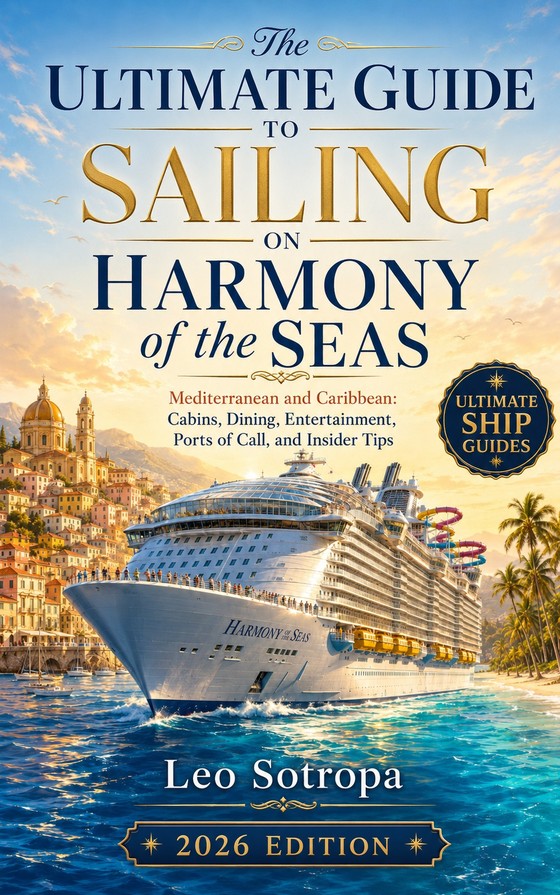
Everything in this article and far more, deck by deck, in The Ultimate Guide to Sailing on Harmony of the Seas.
Get the book →The big picture: one ship, two seasons, seven neighborhoods
Start with the numbers, because they set expectations. Harmony runs to around 226,000 gross tons across roughly 16 guest decks, carrying about 5,400 guests at double occupancy and up to around 6,600 when every berth is full. That is a small floating city, and the reason it does not feel like a stadium is the neighborhood design. Instead of one massive atrium, Oasis Class ships are organized into seven separate zones, each with its own character, sightlines, and pace. You quickly learn to navigate by neighborhood rather than by deck number, and the ship feels smaller and more human than her tonnage suggests.
The seven neighborhoods are Central Park, the Boardwalk, the Royal Promenade, the Pool and Sports Zone, Vitality Spa and Fitness, Entertainment Place, and the Youth Zone. The two that surprise first-time guests most are Central Park and the Boardwalk. Central Park is a genuine open-air garden in the middle of the ship, planted with thousands of live plants, ringed by some of the better restaurants and quiet enough in the evening to forget you are at sea. The Boardwalk, at the aft end, is the opposite energy: a hand-carved carousel, casual eats, and the open-air AquaTheater built into the stern for high-diving shows over the water.
The other defining trait is the split season. In summer she typically sails the Western Mediterranean; in winter she moves to the Caribbean. These are not minor variations on the same trip. One is a port-intensive tour of European cities with inland day trips and cathedral tickets to pre-book; the other is a warm-water run of beaches, reefs, and Royal Caribbean’s private island. Before anything else, confirm which season and region your specific sailing falls in, because it changes what to pack, what to book, and how you spend your days ashore.
Who the ship suits
Harmony is at her best for people who want variety under one roof. Multi-generational families do especially well here, because the range of things to do means a ten-year-old, a teenager, and a grandparent can each have a full day without stepping on each other. The Youth Zone and the sheer density of activity keep kids busy from morning to night; the quieter corners of Central Park, the Vitality Spa, and the adults-only sun areas give parents and grandparents somewhere to retreat when the pace gets loud. Couples who like an active-but-comfortable pace also fit, particularly on the Mediterranean itineraries where the ship is as much a hotel between cities as a destination in itself.
She is less ideal if you want a small, quiet, adults-only atmosphere or an intimate ship where you recognize the crew by day two. At full occupancy there are thousands of people aboard, and while the neighborhood layout disperses them well, sea days at the main pool are busy and popular shows fill up. If your ideal cruise is calm and understated, a smaller ship will serve you better. If you want a resort with a surf simulator, a ten-story slide, Broadway, an ice rink, and a garden, this is the one. First-time cruisers in particular tend to love her because there is always a fallback plan; if you are new to all this, our first-timer’s guide to Harmony of the Seas covers the onboarding day and the rhythm of a sailing in more detail.
Signature venues and thrills
The headline attraction is the Ultimate Abyss, the tallest slide at sea: a ten-story dry slide that drops off the stern of the ship. It is a genuine adrenaline moment and the line moves, so it is worth doing early in the cruise before the novelty wears off for the rest of the ship. Up top in the Pool and Sports Zone you also get the Perfect Storm trio of waterslides, named Cyclone, Typhoon, and Supercell, plus a FlowRider surf simulator where you can try bodyboarding or stand-up surfing under the eye of a coach.
The sporty extras keep going: two rock-climbing walls, a zip line that runs across the Boardwalk far below, mini-golf, and a full sports court for basketball and the like. None of this costs extra, which is part of why the ship rewards guests who like to keep moving. The trick is timing. Do the marquee activities on port days or early mornings when most guests are ashore or asleep, and you will wait far less than the crowds who all show up at the same post-lunch hour on a sea day.
The entertainment is unusually strong even by megaship standards, and most of it needs to be reserved ahead through the app. The main theater stages the Broadway musical “Grease” in full. The aft AquaTheater hosts a high-diving acrobatic spectacle that uses the pool, platforms, and the open sky behind the ship. And in Studio B, the ice-skating rink, the “1887” ice show puts professional skaters on a sheet of real ice in the middle of the ocean. Reserve these as soon as booking opens, because the best nights and times go first. For a lighter novelty, the Bionic Bar has robotic arms that mix your drink from a tablet order.

Dining at a glance
Dining splits into two buckets: what is included in your fare and what costs extra. The included side is broad enough that you never need to spend more if you do not want to. The Main Dining Room anchors it with multi-course dinners; the Windjammer Marketplace is the sprawling buffet for casual meals at any hour of the day. Around the Royal Promenade and the neighborhoods you also get Café Promenade for grab-and-go snacks and coffee, Sorrento’s for pizza, El Loco Fresh for casual Mexican, and Park Café in Central Park, home to the famous roast-beef Kummelweck sandwich that regulars line up for at lunch. On the Boardwalk, the Dog House handles hot dogs and sausages.
The specialty restaurants carry an extra charge and are where the ship shows off. Wonderland serves imaginative, whimsical dishes built around a theme of the five senses; it is as much theater as dinner. Chops Grille is the classic steakhouse, and there is Italian in the form of Jamie’s Italian or its current equivalent. Izumi covers Japanese and sushi, Hooked Seafood leans into New England-style catches, and Johnny Rockets does retro diner burgers and shakes. At the top sits the Chef’s Table, a multi-course wine-paired dinner in a private setting. If you plan to eat at more than one or two of these, price out a dining package in the app before you sail; it is usually cheaper than paying à la carte each night.
| Included | Specialty (extra charge) |
|---|---|
| Main Dining Room | Wonderland |
| Windjammer Marketplace buffet | Chops Grille |
| Café Promenade, Sorrento’s pizza | Jamie’s Italian (or current equivalent) |
| El Loco Fresh, Park Café (Kummelweck) | Izumi, Hooked Seafood |
| Boardwalk Dog House | Johnny Rockets, Chef’s Table |
Two practical notes tie the food together. The Royal Caribbean app effectively runs your day: it holds your dining reservations, show bookings, deck plans, and the daily schedule, so download it and log in before you board. And your SeaPass card is your cashless account for everything onboard; daily gratuities are added automatically, and Wi-Fi is a separate paid plan you buy per device or per person. Budget for those two line items so the final bill is not a surprise.
Cabins at a glance
Because she is an Oasis Class ship, Harmony offers some cabin types you will not find on ordinary vessels. The categories run from interior rooms up through Ocean View, Balcony, and suites. What is distinctive is the neighborhood-view stateroom: interior rooms that actually look out onto Central Park or the Boardwalk instead of a blank hallway wall, plus interiors fitted with a “Virtual Balcony,” a floor-to-ceiling screen showing a live ocean feed. Balconies come in three flavors too, facing the open ocean, Central Park, or the Boardwalk.
For value, a straight interior or a Central Park or Boardwalk-view interior gives you the ship for the lowest fare. For the best all-round experience, a midship Balcony on the mid-decks is the sweet spot: steady motion, quick access up and down, and your own outdoor space. On the Mediterranean itineraries a balcony earns its keep on scenic sail-ins to ports like Barcelona and Naples. In either season, an ocean-facing balcony gives you more natural light and fresh air than a neighborhood-view one, which looks inward. At the top end sit the suites, up to the two-deck Royal Loft Suite and the AquaTheater Suites with their enormous aft balconies overhanging the water.
A few rooms are worth avoiding, and the deck plan will confirm each one. Boardwalk balconies directly over the AquaTheater get noise and the glow of late shows. Cabins directly under the pool deck or the Windjammer catch early-morning scraping of deck chairs. Forward high-deck rooms feel the most motion, which matters if anyone in your party is prone to seasickness, and obstructed lower-deck balconies trade your view for a lifeboat. Spend ten minutes on the deck plan before you pick, or read our fuller breakdown of the best cabins on Harmony of the Seas to match a room to how you actually travel.
Where she sails: the two seasons
Western Mediterranean summers
In summer Harmony typically runs round-trip from Barcelona or Civitavecchia, the port for Rome. A week strings together some of the most famous cities in Europe: Barcelona itself, Palma de Mallorca, Provence via Marseille, Florence and Pisa reached from La Spezia or Livorno, Rome from Civitavecchia, and the Naples area for Capri and the Amalfi Coast. The catch is that several of the best sights are inland. Florence is a train or coach ride from the port, and the Vatican and Colosseum are well inland from Civitavecchia, so you plan tours or trains and watch the all-aboard time carefully.
Because these are timed, ticketed attractions, book ahead. Sagrada Família and Park Güell in Barcelona sell timed-entry tickets that vanish; arrive early at Las Ramblas and the Gothic Quarter before the heat and crowds. The Vatican needs advance booking. Pompeii pairs naturally with a Naples day, and Notre-Dame de la Garde and the Old Port anchor Marseille. The Mediterranean season rewards preparation more than the Caribbean one does, so treat the planning as part of the trip. Our guide to Harmony’s Mediterranean ports goes port by port with what to pre-book and how far each sight sits from the pier.
Caribbean winters
In winter she repositions to the Caribbean, where the mood shifts to beaches and reefs. Itineraries commonly include Perfect Day at CocoCay, Royal Caribbean’s private Bahamian island, along with a mix of San Juan in Puerto Rico, Charlotte Amalie in St. Thomas, Philipsburg in St. Maarten, Cozumel and Costa Maya in Mexico, and Roatán in Honduras. CocoCay alone is a full day out: Chill Island and the Oasis Lagoon pool are included, while the Thrill Waterpark, the Coco Beach Club, and private cabanas cost extra and sell out early, so book them the moment your planner opens.
The Caribbean ports lean toward things you can do on your own. Old San Juan and the forts of El Morro and San Cristóbal are a walkable afternoon. Magens Bay is the beach draw in St. Thomas; Maho Beach and the two-nation split of St. Maarten make for an easy day. Cozumel and Costa Maya open onto reefs and Maya ruins like Chacchobén and Tulum, and Roatán sits on the Mesoamerican reef with easy beach and snorkel days. Because the Caribbean days are warm and self-directed, they need less advance homework than the Mediterranean, though booking a highlight excursion or two still beats scrambling on the pier. Ports vary by sailing, so always confirm your exact itinerary in the app. For a deeper look at making the most of this season, see our Harmony Caribbean cruise guide.
How to plan a Harmony cruise
The single most useful habit is to front-load your bookings. As soon as the online planner opens for your sailing, reserve the shows, the specialty dinners you want, any CocoCay extras, and your shore excursions. The ship carries thousands of guests, and the best times and experiences are gone weeks before departure. This is the opposite of a small-ship cruise where you can wing it; on Harmony, the people who plan get noticeably more out of the same fare.
- Download the Royal Caribbean app and log in before you board; it holds reservations, deck plans, and the daily schedule.
- Confirm your season and region first, then pack and plan accordingly, cities and cathedrals for the Med, beaches and reefs for the Caribbean.
- Book shows, specialty dining, and CocoCay extras the day your planner opens.
- Do the Ultimate Abyss, FlowRider, and Perfect Storm slides on port days or early mornings to skip the sea-day crowds.
- Budget for daily gratuities and a Wi-Fi plan on top of your fare.
Beyond that, give yourself a slow first afternoon to learn the neighborhood layout, because the geography is the thing that makes a ship this size manageable. Once you know that Central Park is your quiet zone, the Boardwalk is the family energy, and the Royal Promenade is the indoor main street, the ship stops feeling overwhelming. For a running list of the small tricks that regulars use, our Royal Caribbean Harmony tips is a good companion to this overview.
Plan your ports of call
Make the most of every day ashore with our in-depth port guides for the stops on this ship’s itineraries:
- Barcelona
- Costa Maya
- Cozumel
- Florence and Pisa
- Marseille and Provence
- Naples
- Palma de Mallorca
- Perfect Day at CocoCay
- Roatan
- Rome
- San Juan
- St. Maarten
- St. Thomas
Get the complete Harmony of the Seas playbook
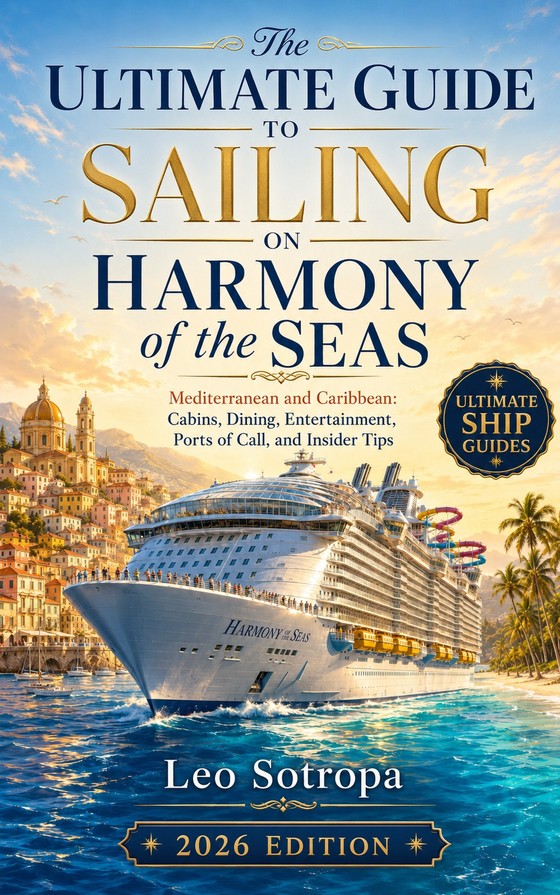
If you want every neighborhood, venue, cabin, and port turned into a step-by-step plan, “The Ultimate Guide to Sailing on Harmony of the Seas” lays it all out. It is part of the Ultimate Ship Guides series by Leo Sotropa, with clear action steps in every chapter so you board knowing exactly what to book and when.
Frequently asked questions
Where does Harmony of the Seas sail?
She splits her year between two regions. In summer she typically sails the Western Mediterranean round-trip from Barcelona or Civitavecchia (Rome), and in winter she moves to the Caribbean with itineraries that often include Perfect Day at CocoCay. Ports vary by sailing, so confirm your exact season, homeport, and itinerary in the Royal Caribbean app before you plan.
How big is Harmony of the Seas?
She is around 226,000 gross tons across roughly 16 guest decks, carrying about 5,400 guests at double occupancy and up to around 6,600 when fully booked. She was the third ship of Royal Caribbean’s Oasis Class and, for a time, the largest cruise ship in the world. The neighborhood layout keeps her from feeling as vast as those numbers suggest.
What are the seven neighborhoods?
They are Central Park, the Boardwalk, the Royal Promenade, the Pool and Sports Zone, Vitality Spa and Fitness, Entertainment Place, and the Youth Zone. Central Park is an open-air garden with thousands of live plants, and the Boardwalk holds the hand-carved carousel and the aft AquaTheater. Learning the neighborhoods is the fastest way to navigate a ship this size.
Which shows and activities should I reserve ahead?
Reserve the big three entertainment options as soon as booking opens: the Broadway musical “Grease” in the main theater, the high-diving AquaTheater spectacle, and the “1887” ice show in Studio B. It is also smart to pre-book specialty dining and, on Caribbean sailings, CocoCay extras like the Thrill Waterpark and Coco Beach Club, all of which sell out early.
What is the best cabin on Harmony of the Seas?
For value, an interior or a Central Park or Boardwalk-view interior gives you the ship at the lowest fare. For the best all-round experience, choose a midship Balcony on the mid-decks, and favor an ocean-facing balcony over a neighborhood-view one for light and air. Check the deck plan to avoid Boardwalk balconies over the AquaTheater and rooms under the pool deck or Windjammer.
Is Harmony of the Seas good for families and first-timers?
Yes on both counts. The range of free activities, the Youth Zone, and the neighborhood layout make her strong for multi-generational families, since different ages can spread out and still find plenty to do. First-time cruisers tend to love her because there is always a fallback plan and the app keeps everything organized. If you want a small, quiet, adults-only atmosphere, though, a smaller ship suits better.
What costs extra beyond the cruise fare?
Your fare covers the Main Dining Room, the Windjammer buffet, and most casual spots, plus all the marquee thrills like the Ultimate Abyss and FlowRider. Extra charges apply to specialty restaurants such as Wonderland and Chops Grille, plus daily gratuities added to your SeaPass account, a paid Wi-Fi plan, shore excursions, drinks packages, and CocoCay extras. Price out dining and internet packages in the app before you sail, as they often cost less pre-booked.
Ready for the whole ship in one place? It is all in The Ultimate Guide to Sailing on Harmony of the Seas.
Get the book →
Meet Leo: The Heartbeat Behind ‘A Country A Month’
Journeying through the pages of A Country A Month, you might often feel the rhythm of a storyteller’s heartbeat, pulsating through each line, each image, and each adventure shared. That heartbeat belongs to none other than our remarkable website editor, Leo.
With a lens in one hand and a pen in the other, Leo seamlessly marries his passions for photography and writing. His eye captures moments that words can barely describe, yet his eloquence brings those images to life, transcending borders and connecting us all through shared stories. An avid traveler, every country he’s visited has added another chapter to his expansive tale, and through our platform, he generously shares these chapters with us.