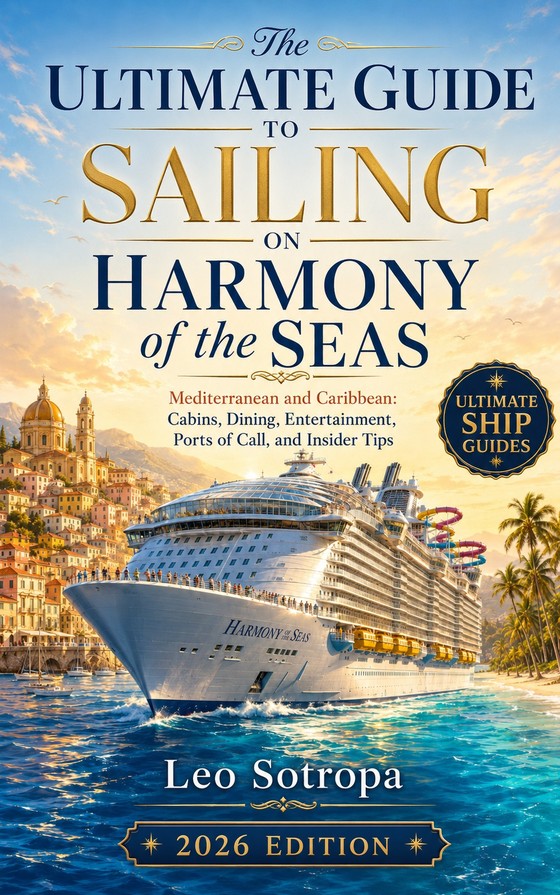
Looking for a straightforward answer to whether the Harmony of the Seas book is worth your time before you sail? Here it is: The Ultimate Guide to Sailing on Harmony of the Seas: Mediterranean and Caribbean by Leo Sotropa is an independent, ship-specific handbook written for one purpose, which is to help you walk aboard Harmony of the Seas already knowing where you are going, what to book, what to skip, and how to spend your money well. It is not a generic cruise primer that lists advice you could apply to any ship. It is a focused guide to this one Royal Caribbean vessel, and to the unusual way she splits her year between the western Mediterranean in summer and the Caribbean in winter.
That split season is the reason this book exists in the form it does. Most guides assume you are sailing somewhere warm and predictable. Harmony of the Seas is different. The same ship that can drop you at the edge of Rome in July can carry you to a coral reef off Roatán in January. Planning for one does not prepare you for the other, and this guide plans for both, right down to handling two currencies and two very different kinds of shore day. If you have booked Harmony, or you are deciding whether to, this is a book built specifically for what you are about to do.
What this book is
The Ultimate Guide to Sailing on Harmony of the Seas is one title in the Ultimate Ship Guides series by Leo Sotropa. Each book in the series takes a single ship and treats it seriously, as a place worth understanding in detail rather than a backdrop for stock cruise tips. This one is dedicated entirely to Harmony of the Seas, the third ship in Royal Caribbean’s Oasis Class and, for a stretch of time, the largest cruise ship in the world.
It is independent and unofficial. That matters more than it might sound. Because it is not produced by the cruise line, it can tell you plainly which staterooms to avoid, where a specialty restaurant earns its extra cost and where it does not, and how to sidestep the queues that form at the ship’s most popular attractions. It is the kind of candid, on-your-side advice that a marketing brochure will never give you, organized so you can actually use it while you plan and while you sail.
The book comes in Kindle and in a 6×9 illustrated paperback. Every chapter closes with a short set of practical Action Steps, so you are never left with interesting information and no idea what to do with it. You read a section, and then you have a small, concrete list of things to book, confirm, or decide. It is designed to move you from reading to ready, and to keep you moving instead of second-guessing.
The hook: one ship, two seasons, two worlds
Harmony of the Seas has a distinguishing feature that shapes everything about how you should plan a voyage on her. She runs a split season. In summer she sails the western Mediterranean, and in winter she moves to the Caribbean. A guide that ignores this would be half a book. This one is built around it.
The two seasons ask completely different things of you. A Mediterranean day might mean an early, ambitious push into a historic city with a fixed amount of time before all-aboard, a language you may not speak, and centuries of art and history to prioritize. A Caribbean day is more likely to mean a beach, a reef, a decision about which excursion is worth it, and a slower rhythm. The clothes you pack, the excursions you book, the money you carry, and the way you plan your shore hours all shift depending on which season you have chosen.
The book handles this head-on with dual-season and dual-currency planning. It does not make you translate generic advice into your specific sailing. It tells you how to approach the Mediterranean itinerary and how to approach the Caribbean one, and it gives you the best balcony choices for each season rather than pretending the two are interchangeable. If you have ever felt that a cruise guide was written for someone else’s trip, this is the answer to that problem for Harmony specifically.
What’s inside
The guide is comprehensive without being padded. It moves through the ship, the cabins, the destinations, the dining, the entertainment, and the practical strategy of a big-ship cruise, and each part is written to be acted on. Here is what you will find.
The seven neighborhoods and how to move
Harmony of the Seas is organized into seven distinct neighborhoods, and the book tours all of them so the ship stops feeling like a maze. Two of them define the Oasis Class experience. Central Park is a genuine open-air garden in the middle of the ship, planted with real greenery and lined with quieter restaurants and bars. The Boardwalk is its lively counterpart, home to a hand-carved carousel and the sightlines down to the AquaTheater. The guide explains how the neighborhoods connect, where the shortcuts and bottlenecks are, and how to get from one end of the ship to the other without wasting half your afternoon. On a vessel this size, knowing how to navigate fast is not a small thing, and it quietly buys back time you would otherwise lose wandering.
The full cabin guide
This is one of the most useful chapters, because a stateroom decision is hard to undo once you are aboard. The book names the exact staterooms to avoid, the ones sitting above noisy venues, below busy decks, or in spots where the layout works against you. It points to the smartest values, the cabins that give you the most comfort for the least money. And it recommends the best balconies for each season, because a balcony that shines in the Caribbean sun is not automatically the right pick for a Mediterranean crossing. If you read only one section before you book, this is a strong candidate.
Thirteen in-depth destination chapters
This is where the split season really pays off. The guide devotes thirteen full destination chapters to the ports Harmony visits, each with history, the sights worth your limited hours, food to seek out, and a ready-made day plan you can follow or adapt.
On the Mediterranean side, that means Barcelona, Palma de Mallorca, Provence, Florence and Pisa, Rome, and Naples with the Amalfi Coast. These are demanding ports where a little planning is the difference between seeing what you came for and standing in the wrong line. On the Caribbean side, it covers Perfect Day at CocoCay, San Juan, St. Thomas, St. Maarten, Cozumel, Roatán, and Costa Maya. The day plans are the practical heart of these chapters: instead of a list of everything a place offers, you get a realistic route that fits the time your ship actually gives you in port.
The complete dining guide
Dining on a ship this large can be bewildering, and the money adds up quickly if you say yes to everything. The book lays out what is included in your fare, what is worth the splurge, and what to reserve in advance before the best times disappear. It gives honest attention to the specialty restaurants, including Wonderland, the whimsical spot where the menu plays with your expectations of what food should look and taste like. The point is not to talk you into more spending. It is to help you put your dining budget where it actually returns something.
The shows, the slides, and the thrills
Harmony of the Seas carries some of the most ambitious entertainment and attractions at sea, and the guide covers them with an eye on timing. There is the Ultimate Abyss, the tallest slide at sea, and the Perfect Storm waterslides for anyone chasing a genuine rush. There is a strong lineup of shows: the Broadway musical Grease, a high-diving spectacular in the AquaTheater, and the 1887 ice show. The book tells you what each one is and, just as importantly, when to go and how to reserve so you are not turned away or stuck in a long line. Insider timing to beat the crowds runs through this whole section.
The crew, families, adults, and honest money advice
Beyond the headline attractions, the guide fills in the practical texture of the sailing. There is a chapter on the crew, the people who make a ship this size actually work. There is family know-how for parents trying to keep everyone happy across a very big vessel, and there are adults-only escapes for travelers who want quiet corners away from the busiest decks. The money advice is honest and direct, aimed at helping you avoid the small charges that quietly stack up. It sits alongside the dual-season and dual-currency planning, an embarkation strategy for a smooth first day, and a closing set of pro tips and FAQs. And every chapter, as always, ends with Action Steps.
Who it’s for
The guide is written to be useful to several kinds of traveler, and it is honest about serving each of them differently.
- First-timers who feel a little intimidated by the sheer scale of Harmony of the Seas and want a calm, ordered way to understand the ship before they board.
- Families juggling different ages, interests, and energy levels, who need to know where the kids’ spaces, the pools, the slides, and the quieter retreats actually are.
- Seasoned cruisers who already know how cruising works but want the specifics of this ship and these ports, so they can skip the learning curve and go straight to the good decisions.
- Gift buyers looking for something thoughtful for a friend or family member with a Harmony sailing booked, a present that will genuinely improve the trip.
Because it is organized by topic and closes each chapter with Action Steps, you can read it cover to cover or jump straight to the cabin chapter, the port you are worried about, or the dining plan. It works for the planner who reads everything and for the traveler who only wants the parts that apply to them.
Why a ship-specific guide beats a generic primer
General cruise advice has a ceiling. It can tell you to arrive at the port early, to book specialty dining before you sail, and to download the app, and all of that is true of almost any cruise. What it cannot tell you is which specific cabins on Harmony sit in awkward spots, how Central Park and the Boardwalk change the feel of your day, or how to structure a few hours in Rome so you see what matters and still make it back to the ship on time. Those answers only come from a book about this ship and these itineraries.
The real value of a ship-specific guide is that it lowers your stress before you ever board. Most pre-cruise anxiety comes from not knowing: not knowing whether you booked the right cabin, not knowing what is included versus what costs extra, not knowing how to spend a short port day, not knowing whether that attraction the kids want will have a two-hour line. This book replaces those open questions with clear, specific answers and a set of Action Steps for each one. You arrive having already made the decisions that would otherwise crowd your first day.
It also respects your money. A great deal of what makes a big-ship cruise expensive is optional, and the difference between a good value and a wasted charge is usually just information. By telling you plainly where the splurges are worth it and where they are not, the guide tends to pay for itself many times over in decisions you would otherwise make blind.
About the author and the series
The book is written by Leo Sotropa as part of the Ultimate Ship Guides series, a collection of independent, ship-by-ship handbooks that each take a single vessel and cover it in depth. The approach is consistent across the series: honest, practical, on the reader’s side, and specific to the ship in hand rather than to cruising in general.
The series has a companion website at acountryamonth.com, where you will find free articles on Harmony’s sibling ships in the Oasis Class. If you want to get a feel for the writing and the Oasis-Class experience before you buy, those are a good place to start. You can read the free companion guide to the Oasis of the Seas, the original ship of the class, or compare notes with the Symphony of the Seas, Harmony’s near-twin. There are also full write-ups of the Wonder of the Seas and the Allure of the Seas. Reading a couple of those will show you how the same class of ship changes from vessel to vessel, and how much of the Harmony experience is shared across the family.
One honest note that runs through the book: the guide is a planning tool, not a live feed. Venues, itineraries, and prices do change, so the author is clear that you should confirm the current details for your specific sailing in the Royal Caribbean app. The book gives you the understanding and the strategy; the app gives you the up-to-the-minute specifics. Used together, they cover you.
Get The Ultimate Guide to Sailing on Harmony of the Seas
The Ultimate Guide to Sailing on Harmony of the Seas: Mediterranean and Caribbean by Leo Sotropa is an independent, ship-specific handbook in the Ultimate Ship Guides series, available on Kindle and paperback, that walks you through the ship, the cabins, the dining, and both her Mediterranean and Caribbean ports. Every chapter ends with clear action steps, so you finish each part knowing exactly what to book, skip, and plan next.
Frequently asked questions
Is this an official Royal Caribbean book?
No. It is an independent, unofficial guide written by Leo Sotropa and published as part of the Ultimate Ship Guides series. That independence is the point. Because it is not tied to the cruise line, it can tell you honestly which cabins to avoid, where specialty dining is and is not worth the extra cost, and how to work around the busiest attractions, in a way an official brochure never would.
Should I get the Kindle or the paperback?
Both editions contain the same guide, so it comes down to how you like to travel. The Kindle version is easy to carry and search on your phone or tablet while you are aboard and in port, which many cruisers prefer. The 6×9 illustrated paperback is nice for planning at home, for flipping between chapters, and as a gift. Plenty of readers use the paperback to plan and keep the Kindle copy handy on the ship.
Is the information up to date?
The book is kept current in its latest edition and focuses on the parts of the Harmony experience that stay stable, the ship’s layout, its neighborhoods, the cabin strategy, the ports, and the overall approach to planning. Details like exact venues, itineraries, and prices can shift over time, which is why the guide tells you to confirm the current specifics for your sailing in the Royal Caribbean app. The book gives you the strategy; the app gives you the live details.
Does it actually cover Harmony’s specific ports?
Yes, in depth. There are thirteen destination chapters covering both of Harmony’s seasons. On the Mediterranean side that includes Barcelona, Palma de Mallorca, Provence, Florence and Pisa, Rome, and Naples with the Amalfi Coast. On the Caribbean side it covers Perfect Day at CocoCay, San Juan, St. Thomas, St. Maarten, Cozumel, Roatán, and Costa Maya. Each chapter includes history, the sights worth your time, food, and a ready-made day plan built around the hours your ship gives you in port.
Is it good for first-time cruisers?
It is written with first-timers very much in mind. Harmony of the Seas is enormous, and that scale is exactly what tends to overwhelm people new to cruising. The guide breaks the ship down into its seven neighborhoods, walks you through embarkation, and explains what is included versus what costs extra, so you board feeling oriented instead of lost. The Action Steps at the end of each chapter give newcomers a clear checklist rather than a wall of information.
Would it make a good gift?
Yes. For anyone with a Harmony of the Seas sailing booked, it is a thoughtful present that will genuinely improve their trip rather than sit on a shelf. The illustrated paperback in particular makes a nice physical gift, and because the book is organized to help travelers of every experience level, it works whether the recipient is a nervous first-timer or a seasoned cruiser who just wants the specifics of this ship.
Does it replace the Royal Caribbean app?
No, and it is not meant to. The two do different jobs. The app handles live logistics for your specific sailing, current times, reservations, and any last-minute changes. The book gives you the understanding and the strategy the app does not: which cabins to book and avoid, how to plan each port, where to spend and where to save, and how to approach both the Mediterranean and Caribbean seasons. Bring both, and you are covered from the moment you start planning through your last day aboard the ship.

Meet Leo: The Heartbeat Behind ‘A Country A Month’
Journeying through the pages of A Country A Month, you might often feel the rhythm of a storyteller’s heartbeat, pulsating through each line, each image, and each adventure shared. That heartbeat belongs to none other than our remarkable website editor, Leo.
With a lens in one hand and a pen in the other, Leo seamlessly marries his passions for photography and writing. His eye captures moments that words can barely describe, yet his eloquence brings those images to life, transcending borders and connecting us all through shared stories. An avid traveler, every country he’s visited has added another chapter to his expansive tale, and through our platform, he generously shares these chapters with us.