Marseille is your gateway to Provence, and how you spend a cruise day here comes down to one decision: stay in France’s oldest, saltiest city, or use it as a launch pad into the countryside beyond. The city itself is worth a full day of the Old Port, the basilica on the hill, the old quarter, and a bowl of bouillabaisse. But the region is rich enough that many cruisers day-trip to Aix-en-Provence, Arles, or the cliffs of Cassis instead. This Marseille cruise port guide covers both, plus the piece most people get wrong: the terminal is a real ride from the city, so plan your transfer first.
Where your ship docks
Large cruise ships dock at the Marseille Provence Cruise Terminal at Mole Leon Gourret, in the working port district north of the city. This is an active industrial harbor — cranes, freight, long access roads — not a picturesque quayside. It is several kilometers from the Vieux-Port and the historic center and not walkable, so do not step off expecting to wander into town.
The standard way in is a shuttle. Most ships and the terminal run a paid shuttle bus that drops you near the Old Port, the logical base for everything in the city; taxis wait at the terminal too. If you are on a ship excursion, your coach collects you right at the terminal, removing the transfer question entirely. Check your docking location, shuttle times, and the last shuttle back in your cruise line’s app, because berths and schedules vary by sailing.
Top things to do on a port day in Marseille
The Vieux-Port (Old Port)
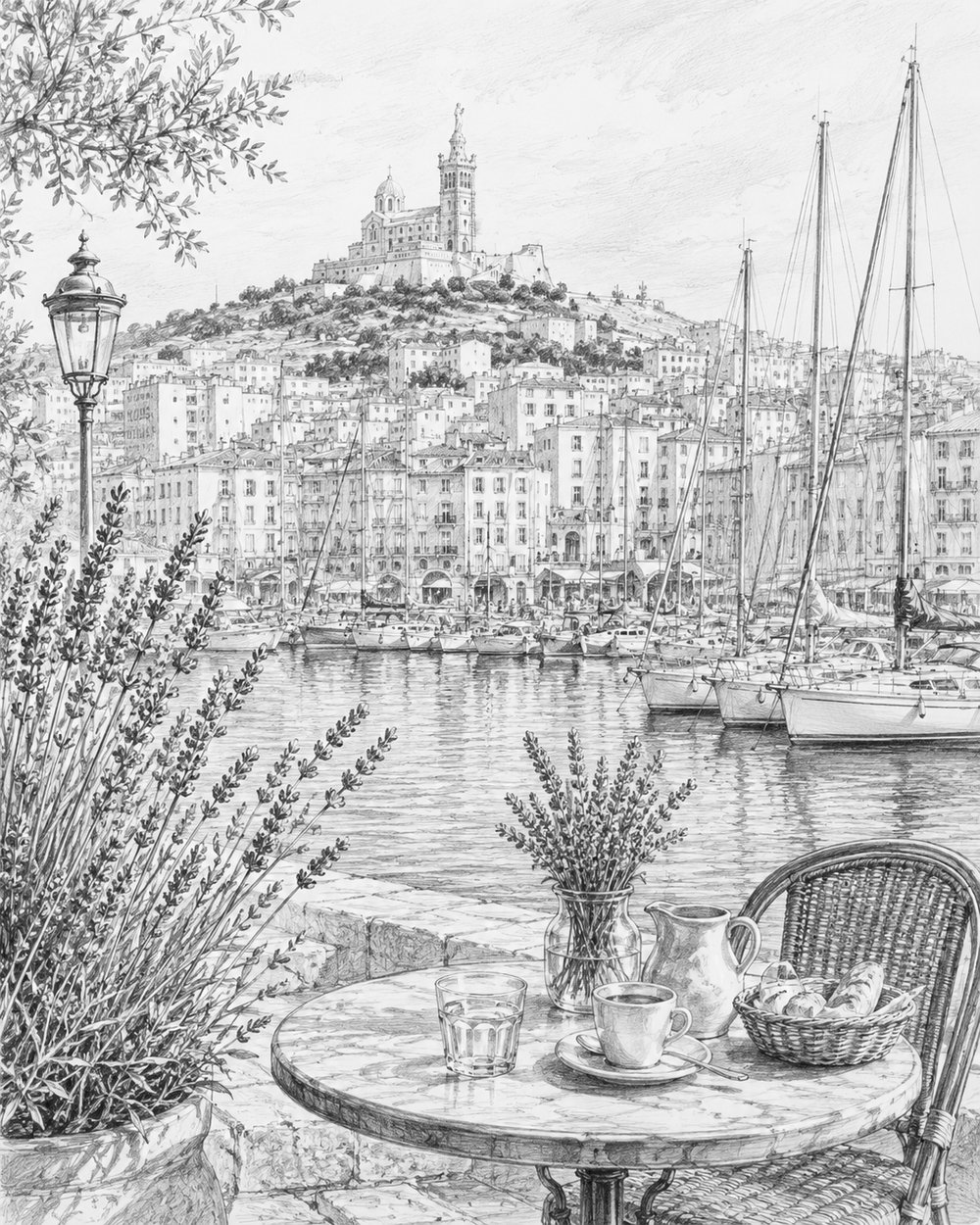
The Vieux-Port is the heart of Marseille and where the shuttle drops you, so it is the natural place to begin. This rectangular harbor has been in use since Greek sailors founded the city around 2,600 years ago, and it still fills with masts and small boats. Walk the quays, catch the morning fish market near the Quai des Belges where fishermen sell the night’s catch off the boats, and stand under Norman Foster’s mirrored pavilion, a steel canopy that reflects the whole scene overhead.
Notre-Dame de la Garde
The basilica of Notre-Dame de la Garde crowns the highest hill in Marseille, topped by a golden statue of the Virgin that locals call “la Bonne Mere” — the protector of sailors. The reason to go up is as much the view as the church: from the terrace you see the coastline, the Old Port far below, the offshore islands including the Chateau d’If, and the whole city against the sea. The climb is steep, so many take a taxi or the tourist road-train up.
Le Panier, the old quarter
Le Panier is Marseille’s oldest neighborhood, a hillside maze of narrow lanes, pastel shutters, staircases, and street art just north of the Old Port. It is made for wandering with no fixed plan, turning a corner into a tiny square, a craft shop, or a wall of murals. Give it an hour, wear shoes that handle cobbles and slopes, and let yourself get a little lost — it is one of the most atmospheric corners of the city and free.
The MuCEM
At the mouth of the Old Port, the MuCEM (Museum of European and Mediterranean Civilizations) is Marseille’s landmark modern building — a dark cube wrapped in concrete lacework, linked by a slender footbridge to the old Fort Saint-Jean. Even if you skip the exhibitions, the rooftop and walkways give you sea views and striking architecture, and the fort gardens are free to walk. It sits right beside Le Panier, making an easy waterfront stretch.
Bouillabaisse and a Provencal lunch
Bouillabaisse — the rich Marseille fish stew served in two courses, broth first with rouille and croutons, then the fish — was born in this port, and eating it here is part of the point. It is a serious, unhurried dish, so it suits a day when your all-aboard time leaves room for a proper sit-down meal. If time is tight, grilled fish, a pastis at a quayside cafe, or tapenade and ratatouille give you the flavor without the commitment.
The big decision: stay in Marseille or day-trip into Provence
This choice shapes your whole day. Marseille rewards a full day on its own, but it is also the front door to some of the most beloved corners of Provence, several reachable by train or road within a cruise call.
Aix-en-Provence
Elegant, honey-colored Aix is the classic Provence day trip — plane-tree boulevards, fountains, a lively market, cafes on the Cours Mirabeau, and the home of the painter Cezanne. It is the closest big excursion to Marseille and the easiest to combine with the city, delivering the postcard Provence of shaded squares and unhurried lunches in a compact package.
Arles
Arles is for history and art lovers. Its Roman amphitheater and theater are UNESCO-listed and still in use, the old town is well preserved, and Van Gogh painted some of his most famous canvases here. It sits farther from Marseille than Aix, so it eats more of your day in transit — a better pick if you can focus on one destination.
Cassis and the calanques
Just east of Marseille, the calanques are dramatic fingers of turquoise water set between white limestone cliffs, and the pretty harbor town of Cassis is the classic base for seeing them. Boat trips run from Cassis’s harbor into the inlets — the most scenic nature option near the port. It is weather-dependent, with boats and hikes limited on windy days, so it works best in calm conditions.
Lavender country, in season
The purple lavender fields that define the Provence of a thousand photographs bloom only in the warm months, roughly early summer, and the best-known ones (around the Valensole plateau and the Luberon) are a long way inland. If your call lands in the blooming window, this is a full-day commitment best done as an organized tour; outside the short season you will see harvested rows, not purple carpets. Confirm timing before you count on it.
Ship excursion vs going independent
Marseille is well set up for independent travel. The main rail station, Marseille Saint-Charles, connects to Aix-en-Provence, Arles, Cassis, and beyond, a manageable trip from the Old Port. Doing it yourself is cheaper and more flexible. The trade-off is that you own the timing — the terminal shuttle, the metro to Saint-Charles, and every connection are on you, and a missed return train is your problem, not the ship’s.
A ship excursion removes that stress. Your coach leaves from the terminal, a guide handles the logistics, and — the real value — the ship waits for its own tours if they run late. For the farther options, or a first time juggling European trains under a deadline, the tour is safer, while Marseille itself and nearby Aix are easy independently. Exploring the city and Old Port on foot is a fine day in its own right — much as you might do at Barcelona, a neighboring port on many Western Mediterranean loops.
How much time you need
A standard port call gives you time for one substantial plan, not two. In the city, a comfortable day is: shuttle in, the Old Port and fish market, up to Notre-Dame de la Garde, back through Le Panier and the MuCEM, then lunch. If you day-trip, treat it as your whole day — Aix and back with a few hours in town works well, while Arles or lavender country will use nearly every minute. Build in a generous buffer for the return and follow the all-aboard time in the app.
What to skip and watch out for
Do not try to combine a full Provence day trip with a full day in Marseille — you will do both badly and risk the return, so pick one. In high summer the hilltop basilica and exposed quays get hot and shadeless, so carry water and wear comfortable shoes for the slopes of Le Panier. Weather also governs the coast — if a strong mistral blows, Cassis boat trips and calanque hikes may be cut, so keep a city backup plan ready.
Cruise ships that visit Marseille
Marseille is a mainstay of Western Mediterranean itineraries, and a wide range of ships call here on loops that also visit ports like Barcelona and the Italian Riviera. If you are on one of these, our ship guides go deeper:
Frequently asked questions
Where do cruise ships dock in Marseille?
Large ships dock at the Marseille Provence Cruise Terminal at Mole Leon Gourret, in the industrial port area north of the city. It is several kilometers from the Old Port and not walkable, so plan on the shuttle bus, a taxi, or your ship’s excursion coach to reach town.
How do I get from the cruise terminal to the city center?
The usual route is the paid shuttle bus between the terminal and a drop-off near the Vieux-Port, the best base for the city; taxis are also available. Note the times and the last shuttle back in your cruise line’s app, since schedules vary by ship and sailing.
Should I stay in Marseille or take a day trip to Provence?
Both are good; the mistake is doing both in one day. Marseille alone fills a full port day with the Old Port, Notre-Dame de la Garde, Le Panier, and lunch. To see the countryside instead, pick one destination — Aix-en-Provence is easiest, with Arles, Cassis, and lavender country as bigger trips.
Can I visit Aix-en-Provence or Arles independently by train?
Yes. Marseille Saint-Charles station connects to Aix-en-Provence, Arles, and Cassis, and independent travel is cheaper and more flexible. The catch is that you manage every connection and the return under the all-aboard deadline, so leave a buffer or take a ship excursion for the farther towns.
When can I see the lavender fields?
Lavender blooms only in the warm months, roughly early summer, and the famous fields are a long way inland, so it is a full-day organized tour, not a quick add-on. Outside the short window you will see harvested rows instead of purple, so confirm timing first.
Is Notre-Dame de la Garde worth the trip up?
Yes — it is the city’s signature sight and gives the best views in Marseille, taking in the coast, the offshore islands, and the whole city below. The walk up is steep, so consider a taxi or the tourist road-train, especially in the heat.
How much time do I need for a Marseille cruise day?
A typical call gives time for one solid plan: the city loop of Old Port, basilica, Le Panier, MuCEM, and lunch fits comfortably, while a day trip fills the whole day. Marseille often pairs with a nearby call such as Naples on longer Mediterranean sailings, so check your itinerary to see how it fits your week.

Meet Leo: The Heartbeat Behind ‘A Country A Month’
Journeying through the pages of A Country A Month, you might often feel the rhythm of a storyteller’s heartbeat, pulsating through each line, each image, and each adventure shared. That heartbeat belongs to none other than our remarkable website editor, Leo.
With a lens in one hand and a pen in the other, Leo seamlessly marries his passions for photography and writing. His eye captures moments that words can barely describe, yet his eloquence brings those images to life, transcending borders and connecting us all through shared stories. An avid traveler, every country he’s visited has added another chapter to his expansive tale, and through our platform, he generously shares these chapters with us.