Planning a trip to Mexico City is easier when the city is treated as a set of connected neighborhoods and decisions, not a checklist of famous names. This complete guide brings together the essential sights, the right time to visit, transport, places to stay, food, realistic costs, and the choices that most affect a first trip.
Use this article with the complete Mexico City travel guide, the three-day itinerary, and the where-to-stay guide.
Start with a number that surprises almost everyone who has not been: Mexico recorded a record 47.8 million international arrivals in a recent year, and Mexico City, not a resort strip on the coast, is Latin America’s most visited capital. Ask a first-timer why, once they are home, and the easy answers (the food, the museums, the value) are all true and all incomplete. The real answer is that this is a city built in layers, and you can see every layer at once, often on the same block: a temple platform found by accident by electrical workers sits below a colonial cathedral whose bell towers visibly lean, two streets from glass towers and a mural by Diego Rivera. Most cities pick an era and perform it for visitors. Mexico City performs nothing. It simply keeps living on top of everything it used to be, and hands you the whole stack, all at once, on your first afternoon.
That is also, in plain terms, why this book exists rather than a folded map. Mexico City is enormous: about 9.2 million people inside the city proper, spread across sixteen boroughs and a high valley ringed by volcanoes, with a metropolitan area that reaches into the twenty millions, one of the largest urban concentrations on Earth. It sits at 2,240 meters, high enough that your first day here will remind you of that fact whether you asked it to or not. Its great neighborhoods feel like different cities entirely: Art Deco Roma Norte shares almost nothing with colonial Coyoacan, and neither resembles the floating gardens of Xochimilco, a UNESCO World Heritage site in its own right where families still farm the same canal plots their grandparents worked. A visitor who wings it here does not fail gently. They lose an afternoon to traffic between two neighborhoods that looked close on a map, or they queue at noon for a museum a booked timed slot would have skipped, or they wave down the wrong kind of taxi outside a nightclub at 1am, a mistake this book spends real pages making sure you never make.
This guide is built the way a longtime local friend would build it. First the city itself: what it feels like to stand in the Zocalo for the first time, how it grew from a lake island into a valley of sixteen million and more, and the signature sights everyone crosses an ocean for, with honest verdicts on which earn your time. Then the planning layer: when to come, how to get here and move around a city too big to walk end to end, and where to sleep. Then the city up close, neighborhood by neighborhood, each one with a walkable route you could tear out and follow this afternoon. Then the eating (this may be the best food city on Earth, and this book takes that claim seriously), the museums and culture, the day trips to Teotihuacan and beyond, and ready-made itineraries for one, two, and five days. And at the end, the deeper story: how a lake city became the largest metropolis in North America, and the taqueros, mariachi, market porters, and museum guides who keep it running.
A word on what this book is not. It is not a directory; Mexico City has apps and listings sites for that, and they update faster than any book can. What a book can still do better is judge, sequence, and tell the truth at length: which timed ticket to book the week you buy your flight, which famous stop is quietly optional, what order turns four sights into one effortless morning, and why the city looks the way it does, so the streets mean something once you have walked them. Every price, fare, and opening pattern in this book was accurate when it was written, and where things change often (transit fares, museum tickets, entry rules), you will see the phrase “as of this writing” and a pointer to the official site, because prices rise and booking rules shift here as everywhere. Where a restaurant or market appears by name, it is either an institution that has outlasted decades of trends or it is hedged by category and street, because nothing dates a guidebook faster than false certainty about things that change.
One honest note before the complete guide: altitude, distance, and a real language gap outside the main tourist neighborhoods mean Mexico City rewards a little preparation more than most cities on this list. It also repays that preparation better than almost anywhere else you could spend the same week.
Action Steps
- Give the city at least four to five days if this is your first visit; the itineraries in the complete guide are built for one, two, and five days, and five is where the city really opens up.
- Read the complete guide before you book anything, for the sights that want advance tickets, and the complete guide for the month that suits you.
- Plan a light first day. the complete guide explains why the altitude deserves that respect, and the complete guide gives you the full playbook.
- Decide early whether Roma Norte, Condesa, or another base fits your trip; the complete guide makes the case for each.
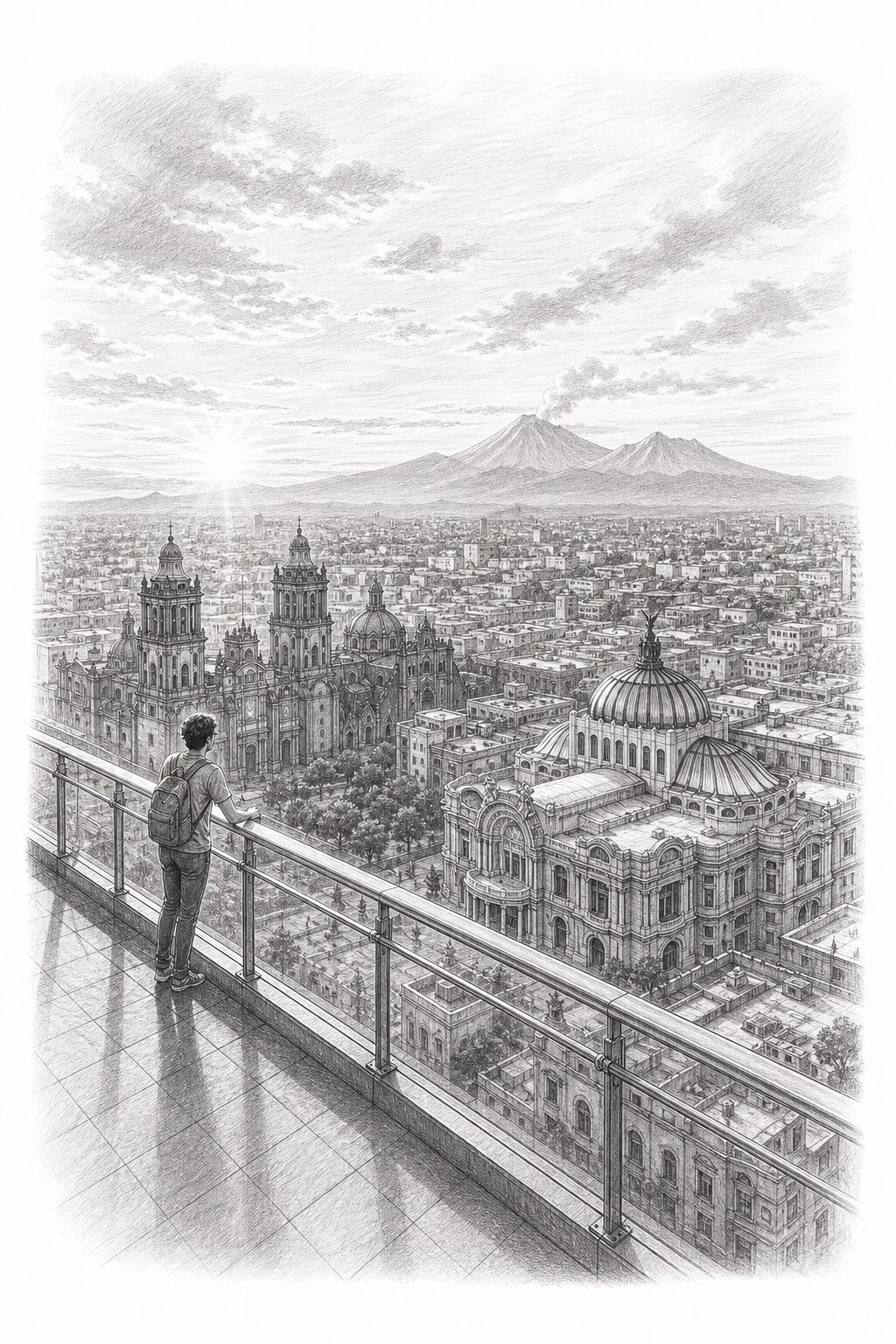
Stand in the middle of the Zocalo at nine in the morning, one of the largest public squares on Earth, and let your eyes do a slow circuit. To the north, the Metropolitan Cathedral rises in gray stone, and if you look closely at its towers you will notice they do not quite agree with vertical: the whole building leans, gently but unmistakably, because it sits on the drained bed of a lake that never entirely stopped trying to take its city back. To the east, the Palacio Nacional runs the length of a full block, its balcony the spot where a president rings a bell and shouts the cry of independence every September 15th to a packed square below. Somewhere near the Cathedral’s flank, a circle of danzantes concheros, dancers in feathered pre-Hispanic-style regalia, keep time on drums and conch-shell horns, a tradition that blends Indigenous and Catholic ritual and has been performed on this ground, in one form or another, for longer than the Cathedral has stood. And at your feet, mostly out of sight unless you walk one block over, sits the excavated stone heart of an entirely different city: the Templo Mayor of Tenochtitlan, found by accident in 1978 when electrical workers hit a carved stone disc with a shovel. You have been in Mexico City for one taxi ride from the airport, and you are already standing on top of four centuries at once.
Here is the thing that makes Mexico City Mexico City: that square is one neighborhood of a capital that contains dozens of others, and almost none of them look or feel like it. Twenty minutes southwest, tree-lined Roma Norte runs its Art Deco facades past mezcal bars and design shops. Further south, colonial Coyoacan arranges its twin plazas around a Franciscan church, calm and provincial in a way that seems impossible for a city this size. West, Chapultepec Park spreads for hundreds of hectares beneath a hilltop castle, and beyond it Polanco sells the city’s finest dining and shopping along a boulevard as polished as anything in Europe. Mexico City is not one city, and never has been, not even at the start. That is the organizing idea of this book, and the reason the neighborhood chapter, the complete guide, does most of the heavy lifting later on.
A city built on a lake
The shape of everything here traces back to a single origin story, and it is worth knowing before you walk another block. Around 1325, the Mexica, a Nahuatl-speaking people commonly called the Aztecs (a name that properly belongs to a broader group), founded the city of Tenochtitlan on a marshy island in Lake Texcoco, guided, according to legend, by a sign from the god Huitzilopochtli: an eagle perched on a nopal cactus, devouring a serpent, an image you now see on every Mexican flag. What they built on that island astonished the Spanish when they finally saw it: a metropolis of perhaps 200,000 people by 1519, larger than most cities in Europe at the time, threaded with canals and farmed on chinampas, floating agricultural plots still worked in Xochimilco today, organized around a sacred precinct now excavated as the Templo Mayor.
That first city ended violently. Hernan Cortes arrived in 1519, was received cautiously by the emperor Moctezuma II, fled the city in the chaos of the “Noche Triste” of 1520, then returned with a Spanish force reinforced by thousands of Indigenous allies who resented Mexica rule, and besieged the city for roughly three months. The new emperor, Cuauhtemoc, surrendered on August 13, 1521. The Spanish built directly on top of the ruins, using the fallen city’s own stones, and the new capital of the Viceroyalty of New Spain rose in their place, so wealthy and ornamented it became known as the “City of Palaces.” Independence came slowly, then all at once: the movement Miguel Hidalgo launched with his 1810 “Grito de Dolores” did not reach the capital until 1821, when Agustin de Iturbide’s forces entered the city and independence was formally declared that September, the root of today’s September 15 to 16 holiday. A brief, French-imposed empire under Maximilian I followed in the 1860s and left one lasting gift: Paseo de la Reforma, the tree-lined boulevard modeled on the avenues of Europe that still organizes the city’s west side. Porfirio Diaz’s long, modernizing, deeply unequal rule from 1876 to 1911 filled in more of that European ambition (Bellas Artes was begun under his government) while widening the gap that helped ignite the Revolution of 1910. The twentieth century then did something almost without precedent: the city held about 500,000 people in 1900 and passed 9 million by the 1980s, filling the valley floor with the low-rise grid you see today. A catastrophic 8.1-magnitude earthquake in 1985 killed thousands, reshaped the skyline, and, in its aftermath, reshaped the city’s civic culture too, as residents who organized their own rescue brigades when the government’s response fell short went on to reshape the city’s politics for decades afterward. By the time you read this, Mexico City’s turn hosting FIFA World Cup matches, including the tournament’s opening match at the historic Estadio Azteca, is recent history rather than news, but it left expanded hotel capacity and fresh interest in the stadium itself, one more layer on a city that never stops adding them.
The valley and its shape
Mexico City sits in a high valley ringed by volcanoes, Popocatepetl and Iztaccihuatl visible on clear days to the southeast, and that valley setting explains almost everything about how the city looks and moves. Rather than one compact historic core with everything radiating outward, you get a sprawling patchwork of low-rise grids and leafy colonias spread across sixteen boroughs, officially called alcaldias: Alvaro Obregon, Azcapotzalco, Benito Juarez, Coyoacan, Cuajimalpa, Cuauhtemoc, Gustavo A. Madero, Iztacalco, Iztapalapa, La Magdalena Contreras, Miguel Hidalgo, Milpa Alta, Tlahuac, Tlalpan, Venustiano Carranza, and Xochimilco. The historic center, where the Zocalo sits, occupies the drained bed of Lake Texcoco, which is why the ground beneath it still settles unevenly and why the Cathedral, and plenty of other colonial buildings around it, lean and sink a little more each decade. There is no single viewpoint from which Mexico City reveals itself the way a river or a harbor might organize another capital. You come to know this city one neighborhood at a time, and the complete guide is built entirely around that fact.
A day in the life
To feel the rhythm you are joining, run the city through one full turn. Before dawn, the flower market at Jamaica is already loud and fragrant, trading around the clock and never more spectacular than in that first gray light, while tamale carts and steamed-corn stands set up near metro exits for the morning rush. By seven, taqueros are firing up trompos for the evening’s al pastor while, at the other end of the meal clock, insulated bike baskets full of tacos de canasta start their morning rounds, a workday breakfast eaten standing. Desayuno runs late and unhurried, chilaquiles and eggs served from seven to eleven, while the Zocalo’s flag ceremony and the danzantes concheros’ drums mark the historic center’s own opening hours. Midday brings the meal that actually organizes the day: comida, taken between two and four, often multi-course, often a set comida corrida, the reason restaurants here can feel oddly quiet at what other cities call dinner hour. From June through October the afternoon sky tends to darken fast around this same window, delivering a predictable downpour that can flood a street within twenty minutes and clear an hour later, so locals plan their outdoor hours before it, not after. As dusk settles, mariachi bands in full charro dress begin gathering at Plaza Garibaldi, tuning up for a night of hired songs running past midnight on weekends, and cena arrives lighter and later, eight to ten, sometimes not at all beyond a late torta. The city keeps this rhythm, with variations for altitude, rain, and season, every single day of the year. You are stepping into a performance that has run, more or less unbroken, for seven hundred years.
The numbers, briefly
Mexico City proper holds about 9.2 million people as of the last census, and the wider Valley of Mexico metropolitan area reaches into the twenty millions, one of the largest urban agglomerations on the planet. It sits at 2,240 meters, about 7,350 feet, an elevation that shapes everything from your first-day breathing to your second-day sunburn. Mexico logged a record 47.8 million international arrivals in a recent year, and within that flow, Mexico City stands as Latin America’s most visited capital, anchored by the Historic Center, a UNESCO World Heritage Site since 1987, and by Chapultepec Park. The Anthropology Museum and the Frida Kahlo Museum are consistently the most visited paid sights; the Cathedral and the Zocalo are the busiest free ones. This is also home to the largest in-situ collection of Diego Rivera murals in the world, and its food culture earned UNESCO Intangible Cultural Heritage recognition in 2010, a distinction very few cuisines on Earth hold.
What genuinely makes it special
Plenty of cities have history. Mexico City has continuity you can put your hand on: an excavated Aztec temple platform sitting beside a colonial cathedral built partly from its own stones, both of them a few minutes’ walk from towers finished this decade, often on the same block. The murals of Diego Rivera, Jose Clemente Orozco, and David Alfaro Siqueiros turn public buildings, the Palacio Nacional above all, into history lessons painted at the scale of a wall. The food culture is not a marketing line; it is a UNESCO-recognized tradition running from street-corner tacos al pastor to some of the most ambitious tasting menus in the Americas, and you can eat astonishingly well at every single price point along that range. Add tree-shaded, walkable neighborhoods like Roma and Condesa that feel like a European capital reimagined at Latin American prices, and you get real value against London, Paris, or New York on food, drink, and mid-range lodging alike.
The honest cons matter just as much, because this book deals straight with you. The altitude affects nearly every visitor for a day or two, covered fully in the section just ahead. The city is too large to walk between districts, so plan by neighborhood cluster, not by how close two dots look on a map. Spring brings occasional smog alerts from March through May, worth checking if you have respiratory sensitivity. The rainy season, June through October, brings fast, flooding afternoon downpours, predictable enough to plan around but disruptive if you do not. And there is a real, geographically specific safety picture that visitors both overestimate and underestimate: cartel-related violence is not a problem inside the tourist-facing neighborhoods this book covers, but taxi scams and pickpocket teams on crowded transit are, and the complete guide names every one of them plainly. Finally, the language gap here runs wider than in Western Europe outside hotels and major sights, so a little Spanish, or at least the phrase kit in the complete guide, goes a long way.
The districts at a glance
You get the full walking-route treatment in the complete guide, but start forming the mental map now. Centro Historico holds the postcard: the Zocalo, the Cathedral, the Templo Mayor, and the murals inside the Palacio Nacional and Bellas Artes. Roma Norte, just southwest, pairs Art Deco elegance with the city’s best restaurant density; its leafy neighbor Condesa wraps two Art Deco parks in a calmer, quieter version of the same charm. West of both, Chapultepec Park and Polanco sit side by side, hundreds of hectares of park and museums next to the city’s most upscale shopping and dining street. South, Coyoacan arranges colonial plazas around the Frida Kahlo Museum, and Xochimilco floats its canal-borne markets past working chinampas, a UNESCO World Heritage landscape in its own right. San Angel offers a quieter, cobblestoned cousin of Coyoacan with a celebrated Saturday art market, and the markets belt around La Merced and Tepito shows you the working city at full volume, best explored by day and with a plan, covered honestly in the complete guide alongside everywhere else.
A word on altitude, since you will ask
Every visitor asks about it eventually, so here is the primer now. At 2,240 meters, most people notice something in the first 24 to 48 hours: a shorter fuse on the stairs, a mild headache, tiredness earlier than expected in the evening, usually milder than at a true high-altitude destination and gone on its own within a day or two. The fix is unglamorous and effective: drink more water than you think you need, go easy on alcohol and strenuous activity on day one, keep over-the-counter pain relief on hand for the headache, and know that the sun is stronger than the temperature suggests, so sunscreen belongs in your routine even on a mild, overcast day. the complete guide covers the rest of the practical picture, but the conversation starts here, because altitude is the one part of this city that affects literally everyone who steps off the plane.
Who this city is best for
Mexico City is close to a perfect trip for food travelers, museum and history people, neighborhood-café wanderers, and art and architecture travelers chasing murals or the austere modernist houses of Luis Barragan. It rewards value-conscious travelers who want a genuinely world-class capital without European prices, and it rewards return visits better than almost any city its size, because the second and third trips are where San Angel’s Saturday market, a slow Xochimilco morning, and a proper Roma comida corrida start to live.
Who might prefer somewhere else? Travelers who want one compact, traffic-free colonial core with everything inside walking distance; that is Oaxaca’s job, or Guanajuato’s, and either pairs beautifully with Mexico City as an add-on rather than a replacement. Anyone with a serious heart or lung condition should get medical clearance first, given the altitude. And beach-seekers should simply know what they are getting: this is a temperate highland capital, not a coastal escape, so pair it with a coastal add-on if a beach is part of the dream. For nearly everyone else, this is one of the great city trips available anywhere on Earth right now.
Action Steps
- Fix the layered-city idea in your head now: Aztec beneath colonial beneath modern, often on the same block; that layering is the whole reason to come.
- Accept the scale early. Plan days by neighborhood cluster, never by how close two things look on a map; the complete guide does this work for you.
- Build in a light first day for the altitude; it affects nearly everyone for a day or two, and respecting it on day one buys you a much better day two.
- If this is your first visit, aim for four to five days minimum; that is the difference between seeing the postcard and meeting the city underneath it.
Frequently asked questions
How many days are enough for Mexico City?
Three well-planned full days cover a strong first visit, while four or five allow slower neighborhoods, additional museums, or a day trip. Count usable sightseeing days rather than hotel nights.
What should be booked first?
Reserve the experience you would be most disappointed to miss, then secure lodging and any limited-entry sights. Verify current rules and opening information on the official operator’s website shortly before travel.
How do you avoid rushing?
Group each day geographically, allow time for security and transport, and treat extra stops as optional. One demanding reservation plus nearby flexible experiences usually produces a better day than a chain of timed entries.
Continue planning Mexico City
- Complete Mexico City travel guide
- 3 days in Mexico City: first-time itinerary
- Where to stay in Mexico City
- Best things to do in Mexico City
- Mexico City food guide
- Mexico City first-time tips
- Mexico City on a budget
Meet Leo: The Heartbeat Behind ‘A Country A Month’
Journeying through the pages of A Country A Month, you might often feel the rhythm of a storyteller’s heartbeat, pulsating through each line, each image, and each adventure shared. That heartbeat belongs to none other than our remarkable website editor, Leo.
With a lens in one hand and a pen in the other, Leo seamlessly marries his passions for photography and writing. His eye captures moments that words can barely describe, yet his eloquence brings those images to life, transcending borders and connecting us all through shared stories. An avid traveler, every country he’s visited has added another chapter to his expansive tale, and through our platform, he generously shares these chapters with us.