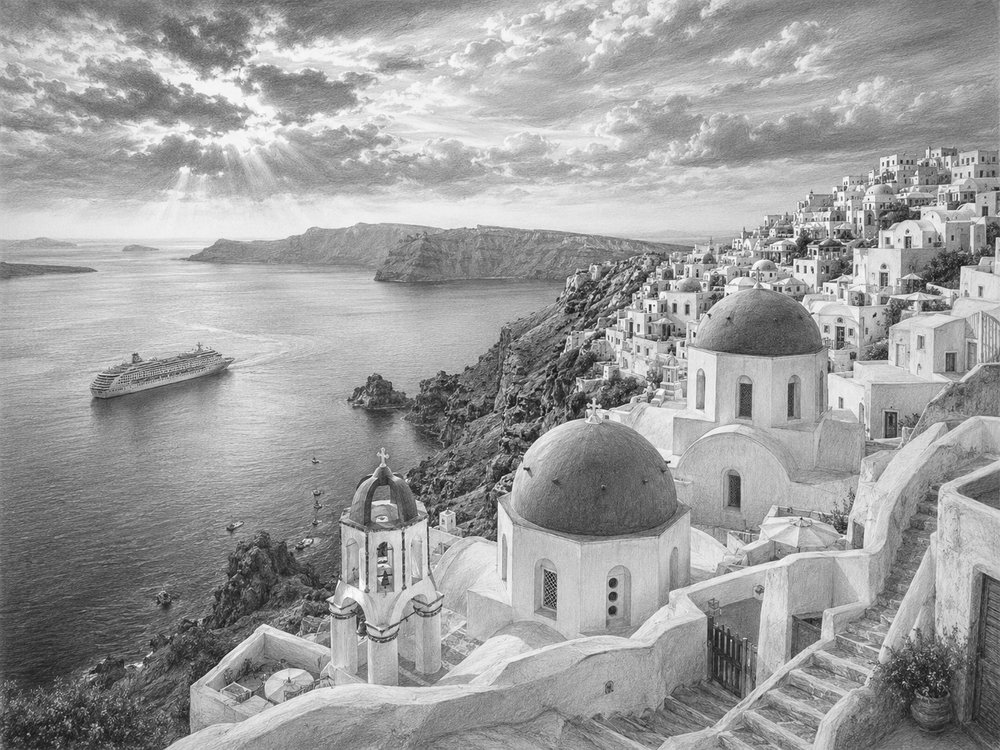
Santorini is one of the most dramatic ports a cruise ship can call at, and one of the trickiest to plan. Your ship anchors in a flooded volcanic caldera, ringed by cliffs that rise hundreds of feet out of the sea, with the white town of Fira along the rim above you. This Santorini cruise port guide covers the one thing every first-timer needs to understand: it is a tender port, and the climb from the water up to town is the day’s first challenge. The short version: tender ashore early, get up to Fira, choose one big thing to do, and leave a generous buffer to get back down.
Where your ship docks: the old port below Fira
Santorini has no cruise pier: the caldera is too deep and the cliffs too sheer, so nearly every ship anchors offshore and tenders passengers to the small old port (Skala) directly below Fira, at the base of the cliff. From there, Fira sits about 200 meters straight up the caldera wall, and you have three ways to make the climb.
The cable car
The cable car is the fast, sweat-free option, running from the old port up to Fira in a couple of minutes. The catch is capacity. It carries only a handful of people per cabin, and when several ships are in on the same day, the queue at the bottom can swallow a big part of your morning, and the queue at the top to come back down is often worse in the afternoon. Ride up early before the crowds build, and plan around the return line.
The donkey path
The famous Santorini donkeys carry riders up the same zigzag path. It is a photogenic tradition, but be honest: the trail is steep, hot, and shared with everyone walking, and many travelers have real concerns about the animals’ welfare and how the ride is run. Plenty of visitors skip it for those reasons.
Walking the steps
The third option is your own two feet, up the roughly 580 switchback steps. It is free and delivers the best caldera views of the three, but it is a genuine workout in the sun, and the steps are shared with the donkeys, which means dodging animals the whole way. Wear real shoes, carry water, and only take this on if you are reasonably fit. Coming down at the end of the day is much easier than going up, and a smart way to dodge the cable car’s afternoon queue.
Top things to do on a port day
Fira and the caldera views
Fira is the island’s capital and where most cruise passengers arrive. Its whitewashed lanes are packed with cafes, shops, and viewpoints that hang right over the caldera, with the ships far below and the volcanic islets of Nea Kameni in the middle of the bay. Fira is walkable and rewarding on its own if you would rather not commit to a long transfer elsewhere.
Oia and the blue domes
Oia (pronounced “ee-ah”), at the northern tip of the island, is the Santorini of postcards: the blue-domed churches, tumbling white houses, and narrow marble lanes framing the sea. It is the most photographed spot in Greece for a reason. Oia is also where the world-famous sunset draws enormous crowds, though most cruise passengers are back aboard well before sunset, so you will usually see it in daylight, which is lovely and far less crowded. Getting there from Fira takes some effort, the trade-off you weigh below.
Akrotiri and ancient Thera
If you have any interest in archaeology, Santorini has two extraordinary sites. Akrotiri is a Bronze Age Minoan town buried and preserved by the same volcanic eruption that shaped the island, so complete it is often called the “Minoan Pompeii,” with multi-story buildings, streets, and frescoes under a modern roof. Ancient Thera is a later Greek and Roman city spread across a high ridge in the southeast. Both are excellent alternatives to fighting the Fira and Oia crowds.
Wineries and Assyrtiko
Santorini’s volcanic soil and bone-dry climate produce a distinctive white wine, and the star grape is Assyrtiko: crisp, mineral, and unmistakably of this place. The vines are trained low in basket-like coils called “kouloura” to shield the grapes from wind and trap moisture. Several wineries in the interior welcome visitors for tastings with caldera or vineyard views, and a wine afternoon is one of the most relaxed ways to spend a port day here.
The beaches
Because Santorini is volcanic, its beaches look like nowhere else in Greece. Red Beach, near Akrotiri, sits beneath dramatic rust-colored cliffs and is one of the most striking spots on the island, though the approach can be rough underfoot, so check current conditions. On the southeast coast, Perissa and Kamari have long stretches of black volcanic sand with sunbeds, tavernas, and easier swimming. These beaches sit opposite the caldera towns, so a beach day means committing to the transfer and skipping Oia.
Ship tour vs independent: getting around the island
Once you are up in Fira, Santorini is easy to explore on your own, which makes it a strong candidate for going independent. The public bus network, run by KTEL, radiates from the main station in central Fira to Oia, Akrotiri, Perissa, Kamari, and the other main towns for a fraction of any tour price. Buses are frequent in high season but do fill up, so allow extra time and do not count on the last one back. Taxis are limited in number and get snapped up fast on busy cruise days.
A ship’s shore excursion costs more, but it buys a guaranteed seat, a guide, and, most importantly, the ship’s promise to wait if the tour runs late, which matters at a tender port where the return bottleneck is real. If it is your first time here, or you want to combine a winery, Oia, and Akrotiri in one trip, a ship tour removes the stress. Independent travelers who plan carefully will save money and move at their own pace. Santorini pairs well with the rest of a Greek Isles itinerary, so if your sailing also stops at Mykonos or begins from Athens (Piraeus), you can plan your independent days as a set.
How much time you need and how to get back in time
A typical cruise call gives you most of a day ashore, enough for one focused plan but not everything. Be realistic: you can do Fira plus one major thing (Oia, a winery, Akrotiri, or a beach), not all of them. Trying to cram in the whole island is how people end up sprinting for a tender.
The single most important discipline at Santorini is the return climb. The afternoon cable-car queue at the top in Fira is notorious, and when several ships are tendering passengers back at once, the wait can run to an hour or more. If you went to Oia or a beach by bus, aim to be back in Fira long before all-aboard, because a delayed bus plus a long cable-car line eats your margin fast. Consider walking down the steps instead of queuing. On an independent day the ship is under no obligation to wait, so treat the posted time as firm.
What to skip and watch out for
- Crowds and timing: Santorini can host several large ships at once, and the caldera towns get intensely busy from mid-morning. Getting ashore on an early tender is the best crowd-avoidance move you can make.
- Heat and sun: there is little shade on the cliff paths, the steps, or at the ruins. Carry water, wear sunscreen and a hat, and pace yourself.
- Footwear: marble lanes, cobbles, and volcanic beaches are unforgiving. Leave the nice shoes on the ship.
- The donkey ride: many travelers skip it over animal-welfare concerns; decide for yourself, and never rely on it to get back to a tender.
- Prices: this is a premium, high-demand island, so cafes, tastings, and transfers cost more than elsewhere in Greece. Confirm current prices as you go.
Cruise ships that visit Santorini
Santorini is a marquee stop on Greek Isles itineraries, and a wide range of ships tender here through the sailing season. If your ship is among those below, its own guide has deck-by-deck details and tips for the ports on your route:
Frequently asked questions
Is Santorini a tender port for cruise ships?
Yes. The caldera is too deep and the cliffs too steep for ships to dock, so nearly all cruise ships anchor offshore and tender passengers to the old port below Fira. From there you go up by cable car, the donkey path, or on foot up the steps.
What is the best way to get from the old port up to Fira?
The cable car is fastest but has limited capacity and long queues on busy days, especially coming down in the afternoon. Walking the roughly 580 steps is free and scenic but hot and shared with the donkeys. Ride the cable car up early and consider walking down to skip the return line.
Can I get from Fira to Oia on my own?
Yes. Local KTEL buses run frequently from the main station in Fira to Oia and cost far less than a tour. They can fill up on busy cruise days, so allow extra time and never rely on the very last one back before all-aboard.
Should I book a ship excursion or explore independently?
Independent travel is very doable here and saves money, thanks to the KTEL buses. But a ship excursion guarantees your seat, includes a guide, and means the ship will wait for your group if the tour runs late, which is reassuring at a tender port.
What can I realistically see in one cruise day?
Plan on Fira plus one major experience: Oia, a winery, the Akrotiri ruins, or a black-sand beach. The island is bigger than it looks, and transfers plus cable-car queues eat time, so trying to do everything ends in a rush back to the tender.
How do I make sure I get back to the ship in time?
Give yourself a big buffer for the return climb. The afternoon cable-car queue at the top in Fira can take an hour or more when several ships are in, so head back well before all-aboard, and remember that walking down the steps is often faster than queuing.
What should I wear and bring for a day in Santorini?
Sturdy walking shoes are essential for the steps, marble lanes, and volcanic beaches. Bring water, sunscreen, and a hat, because there is little shade on the cliff paths or at the ruins. A little cash is handy for the bus and small cafes, and confirm current fares and prices as you go.

Meet Leo: The Heartbeat Behind ‘A Country A Month’
Journeying through the pages of A Country A Month, you might often feel the rhythm of a storyteller’s heartbeat, pulsating through each line, each image, and each adventure shared. That heartbeat belongs to none other than our remarkable website editor, Leo.
With a lens in one hand and a pen in the other, Leo seamlessly marries his passions for photography and writing. His eye captures moments that words can barely describe, yet his eloquence brings those images to life, transcending borders and connecting us all through shared stories. An avid traveler, every country he’s visited has added another chapter to his expansive tale, and through our platform, he generously shares these chapters with us.