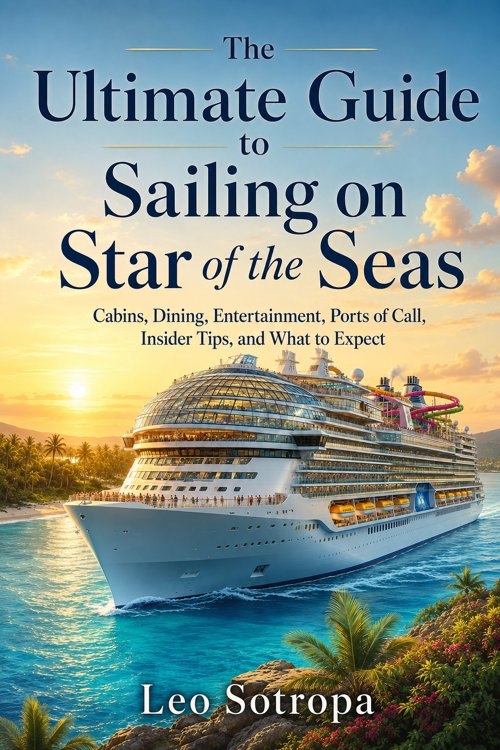
Is the Star of the Seas book worth reading before your cruise, and will it actually make your trip easier? Yes on both counts. The Ultimate Guide to Sailing on Star of the Seas by Leo Sotropa is an independent handbook written for one ship and one ship only: Royal Caribbean’s Star of the Seas, the second vessel in the Icon Class. It is not a general cruise primer that mentions dozens of ships in passing. It is a focused, room-by-room, deck-by-deck companion to a single 248,663-gross-ton floating resort, and it exists to answer the questions you will actually have once you are standing at the terminal in Port Canaveral with a boarding pass and a lot of decisions ahead of you.
This page explains what the book is, what is inside it, who gets the most out of it, and why a guide built around a specific ship saves you more time and money than a broad overview ever could. If you already know you want it, there is a link to buy it further down. If you want to read something free first, this site also hosts a set of companion articles about Star of the Seas that you can browse before you decide.
What the Star of the Seas book actually is
The Ultimate Guide to Sailing on Star of the Seas is part of the Ultimate Ship Guides series by Leo Sotropa. Each title in the series takes a single modern cruise ship and treats it the way a good city guide treats a city: it maps the layout, tells you where the good stuff is, warns you about the tourist traps, and gives you a plan for making the most of limited time. This particular volume is dedicated entirely to Star of the Seas, so every page is about the ship you are sailing on, not a hypothetical average of a whole fleet.
It is independent and unofficial. That matters. Because it is not published by the cruise line, it can be honest about the parts that disappoint, the cabins that are noisy, the venues that are overhyped, and the extras that quietly add up. The tone throughout is practical and warm rather than promotional. You are getting the perspective of someone who has studied how this ship works and wants you to avoid the mistakes that cost first-timers their money and their patience.
The book comes in two formats, Kindle and a 6×9 paperback, and it is illustrated with graphite chapter illustrations that give it a calm, hand-made feel rather than a glossy brochure look. The most useful structural detail is small but consequential: every chapter ends with a set of clear Action Steps. Instead of closing a chapter with a vague summary, the book hands you a short list of concrete things to do, book, confirm, or pack. That turns reading into planning, which is exactly what you want in the weeks before you sail.
One thing the book is honest about from the start: it is a companion, not a live database. Venues, itineraries, and prices change, so the author repeatedly points you to the Royal Caribbean app to confirm the current details for your specific sailing. The book gives you the judgment and the strategy; the app gives you today’s schedule. Used together, they cover you completely.
What’s inside the book
The guide follows the shape of a real cruise, from the moment you start planning to the last port of call. Here is what each major section gives you, grounded in the ship it covers.
The layout and the eight neighborhoods
Star of the Seas is enormous, roughly twenty decks and up to about 7,600 guests at full occupancy, and finding your way around is a genuine skill. The book opens by teaching you how the ship is organized so you stop wasting vacation time walking in circles. Star is built around eight neighborhoods, and the guide explains what each one is for: the indoor main street of the Royal Promenade, the open-air garden and restaurants of Central Park, the glass-domed AquaDome at the bow with its theater and food hall, the main pools of Chill Island, the thrill rides and waterpark of Thrill Island, the family-focused Surfside, the adults-only suspended infinity pool of The Hideaway, and the private Suite Neighborhood. Once you understand the neighborhood map, the whole ship stops feeling like a maze.
The cabin guide: which to book and which to avoid
This is the chapter that can pay for the book several times over. Star of the Seas offers around twenty-eight stateroom types across the usual tiers, from Interior and Ocean View up through Balcony and Suite, plus a set of specialty rooms like Central Park-view balconies, AquaDome Panoramic ocean views, Surfside family rooms, and the Infinite balcony, where the balcony is a drop-down window wall inside the room rather than a separate open-air ledge. The book walks you through the trade-offs instead of just listing categories.
It names the value picks, such as the Interior Plus room with its bigger walk-in closet, and the best all-round choice for most people, a midship Ocean View Balcony on Decks 8 to 10 for space, light, and the least motion. It explains where families should look, including the Family Infinite Ocean View Balcony that sleeps up to six with real bunk beds and a split bathroom, the Surfside Family Suite with its semi-private kids’ area and Sky Class perks, and the multi-level Ultimate Family Townhouse with its own slide, which sits at the top of the price ladder and sells out. It also decodes the Royal Suite Class tiers, Sea, Sky, and Star, so you understand what escalating suite prices actually buy.
Just as valuable is the list of cabins to avoid: rooms directly under the pool deck or under The Hideaway where you will hear scraping deck chairs early in the morning, cabins near the AquaDome, interior-facing rooms that look onto busy walkways instead of the sea, and far-forward high suites that feel the most motion. The guide tells you to confirm every one of these against the live deck plan, but knowing what to look for is the difference between a peaceful room and a week of interrupted sleep. If cabin choice is your main worry, the free companion article on the best cabins on Star of the Seas gives you a taste of this approach before you buy.
The dining guide
Dining on a ship this size is a puzzle of included venues, extra-cost venues, and reservations you should lock in before you board. The book separates them clearly. On the included side it covers the Main Dining Room, the Windjammer buffet, Surfside Eatery, casual spots, and the AquaDome Market food hall, whose stalls include La Cocinita for South American food, Pig Out BBQ, Mai Thai, Feta Mediterranean, and Creme de la Crepes. On the specialty side, where you pay extra, it weighs up whether places like Chops Grille and Izumi are worth it, and it gives special attention to the Lincoln Park Supper Club, a 1930s Chicago-themed room with live jazz and a dinner-and-show format that is a genuine event rather than just a meal.
The point of the chapter is not to tell you to eat everywhere. It is to help you spend your dining budget where it actually improves the trip, and to tell you which tables to reserve early because they fill up. Prices are kept relative throughout, so the advice stays useful and you confirm the current numbers in the app.
Entertainment and the signature thrills
Star of the Seas carries a headline theater production of Back to the Future: The Musical, plus an aqua show called Torque, an ice-skating show called SOL in the Absolute Zero ice arena, and a robot-themed production called Create, alongside live music venues around the ship. The book explains what each show is and, more importantly, when to see it, because timing is everything when several thousand people want the same seats.
Then there are the thrills. Star has the largest waterpark at sea, the Category 6 waterpark with six record-setting slides including the tallest drop at sea and an open free-fall slide, plus the FlowRider surf simulator, the Crown’s Edge skywalk out over the water, and a rock wall. The guide gives you insider timing to beat the lines so you actually get to ride these things instead of standing in a queue for an hour. There are seven pools too, including Royal Bay, the largest pool at sea, the Swim & Tonic swim-up bar, the adults-only Hideaway, the Chill Island pools, and Splashaway Bay for young kids. For a preview of the onboard experience, the companion piece on what to expect on Star of the Seas covers a lot of this ground for free.
The ports of call
Star sails week-long round trips out of Port Canaveral, which sits about an hour from Orlando and its theme parks, making a cruise-and-parks combination easy. The book includes an in-depth ports chapter with destination guides, top excursions, and a must-do shortlist for each stop. Sailings typically alternate between an Eastern route and a Western route. The Eastern itinerary pairs Royal Caribbean’s private island, Perfect Day at CocoCay, with San Juan in Puerto Rico and Philipsburg in St. Maarten. The Western itinerary pairs CocoCay with Costa Maya and Cozumel in Mexico and Roatan in Honduras.
For each port the guide points you toward the real, worthwhile attractions: the included beaches and paid upgrades at CocoCay, the forts and blue cobblestones of Old San Juan, the two-nation shopping and beaches of St. Maarten, the Mayan ruins near Costa Maya, the world-class reef snorkeling at Roatan and Cozumel. It is careful to note that ports can vary by date, so you always confirm your exact sailing, but the shortlists give you a plan rather than a scramble. The free article on Star of the Seas ports and excursions is a good place to see how this chapter thinks.
Money, value, and avoiding upcharges
Some of the most useful pages are about money. The book lays out what is already included in your fare, when add-on packages actually pay off, and how to sidestep the small upcharges that quietly inflate a bill. It explains how the SeaPass card works as your onboard cashless account, that daily gratuities are added automatically, and that there is no free ship-wide Wi-Fi, so internet is a paid plan you should decide on deliberately. None of this is presented as a way to be cheap. It is about spending on the things that matter to you and not leaking money on the things that do not.
Family know-how and adults-only escapes
Star is designed to hold a wide range of travelers at once, and the book speaks to all of them. Families get guidance on Adventure Ocean, the kids’ club, on Splashaway Bay for the youngest, on the dedicated teen space, and on the Surfside neighborhood with its carousel, splash zone, and casual food. Couples and adults get the map to the quieter corners, above all The Hideaway with its suspended infinity pool and party atmosphere. The result is a plan where parents and non-parents on the same booking can each have the trip they wanted. If you are traveling with kids from the Orlando area, the companion article on the Star of the Seas Orlando family cruise is worth a look.
Embarkation strategy, pro tips, and Action Steps
The book covers embarkation day as a strategy in itself, because the first few hours set the tone for the week: what to do the moment you board, what to book before the crowd catches up, and how to use the app for your boarding pass, deck maps, daily schedule, reservations, and check-in. There is also a dedicated chapter of pro tips, common pitfalls, and FAQs that gathers the small lessons most people only learn the hard way. And because every chapter closes with Action Steps, you finish the book with a genuine to-do list rather than a head full of loose facts.
Who the book is for
First-time cruisers get the most obvious benefit. If you have never sailed on a ship of this scale, the sheer number of choices can be overwhelming, and the book turns that overwhelm into a sequence of manageable decisions. It explains the vocabulary, the systems, and the etiquette so you walk on board already knowing how things work. The free guide on a first-time cruise on Star of the Seas pairs naturally with the book for anyone in this group.
Families benefit because the ship is genuinely complicated to plan for when different ages want different things, and the guide keeps everyone’s needs in view at once. Seasoned cruisers benefit too, because even experienced sailors have not necessarily sailed this specific ship, and Star of the Seas has venues, shows, and layout quirks that differ from other Icon-class vessels and from the rest of the fleet. The book gets an old hand up to speed on what is new here without wasting their time on cruising basics they already know.
Finally, it makes a thoughtful gift. If someone you know has a sailing on Star of the Seas booked, a focused guide to their exact ship is a present that shows you paid attention, and it will genuinely improve their trip. Because it is short, illustrated, and organized around action rather than trivia, it is the kind of book a recipient actually reads instead of shelving.
Why a ship-specific guide beats a generic cruise primer
A general cruise book has to hedge. It cannot tell you which cabin numbers sit under the pool deck, because it is describing a dozen ships at once. It cannot tell you that the supper club on this ship has a 1930s Chicago theme, or that the headline show is Back to the Future: The Musical, or which food-hall stall is worth crossing the ship for. A ship-specific guide can, because it only has one ship to describe, and that specificity is where the real time and money savings live.
The deeper benefit is stress. Most pre-cruise anxiety comes from not knowing what to expect and worrying you will miss something or overpay. A guide that walks you through your actual ship, in order, with a to-do list at the end of every chapter, replaces that anxiety with a plan. You board knowing where you are going, what you have already reserved, and what you have deliberately chosen to skip. That confidence is the whole point, and it is something a broad overview simply cannot deliver. The companion overview on the Star of the Seas cruise guide shows the same ship-specific mindset in a free format.
About the author and the series
The book is written by Leo Sotropa as part of the Ultimate Ship Guides series, a growing collection of independent handbooks that each take a single modern cruise ship and cover it in practical depth. The companion website for the series is acountryamonth.com, which hosts free articles about Star of the Seas and other ships. Those free guides are a good way to sample the author’s approach before committing to the full book, and they cover topics from cabins to ports to general tips.
The philosophy behind the series is consistent: be independent, be specific, be honest, and turn information into action. The books are not affiliated with the cruise line, which is exactly why they can be candid about what to skip. And because the details on any ship shift over time, every guide sends you back to the Royal Caribbean app to confirm the current venues, itineraries, and prices for your own sailing.
Get The Ultimate Guide to Sailing on Star of the Seas
The Ultimate Guide to Sailing on Star of the Seas by Leo Sotropa, part of the Ultimate Ship Guides series, is an independent, ship-specific handbook available on Kindle and paperback, with clear Action Steps in every chapter so you turn reading into a ready-to-go plan for your cruise.
Frequently asked questions
Is the book official or independent?
It is independent and unofficial. It is not published by or affiliated with Royal Caribbean, which is precisely what lets it be honest about the cabins to avoid, the venues that are overhyped, and the upcharges worth sidestepping. You get a candid, practical perspective rather than marketing copy.
Should I get the Kindle or the paperback?
Both contain the same content, so it comes down to how you like to read. The Kindle edition is convenient to carry and search on your phone while you are on the ship. The 6×9 paperback, with its graphite chapter illustrations, is easier to flag and hand around during planning and makes the better gift. Many readers use the ebook on board and keep the paperback for planning at home.
Is the book up to date?
The guide describes the latest edition of Star of the Seas and its neighborhoods, venues, and typical itineraries. Because cruise details change over time, it keeps prices relative rather than exact and repeatedly tells you to confirm the current venues, schedules, and itineraries in the Royal Caribbean app for your specific sailing. The book supplies the strategy; the app supplies today’s details.
Does it cover this ship’s specific ports?
Yes. There is a full ports-of-call chapter covering the stops on Star’s round trips from Port Canaveral, including Perfect Day at CocoCay, San Juan, St. Maarten, Costa Maya, Roatan, and Cozumel, with destination guides, top excursions, and a must-do shortlist for each. It also reminds you that ports can vary by date, so you confirm your exact sailing before booking excursions.
Is it good for first-time cruisers?
It is especially good for first-timers. It explains how a ship of this scale works, from the SeaPass card and the app to embarkation-day strategy and reservations, and it turns a long list of unfamiliar choices into a manageable sequence. First-time cruisers tend to get the biggest return on the book because it prevents the common, costly mistakes.
Would it make a good gift?
It makes a thoughtful gift for anyone who already has a Star of the Seas sailing booked. A guide dedicated to their exact ship shows you paid attention, and it will genuinely improve their trip. It is short, illustrated, and organized around action steps, so it is the kind of book a recipient actually reads rather than sets aside.
Does the book replace the Royal Caribbean app?
No, and it does not try to. The two work together. The app is your live tool for boarding passes, deck maps, the daily schedule, reservations, and current prices. The book is the judgment layer on top: what those options mean, which to choose, when to see the shows, which cabins to avoid, and how to plan each port. Bring both and you are covered.

Meet Leo: The Heartbeat Behind ‘A Country A Month’
Journeying through the pages of A Country A Month, you might often feel the rhythm of a storyteller’s heartbeat, pulsating through each line, each image, and each adventure shared. That heartbeat belongs to none other than our remarkable website editor, Leo.
With a lens in one hand and a pen in the other, Leo seamlessly marries his passions for photography and writing. His eye captures moments that words can barely describe, yet his eloquence brings those images to life, transcending borders and connecting us all through shared stories. An avid traveler, every country he’s visited has added another chapter to his expansive tale, and through our platform, he generously shares these chapters with us.