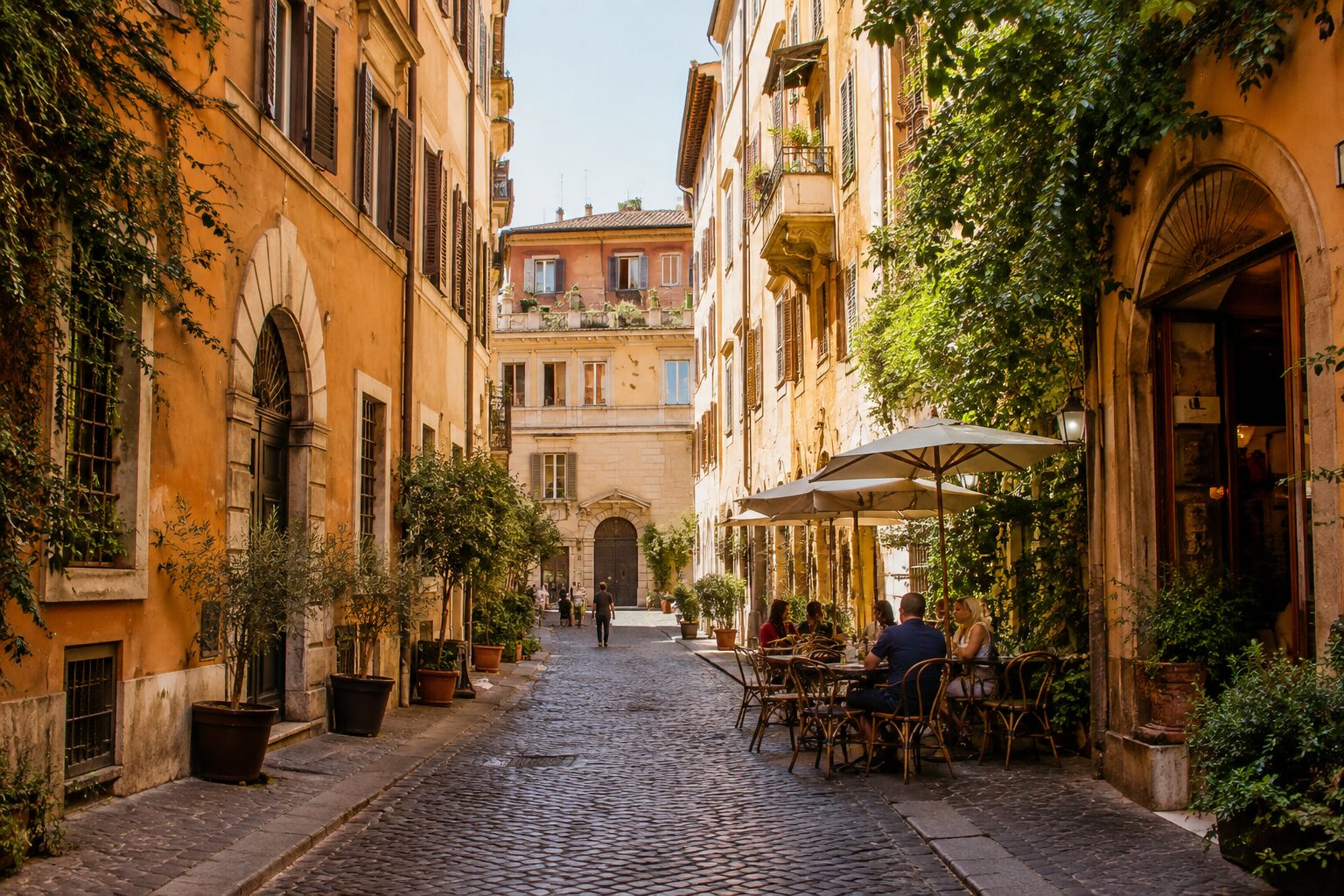
Rome accommodation is about tradeoffs between walking convenience, evening atmosphere, transport, noise, and price.
Historic center: best for first-time walking
Areas near the Pantheon, Piazza Navona, and Campo de’ Fiori place central landmarks at your door. Expect premium prices, crowds, compact rooms, and uneven taxi access.
Monti: best balance of character and ancient Rome
Monti offers restaurants and lived-in streets near the Colosseum. Hills and nightlife noise vary by block, so inspect the exact address.
Prati: best for Vatican visits
Broad streets and direct access to the Vatican make Prati practical. It feels more orderly than the historic center and offers useful dining away from the immediate museum exits.
Trastevere: best for evenings
Cobbled streets and nightlife create atmosphere, but the busiest lanes become loud. Choose a quieter edge if sleep matters.
Testaccio: best for food-focused repeat visitors
Markets and Roman culinary identity make Testaccio rewarding. It is less convenient for a rapid first-time checklist but better for neighborhood life.
Termini: best for transport
Direct airport and intercity connections can make the station area practical and relatively affordable. Quality changes block by block; read recent reviews and map the nighttime route.
Booking checklist
- Air conditioning and elevator availability.
- Street noise and reception hours.
- Walking route over hills and cobblestones.
- Legal occupancy and bed configuration.
- Total price and cancellation terms.
- Airport and station transfer at your arrival time.
Frequently asked questions
What is the best area for a first visit?
The historic center or Monti minimizes sightseeing friction; Prati is ideal for Vatican-heavy plans.
Is Trastevere too noisy?
Some streets are. Address-level reviews matter more than the neighborhood label.
Should you stay by Termini?
It can be convenient and better value, but research the exact block and property carefully.
Use your base with our three-day itinerary and Rome travel guide.
Start with your trip, not a ranking
The right base in Rome depends on the first appointment, the evening atmosphere you enjoy, and the journeys you will repeat. Plot your three most important areas and compare candidate hotels using actual transit routes at the relevant time of day.
Neighborhood names describe large areas. Two hotels marketed under the same district can have very different noise, safety perception, hill, station, and restaurant situations. Inspect the precise block with recent reviews and mapping imagery.
Area-by-area comparison
The historic center
The historic center works best for travelers interested in the Pantheon, Piazza Navona, Trevi Fountain, and exceptional walking at high prices. Do not judge it only by straight-line distance. Map the stations, evening plans, and first appointment of the next morning, then check the precise block and the route back after dark.
Monti
Monti works best for travelers interested in a village-like evening scene close to the Colosseum and ancient sites. Do not judge it only by straight-line distance. Map the stations, evening plans, and first appointment of the next morning, then check the precise block and the route back after dark.
Prati
Prati works best for travelers interested in orderly streets, Vatican access, restaurants, and Metro connections without the historic-center crush. Do not judge it only by straight-line distance. Map the stations, evening plans, and first appointment of the next morning, then check the precise block and the route back after dark.
Trastevere
Trastevere works best for travelers interested in cobbled lanes and nightlife, with significant differences between quiet edges and the busiest restaurant streets. Do not judge it only by straight-line distance. Map the stations, evening plans, and first appointment of the next morning, then check the precise block and the route back after dark.
Testaccio
Testaccio works best for travelers interested in traditional food culture, a working neighborhood atmosphere, and useful links to southern Rome. Do not judge it only by straight-line distance. Map the stations, evening plans, and first appointment of the next morning, then check the precise block and the route back after dark.
Campo de’ Fiori and the Jewish Ghetto
Campo de’ Fiori and the Jewish Ghetto works best for travelers interested in central walking, layered history, markets, and busy visitor traffic. Do not judge it only by straight-line distance. Map the stations, evening plans, and first appointment of the next morning, then check the precise block and the route back after dark.
Termini and Esquilino
Termini and Esquilino works best for travelers interested in rail convenience, international food, variable block-by-block atmosphere, and frequent hotel value. Do not judge it only by straight-line distance. Map the stations, evening plans, and first appointment of the next morning, then check the precise block and the route back after dark.
Aventine
Aventine works best for travelers interested in quiet streets, churches, gardens, and hilltop views within reach of the ancient center. Do not judge it only by straight-line distance. Map the stations, evening plans, and first appointment of the next morning, then check the precise block and the route back after dark.
How to compare hotels accurately
Compare the final checkout price rather than the first nightly number. Include taxes, mandatory charges, breakfast, cancellation flexibility, deposits, and airport transportation. A refundable reservation can be valuable while plans are still changing.
Read room dimensions and bed descriptions carefully. Photographs use wide lenses, and category names are inconsistent. Check lift access, climate control, bathroom arrangement, luggage storage, reception hours, and whether renovation or construction appears in recent reviews.
Noise is hyperlocal. A room facing an internal courtyard can be calmer than one above a nightlife street in the same hotel. Requesting a quiet room is not a guarantee, but explaining the need politely gives the property useful information.
Transit tests before you reserve
Because walking for the historic center, supported by Metro, buses, trams, and taxis; surface journeys can be slower than the map suggests, a station label alone is not enough. Check walking distance to the correct entrance, the number of transfers to your main clusters, late-evening service, stairs or elevators, and weekend changes.
Test the arrival journey with luggage. A base that is excellent for sightseeing may require awkward transfers from the airport. Decide whether one inconvenient arrival is acceptable in exchange for easier daily travel.
Choosing for families, couples, and solo trips
Families often benefit from space, breakfast flexibility, laundry access, a refrigerator, and a nearby park more than a postcard address. Couples may value evening restaurants and walkability. Solo travelers should prioritize a comfortable return route and a front desk or access system that feels straightforward.
Accessibility needs must be confirmed directly. Ask about step-free entrance, lift dimensions, bathroom layout, and the route from the nearest accessible station. Temporary infrastructure problems can change otherwise accurate descriptions.
When a cheaper outer neighborhood makes sense
A well-connected outer base can reduce cost without reducing enjoyment, particularly when the train is direct and evenings near the hotel are pleasant. It is poor value when the savings require long transfers, expensive late taxis, or repeated returns to collect belongings.
Calculate commute time across the whole stay. Thirty extra minutes each way becomes several hours over four days. Sometimes paying more for location effectively buys another half-day of travel.
Booking checklist
Before paying, confirm the exact address, full cost, cancellation deadline and time zone, room configuration, check-in procedure, luggage policy, recent construction reports, and transport on departure morning. Save the confirmation and property contact details offline.
Test the morning commute
Map a weekday morning from The historic center to the first major sight. The district offers the Pantheon, Piazza Navona, Trevi Fountain, and exceptional walking at high prices, but its value depends on a route you are willing to repeat.
Test the evening return
Imagine returning to Monti after dinner or a performance. Check service frequency, the final walk, lighting, crowds, and whether a taxi would undermine the apparent savings.
Room reality
Compare square footage, bed configuration, windows, climate control, and bathroom arrangement. A carefully chosen smaller room can work; a surprising one can make every morning difficult.
Street-level atmosphere
Walk the map around Trastevere virtually and read recent block-specific reviews. Area names are broad, while noise, construction, hills, and restaurant choice can change within a few streets.
Hotel services
Decide which services matter: staffed reception, breakfast, luggage storage, laundry, refrigerator, workspace, or housekeeping. Pay for what improves the stay rather than for a category label.
Cancellation value
A flexible rate may justify a modest premium while transportation and dates remain unsettled. Record the cancellation deadline with its local time zone and revisit prices before it passes.
Arrival with luggage
Test the airport or station route to Termini and Esquilino with bags. Stairs, cobbles, long corridors, and multiple transfers matter more on arrival than during an ordinary sightseeing journey.
Nearby essentials
Locate breakfast, a pharmacy, late food, and the correct station entrance before booking. These ordinary conveniences become disproportionately valuable during jet lag, poor weather, or an early departure.
Sleep versus nightlife
The attractions of The historic center include the Pantheon, Piazza Navona, Trevi Fountain, and exceptional walking at high prices. Decide whether that atmosphere should be outside the door or a short ride away, and read room-location comments carefully.
Total trip value
Multiply extra commute time by the number of sightseeing days, then compare it with the room savings. Location is not everything, but repeated inconvenient journeys have a real cost.
Test the morning commute
Map a weekday morning from Prati to the first major sight. The district offers orderly streets, Vatican access, restaurants, and Metro connections without the historic-center crush, but its value depends on a route you are willing to repeat.
Test the evening return
Imagine returning to Trastevere after dinner or a performance. Check service frequency, the final walk, lighting, crowds, and whether a taxi would undermine the apparent savings.
Room reality
Compare square footage, bed configuration, windows, climate control, and bathroom arrangement. A carefully chosen smaller room can work; a surprising one can make every morning difficult.

Meet Leo: The Heartbeat Behind ‘A Country A Month’
Journeying through the pages of A Country A Month, you might often feel the rhythm of a storyteller’s heartbeat, pulsating through each line, each image, and each adventure shared. That heartbeat belongs to none other than our remarkable website editor, Leo.
With a lens in one hand and a pen in the other, Leo seamlessly marries his passions for photography and writing. His eye captures moments that words can barely describe, yet his eloquence brings those images to life, transcending borders and connecting us all through shared stories. An avid traveler, every country he’s visited has added another chapter to his expansive tale, and through our platform, he generously shares these chapters with us.