
How do you plan a great winter sailing on Harmony of the Seas in the Caribbean? Start by knowing the two kinds of days you’ll have: a stop at Perfect Day at CocoCay, Royal Caribbean’s private Bahamas island, where the best things divide neatly into free and paid; and a run of real Caribbean ports — San Juan, Charlotte Amalie, Philipsburg, Cozumel, Costa Maya, and Roatán — where you’ll choose between a beach day and a booked excursion. This guide walks through what to do at each stop, how to decide beach versus tour, and how to pace a port day so you’re back aboard before all-aboard. Ports vary by sailing, so always confirm your exact itinerary in the Royal Caribbean app.
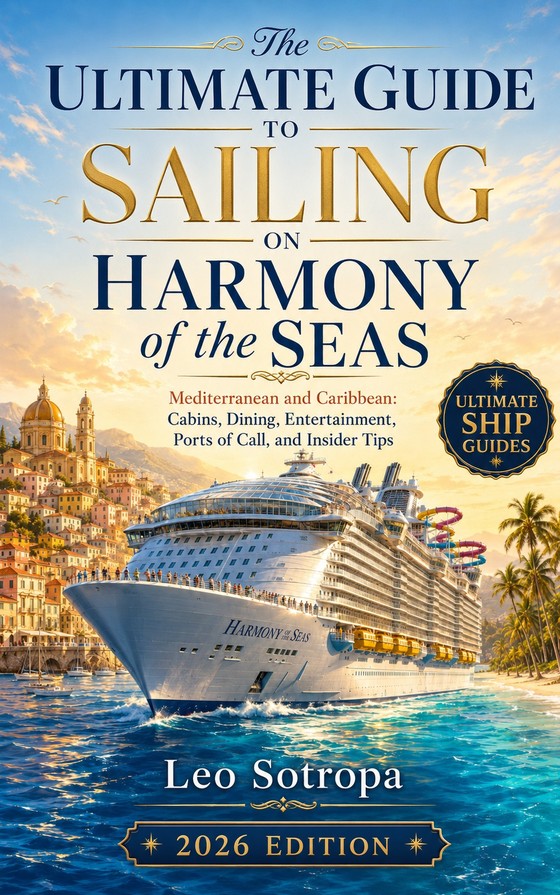
Everything in this article and far more, deck by deck, in The Ultimate Guide to Sailing on Harmony of the Seas.
Get the book →Harmony of the Seas is the third ship in Royal Caribbean’s Oasis Class, and for a time she was the largest cruise ship in the world. What makes her unusual among the fleet is a split season: she spends her summer in the Western Mediterranean and her winter in the Caribbean. That means the same ship you might sail past Barcelona and Rome shows up months later warming her way through the islands. If you’re reading this to plan a sunny escape, you want the Caribbean season — and it’s a genuinely different trip from her Mediterranean one, which we’ll get to near the end.
The two kinds of days on a Caribbean sailing
On a Caribbean itinerary, your days sort into three buckets, and planning gets much easier once you name them. There are sea days, when the ship itself is the destination and you’re riding the Ultimate Abyss, catching “Grease” in the main theater, or claiming a chair by the pool. There’s Perfect Day at CocoCay, a private-island stop that runs on its own logic of included versus paid. And there are the traditional ports — islands and Mexican coast towns where you leave the ship and the question is always the same: beach or excursion?
The single most useful habit is to decide each port day in advance rather than at the gangway. Excursions with limited capacity — reef snorkels, ruins tours, the better beach clubs — sell out, and the good ones sell out first. Book what matters early through the app, and leave the easy, walk-off ports as your flexible days. If you want a fuller rundown of onboard logistics and booking rhythm, our Royal Caribbean Harmony of the Seas tips cover the app, the SeaPass card, and how reservations work across the sailing.
Perfect Day at CocoCay: included vs paid
CocoCay is the stop people get wrong most often, because it looks like it costs a fortune and doesn’t have to. The island splits cleanly into things your fare already covers and things that carry an extra charge. Knowing the line before you arrive is the difference between a relaxed free day and an accidental spending spree.
What’s already included
Chill Island and Oasis Lagoon are included with your cruise. Chill Island is the classic postcard beach — calm water, loungers, easy swimming — and Oasis Lagoon is the large freshwater pool with a swim-up bar (drinks cost extra, but the pool itself doesn’t). Complimentary food is served at the island’s counters, and there are hammocks, shaded spots, and plenty of room to spread out. For a lot of families, that’s the entire day, and it’s a good one. You can walk off the ship, find a chair, swim, eat, and never open your wallet beyond a drink.
What costs extra
The Thrill Waterpark, with its slides and wave pool, is a separately ticketed attraction. So is Coco Beach Club, the more exclusive beach area with its own pool and upscale setting, and so are the private cabanas dotted around the island. All three are worth it for the right traveler — thrill-seekers, couples wanting quiet, groups who want a home base — but they book up, and prices climb closer to sailing. If you know you want any of them, reserve early in the app rather than hoping for day-of availability.
| Included with your fare | Extra charge (book early) |
|---|---|
| Chill Island beach and loungers | Thrill Waterpark (slides, wave pool) |
| Oasis Lagoon freshwater pool | Coco Beach Club |
| Complimentary island food counters | Private cabanas |
One practical note: because CocoCay is a Royal Caribbean island, everything runs on your SeaPass card and the app, and getting on and off the ship is quick. That makes it the easiest port to keep loose — no tenders, no taxis, no language barrier — which is exactly why it’s a good day to leave unbooked if your budget is going toward excursions elsewhere.
San Juan, Puerto Rico
San Juan is the port where you should skip the beach and walk the city. The ship docks close to Old San Juan, a walkable district of blue cobblestones, pastel buildings, and two enormous Spanish forts. El Morro guards the harbor entrance on a dramatic headland, and San Cristóbal sprawls above the old town — both are easy to reach on foot and reward an hour or two of wandering. This is a rare Caribbean stop where the excursion you want might just be your own two feet.
Plan it as a morning walk before the heat builds. Start at whichever fort is closer to the pier, cut through the old streets, and stop for lunch in town. If you’d rather have a guide handle the history and logistics, a booked walking tour covers the forts and the plazas without you navigating; if you’re comfortable exploring, do it independently and save the money. Either way, San Juan is a city day, not a swimsuit day.
Charlotte Amalie, St. Thomas
St. Thomas is the classic beach-or-shop decision. Charlotte Amalie is one of the Caribbean’s best-known duty-free shopping towns, so if browsing jewelry and watches is your thing, you can spend the whole call within walking distance of the pier. But the island’s real draw is Magens Bay, a long, calm, curving beach that regularly lands on “best in the world” lists. It’s a short taxi ride away, and a half-day there is the reason many people pick this itinerary.
A sensible split: taxi to Magens Bay in the morning for the water and the sand, then come back to town for a bit of shopping before all-aboard. History buffs can add Blackbeard’s Castle and the hillside overlooks for the harbor views. If you only do one thing, make it the beach — the shopping is fine, but you can buy a watch anywhere, and you can’t swim at Magens Bay from home.

Philipsburg, St. Maarten
St. Maarten gives you the most variety of any port on the run, because the island is two countries in one — the Dutch side, where Philipsburg and the cruise pier sit, and the French side to the north. Philipsburg’s Great Bay Beach is right in town with a boardwalk of bars and shops behind it, so an easy day needs no planning at all: walk off, find a chair, swim, eat, repeat.
The famous stop is Maho Beach, where jets from the adjacent airport pass startlingly low over the sand on their approach. It’s a spectacle worth timing around the flight schedule, though the swimming is secondary to the show. For a quieter, prettier beach, Orient Bay on the French side is the local favorite. Deciding between them is really a choice of mood: Maho for the novelty and the crowd, Orient Bay for a proper beach day, or the town beach if you’d rather not travel at all. An island tour that samples both sides is a good way to see the contrast if you can’t choose.
Cozumel, Mexico
Cozumel is the excursion-heavy port, and the water is the point. The island sits on the Mesoamerican reef, so the snorkeling and diving are genuinely world-class — clear water, healthy coral, and easy reef access make this the best underwater day of most Caribbean itineraries. Beach clubs line the coast for a relaxed day of sun with a chair and a swim, and the town is walkable for shopping and food near the pier.
The bigger decision at Cozumel is whether to stay on the island or cross to the mainland for Maya ruins. Day trips to sites like Tulum, perched on a cliff above the sea, are popular but involve a ferry and a long day — budget the time and know you’ll see less of Cozumel itself. If reefs and beaches are why you cruise, stay put and book a snorkel trip; if the ruins are a bucket-list item, commit to the mainland excursion and treat it as the whole day. Trying to do both usually shortchanges both.
Costa Maya, Mexico
Costa Maya is quieter and more purpose-built than Cozumel — a smaller port town with a manufactured village of shops, pools, and bars right by the pier. That makes it an easy, low-effort stop if you just want to stroll, swim in a pool, and browse without going far. But the reason to book ahead here is the ruins: Chacchobén, a Maya site set in the jungle inland, is a manageable half-day tour and one of the more rewarding archaeological visits on the western Caribbean run.
Think of Costa Maya as the ruins port and Cozumel as the reef port, and you’ll plan them well together on an itinerary that includes both. If you did the reef in Cozumel, do the ruins here; if you’re not a ruins person, Costa Maya is a fine easy day near the ship. Beach clubs and snorkel trips exist too, but they’re the reason to book Cozumel, not this stop.
Roatán, Honduras
Roatán is the sleeper hit — a Honduran island wrapped in the Mesoamerican reef, with beaches that rival any on the itinerary. The snorkeling and diving here are excellent, on par with Cozumel, and the beaches tend to be less developed and more relaxed. For many cruisers this is the day they remember most, precisely because it feels a little less polished than the bigger-name stops.
The straightforward play is a beach-and-reef day: a beach club with easy snorkeling off the sand, or a boat trip out to the reef. Because Roatán’s tourism is a bit more spread out, a booked excursion or a pre-arranged beach club takes the guesswork out of transport and gets you to the good water efficiently. This is a port where paying for a little structure pays off — the independent-taxi approach works, but the reef is the reason you’re here, so make sure you actually reach it.
Beach vs excursion: how to decide each port
Across all these stops, a simple framework keeps you from over-planning or under-planning. Some ports reward staying loose, and some reward booking hard.
- Walk-off, no booking needed: CocoCay’s included beaches, San Juan’s old town, Philipsburg’s town beach — you can do these well on foot with zero reservations.
- Beach days worth a taxi: Magens Bay in St. Thomas, Orient Bay or Maho in St. Maarten — easy to reach, no formal tour required.
- Book early or miss out: reef snorkels in Cozumel and Roatán, Maya ruins from Cozumel or Costa Maya (Chacchobén), and CocoCay’s Thrill Waterpark, Coco Beach Club, or cabanas.
A good balance for a week is one or two big booked excursions, one or two easy beach days, and the walk-off ports left flexible. That spreads your budget, prevents excursion fatigue, and gives you a rest day or two where the plan is simply “get off, find water, come back.” If this is your first Royal Caribbean sailing, our guide to a first-time cruise on Harmony of the Seas covers the wider rhythm of embarkation, dining, and shows around these port days.
How to plan a port day so you don’t miss the ship
The one rule that matters more than any excursion choice: know your all-aboard time and build backward from it. All-aboard is typically half an hour before departure, and the ship does not wait for independent travelers. Ship-sponsored excursions are guaranteed to get you back — if the tour runs late, the ship holds — which is a real argument for booking through Royal Caribbean when you’re going far from the pier or crossing to a mainland.
- Check the app the night before for the docked time, all-aboard time, and any port notes.
- Carry your SeaPass card and a photo ID; you can’t reboard without the card.
- Give yourself a buffer — aim to be back at the pier an hour before all-aboard, more if a taxi or ferry is involved.
- Keep some local cash for taxis and beach chairs; not everywhere takes cards.
- Note the time zone — some ports don’t match ship time, and the ship runs on ship time.
For the ports that involve a boat or a long drive — the Tulum day trip from Cozumel, reef trips in Roatán — the guaranteed-return math tilts strongly toward a ship excursion. For the walk-off ports, independence is easy and cheap. Match your booking style to the distance, and you’ll rarely feel the clock.
Making the most of the ship on port days
Don’t forget that Harmony herself is a destination, and port days are the quietest time to enjoy her. When most guests are ashore, the lines for the Ultimate Abyss, the Perfect Storm waterslides, the FlowRider, and the rock walls shrink to nothing. If you’ve already seen a port, or you’re saving your energy, a half-day off followed by an empty ship can be the best of both. Central Park and the Boardwalk are calm and pleasant in the afternoon, and the pool deck is at its most spacious.
It’s also worth timing your big onboard bookings — a Wonderland or Chops Grille dinner, the reserved shows like “Grease,” the ice show, or the AquaTheater spectacle — around your busiest port days so you’re not rushing back to make a reservation. A little coordination between shore plans and ship plans is what separates a smooth week from a hectic one. For the full picture of what’s aboard, see what to expect on Harmony of the Seas.
Caribbean season vs Mediterranean season
Harmony’s dual season means the same ship offers two very different vacations, and it’s worth understanding the contrast even if you’ve already chosen the sun. The Caribbean season is a beach-and-water trip: warm, relaxed, short tender-free port calls, and days built around swimming, snorkeling, and sand. The pace is easy, the ports are close together, and the biggest planning decision is beach versus excursion.
Her summer Western Mediterranean season is a different animal — a sightseeing trip typically round-trip from Barcelona or Civitavecchia, with ports like Palma de Mallorca, Provence, Florence and Pisa, Rome, and Naples. Many of the marquee sights there are inland, so you’re planning trains and tours and minding all-aboard far more carefully, and timed tickets for places like the Vatican or the Sagrada Família sell out well ahead. If you’re weighing that itinerary too, our guide to Harmony of the Seas Mediterranean ports lays out how those port days work.
The short version: choose the Caribbean season if you want to unwind on beaches with minimal logistics, and the Mediterranean season if you want history, cities, and a busier, more excursion-driven week. Same neighborhoods, same Ultimate Abyss, same shows — very different days ashore. Always confirm which season and region your specific sailing is when you book, because the ship crosses the Atlantic between them.
Get the complete Harmony of the Seas playbook
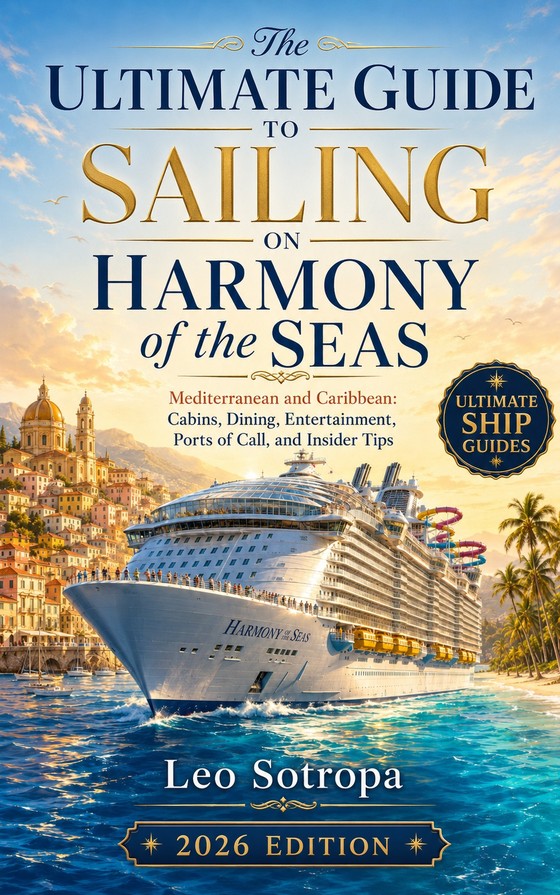
Ready to plan every port day, cabin choice, and dinner reservation without second-guessing? “The Ultimate Guide to Sailing on Harmony of the Seas” walks you through it all with clear action steps in every chapter — part of the Ultimate Ship Guides series by Leo Sotropa.
Frequently asked questions
Is Perfect Day at CocoCay included in my cruise fare?
The stop itself is included, along with Chill Island’s beaches, the Oasis Lagoon freshwater pool, and the island’s complimentary food counters. The Thrill Waterpark, Coco Beach Club, and private cabanas cost extra and book up early, so reserve them in the Royal Caribbean app ahead of your sailing if you want them. Many guests have a full, happy day using only the included areas.
Which Harmony Caribbean ports are best for beaches versus excursions?
For beaches, head to Magens Bay in St. Thomas, Orient Bay in St. Maarten, and the reef-fringed beaches of Roatán. For excursions, Cozumel and Roatán deliver world-class snorkeling and diving, while Costa Maya and Cozumel offer Maya ruins like Chacchobén and Tulum. San Juan is best as a walking city day rather than a beach stop.
Do I need to book shore excursions in advance?
For the high-demand ones — reef snorkels, ruins tours, and premium beach clubs — yes, because capacity is limited and they sell out. Walk-off ports like San Juan’s old town and Philipsburg’s town beach need no booking. A good approach is to reserve one or two big excursions early and leave the easy ports flexible. Confirm availability in the app.
Should I book excursions through Royal Caribbean or independently?
For anything involving a ferry or a long drive from the pier — a Tulum day trip from Cozumel, a reef boat in Roatán — ship-sponsored excursions guarantee the ship waits if your tour runs late, which is worth the premium. For walk-off ports and quick beach taxis, independent plans are cheaper and easy. Match your choice to how far you’re going from the ship.
What’s the difference between Harmony’s Caribbean and Mediterranean seasons?
Harmony has a split season: a winter of Caribbean sailings and a summer of Western Mediterranean voyages. The Caribbean season is a relaxed beach-and-water trip with close, easy ports; the Mediterranean season is a sightseeing trip with many inland sights, timed tickets, and more excursion planning. Always confirm which season and region your specific sailing is when you book.
How do I make sure I don’t miss the ship at a port?
Check the app the night before for the all-aboard time, which is usually about half an hour before departure, and build your day backward from it. Carry your SeaPass card and photo ID, aim to be back at the pier an hour early, keep local cash for taxis, and remember the ship runs on ship time even where the port’s time zone differs.
Is it worth staying on the ship during port days?
Sometimes, yes. When most guests go ashore, the Ultimate Abyss, Perfect Storm waterslides, FlowRider, and pool deck are at their quietest, and Central Park and the Boardwalk are calm. If you’ve seen a port before or want a rest, a half-day off followed by an empty ship is a great combination. Timing specialty dinners and reserved shows around your busiest port days also keeps the week smooth.
Ready for the whole ship in one place? It is all in The Ultimate Guide to Sailing on Harmony of the Seas.
Get the book →
Meet Leo: The Heartbeat Behind ‘A Country A Month’
Journeying through the pages of A Country A Month, you might often feel the rhythm of a storyteller’s heartbeat, pulsating through each line, each image, and each adventure shared. That heartbeat belongs to none other than our remarkable website editor, Leo.
With a lens in one hand and a pen in the other, Leo seamlessly marries his passions for photography and writing. His eye captures moments that words can barely describe, yet his eloquence brings those images to life, transcending borders and connecting us all through shared stories. An avid traveler, every country he’s visited has added another chapter to his expansive tale, and through our platform, he generously shares these chapters with us.