Ketchikan packs an outsized amount into a single cruise day: totem poles in numbers you will not see anywhere else on earth, a boardwalk of red former brothels on stilts over a salmon creek, and a wall of rainforest running straight down to the water. The best way to spend a day here is to walk off the ship into the compact downtown, cover Creek Street and a totem park in the morning, and save your money and energy for one big splurge in the afternoon. This Ketchikan cruise port guide walks through where you dock, what is worth doing, and how to fit it into the hours you have.
Ketchikan sits at the southern tip of the Inside Passage, wrapped in the Tongass National Forest. It calls itself the salmon capital and the totem pole capital of the world, and on a clear day it earns both. It is also one of the rainiest towns in North America, with heavy rainfall that keeps the forest a deep, dripping green — a reason to pack a rain shell, not a reason to stay away.
Where your ship docks
Ketchikan’s great advantage over almost every other Alaska port is that your ship ties up right in town. The downtown berths line the waterfront, and when you walk down the gangway you are already in Ketchikan proper — Creek Street, the visitor center, shops, and cafes are all within a few flat blocks. There is no tender and no long walk out of an industrial port zone. The day begins the moment you step off.
The one thing to check in your cruise line’s app is which berth you are assigned. Ketchikan has several docks, and on very busy days a ship can be berthed farther along the waterfront, or a smaller vessel may anchor and tender in. Confirm your exact berth, all-aboard time, and whether your ship tenders on the day.
Top things to do on a port day
Walk historic Creek Street
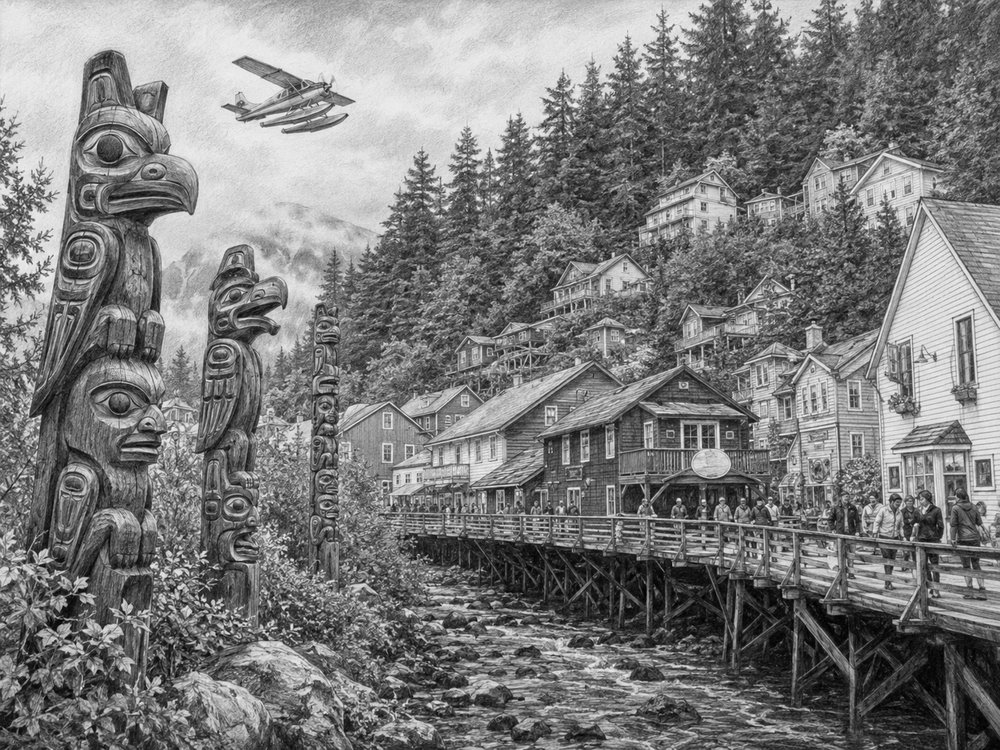
Creek Street is Ketchikan’s signature walk and it is free. It is a wooden boardwalk built on pilings over Ketchikan Creek, lined with brightly painted houses that were the town’s red-light district in its rough cannery and mining days. Today those buildings hold shops, small museums, and cafes, but the boardwalk itself is the draw — narrow, creaking, and hanging right over the rushing water. During the summer salmon runs you can watch salmon fight their way up the creek below you, with eagles and the occasional harbor seal working the same fish. A funicular at one end carries you up the hillside if you would rather ride than climb. Give it at least an hour, more if the salmon are running.
See the world’s largest collection of totem poles
Ketchikan and its surrounding Tlingit, Haida, and Tsimshian communities hold the largest collection of standing totem poles in the world, and seeing them is the most meaningful thing you can do here. There are three main places, and you do not need all three.
- Totem Bight State Historical Park — north of downtown, a beautiful setting of restored poles along a shoreline path, with a colorful reconstructed clan house. It is the most scenic of the three.
- Saxman Native Village — a working Tlingit community just south of town with a large totem park and, on organized visits, a carving shed and dance performances that put the poles in living cultural context.
- Totem Heritage Center — an easy walk from downtown, this indoor museum preserves original, unrestored 19th-century poles retrieved from abandoned village sites. Seeing the weathered, aged originals is a very different experience from the bright restored parks.
If you only have a short day, the Totem Heritage Center is walkable from the ship. Totem Bight needs a bus, taxi, or tour, and many independent visitors combine it with a Ketchikan city tour to avoid managing transport north of town.
Catch the Lumberjack Show
The Great Alaskan Lumberjack Show is an unapologetically touristy grandstand event right by the downtown docks, with log-rolling, axe-throwing, tree-climbing, and chainsaw carving staged as a competition between two teams. It is short, it is under cover if the weather turns, and it is genuinely fun for families. Steps from the ships, it slots neatly around a morning walk.
Fly or cruise into Misty Fjords
Misty Fjords National Monument is the marquee splurge and the reason some people book Ketchikan months out. It is a vast wilderness of sheer granite cliffs, waterfalls, and glacier-carved sea fjords east of town, reachable only by air or water. The unforgettable way to see it is by floatplane: a small aircraft lifts off the harbor, banks over the fjords, and lands on a remote alpine lake before flying you back. It is expensive and weather-dependent — Misty Fjords is misty for a reason — but on a good day it is one of the great scenic flights in North America. Boat excursions run into the monument too, often combining a cruise in with a flight out. It is the one experience worth spending real money on here.
Fish for salmon or walk the rainforest
As the self-declared salmon capital of the world, Ketchikan is a natural place for a fishing charter, and half-day trips for salmon or halibut are popular. If fishing is not your thing, the Tongass rainforest itself is the attraction: guided walks, canoe trips, and zip-line courses run just outside town and fit a cruise schedule. Even a stroll along the creek trails behind town gives you towering spruce and hemlock, thick moss, and running water.
Ship tour or independent?
Ketchikan is one of the easier Alaska ports to do independently, precisely because you walk off into town. Creek Street, the Totem Heritage Center, the Lumberjack Show, and the shops are all self-guided and cheap or free — skip the ship’s tour and just walk.
Book through the ship when the activity is far from the pier or weather-sensitive — above all the Misty Fjords trips and salmon charters. The ship’s version costs more, but the operator holds the vessel if your ship is late back to port, and that guarantee matters when the experience is an hour of flying or a boat deep in a wilderness fjord. If you book independently, choose an operator that advertises a cruise-guest guarantee. Totem Bight sits in between: easy to reach by taxi, but a booked city-and-totems tour removes the logistics.
Ketchikan pairs naturally with the rest of an Inside Passage run. If your itinerary continues north, see our Juneau cruise port guide for the glacier-and-whale day and the Skagway cruise port guide for the Gold Rush railway.
How much time you need
Ketchikan calls tend to be a good chunk of the day, but the town’s popularity means it can be one of the busier ports on the route. A realistic plan for an average call looks like this:
- Short on time or budget: walk Creek Street, watch the salmon, see the Totem Heritage Center, and catch the Lumberjack Show — all on foot, near the ship.
- A standard day: a morning downtown as above, then an afternoon tour to Totem Bight or Saxman, or a salmon charter.
- The big splurge: reserve a Misty Fjords floatplane or boat trip and build the day around it, keeping a wide margin before all-aboard.
Whatever you choose, note the all-aboard time the moment you step off. Floatplanes and charters can be delayed by the same weather that makes them special.
What to skip and watch out for
The one thing worth skipping is the strip of diamond and jewelry shops clustered near the docks. They are the same chains you see in every cruise port, and they crowd out the town’s own galleries and Native art. Walk a couple of blocks past them to find Ketchikan’s real shops. Do not over-plan three totem sites in one day either; pick one or two.
The main thing to watch is the rain. Ketchikan is one of the wettest places in North America, so bring a waterproof jacket and shoes with grip — the boardwalk and totem park paths get slick. Do not judge the day by a gray morning. And build buffer into any Misty Fjords plan, because flights can be scrubbed when the cloud sits low.
Cruise ships that visit Ketchikan
Many ships that sail the Inside Passage call at Ketchikan on round-trip or one-way Alaska itineraries. These guides cover vessels that regularly visit — check your own sailing for its exact schedule and docking.
Frequently asked questions
Does the cruise ship dock right in Ketchikan?
Yes. Ketchikan’s cruise berths are on the downtown waterfront, so you walk off the gangway straight into town, with Creek Street and the shops within a few flat blocks. On very busy days a ship may berth farther along the front or, rarely, tender in, so check your assigned berth in the app.
What is Ketchikan best known for?
Three things: the world’s largest collection of totem poles, the historic Creek Street boardwalk on stilts over a salmon stream, and Misty Fjords National Monument. It also bills itself as the salmon capital of the world and sits in the Tongass rainforest, so fishing and forest trips are big draws too.
Is Misty Fjords worth the money?
On a clear day, yes — it is the standout experience in Ketchikan and one of the great scenic flights or boat trips in Alaska. It is expensive and weather-dependent, so book it through the ship or an operator that guarantees your return, and keep a buffer before all-aboard.
Which totem site should I visit?
If you are staying on foot, the Totem Heritage Center downtown displays original, weathered poles and is walkable from the ship. For the classic restored poles, Totem Bight north of town is the most photogenic. Saxman Native Village adds living Tlingit culture with dance and carving. Pick one or two rather than all three.
How much time do I need in Ketchikan?
Add a totem park tour or salmon charter to a downtown morning for a standard day, and reserve a full margin for Misty Fjords.
Do I need a rain jacket?
Yes. Ketchikan is one of the rainiest towns in North America, and rain comes and goes through the day. Bring a waterproof jacket and shoes with grip, since the boardwalk and totem park paths get slippery. Do not let a gray morning change plans.
Can I do Ketchikan without a ship tour?
Easily, for the in-town sights. Creek Street, the Totem Heritage Center, the Lumberjack Show, and the shops are all self-guided because you walk off into the center of town. Save booked tours for things far from the pier or weather-sensitive, especially Misty Fjords trips and salmon charters.

Meet Leo: The Heartbeat Behind ‘A Country A Month’
Journeying through the pages of A Country A Month, you might often feel the rhythm of a storyteller’s heartbeat, pulsating through each line, each image, and each adventure shared. That heartbeat belongs to none other than our remarkable website editor, Leo.
With a lens in one hand and a pen in the other, Leo seamlessly marries his passions for photography and writing. His eye captures moments that words can barely describe, yet his eloquence brings those images to life, transcending borders and connecting us all through shared stories. An avid traveler, every country he’s visited has added another chapter to his expansive tale, and through our platform, he generously shares these chapters with us.