Rome’s essential experiences span ancient ruins, churches, art, food, and ordinary streets. Choose depth over completion.
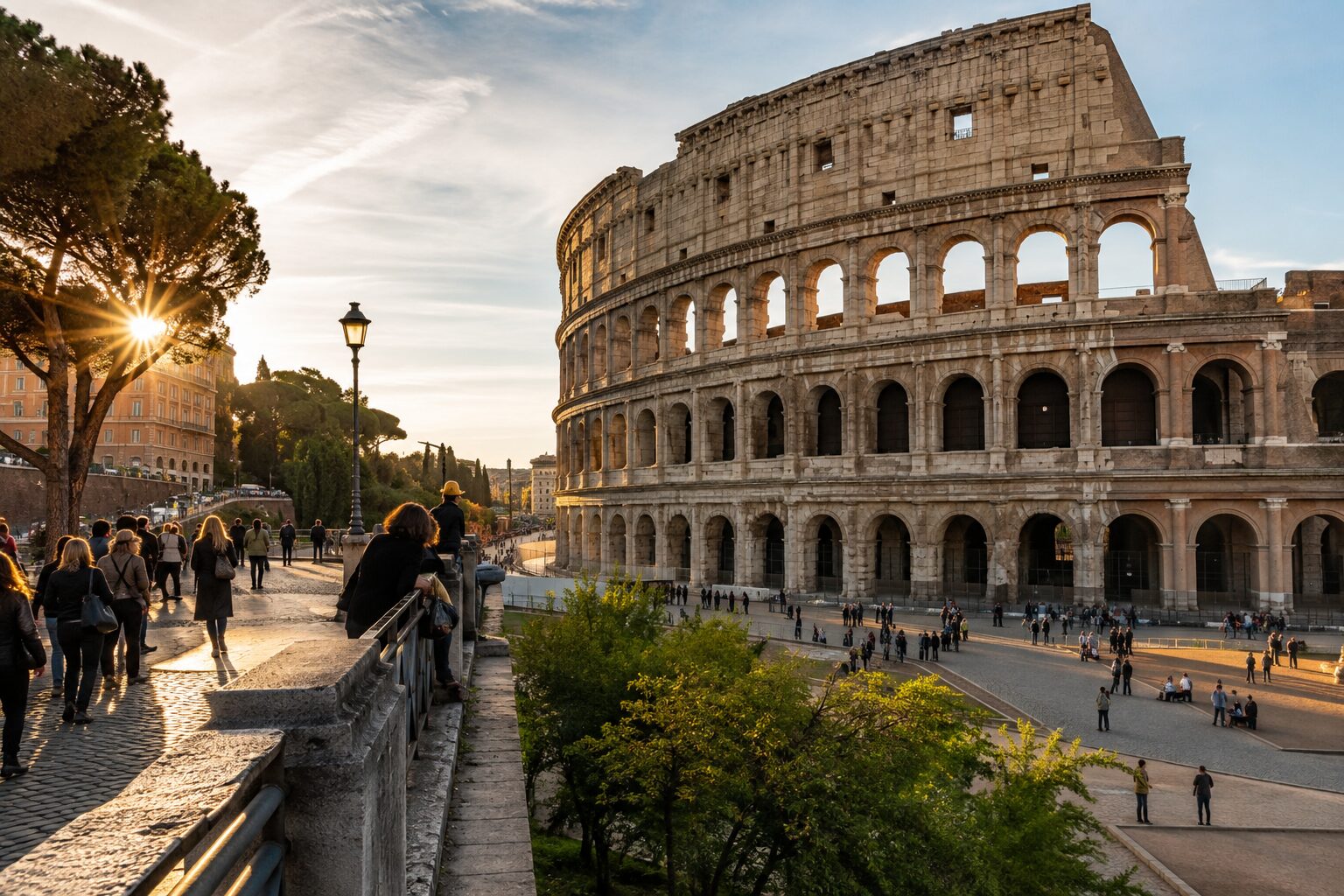
1. Enter the Colosseum
Use named official tickets and reserve the correct product.
2. Walk the Roman Forum
Bring context and enough time; the ruins become meaningful when you understand the civic spaces.
3. Climb Palatine Hill
Explore imperial remains and views over the Forum.
4. Visit St Peter’s Basilica
Dress appropriately and expect security screening.
5. See the Vatican Museums
Reserve officially and choose a focused route through the vast collections.
6. Enter the Pantheon
Study the engineering of the dome as well as the piazza outside.
7. See Trevi Fountain early
Morning or late evening offers a calmer experience than midday.
8. Walk Piazza Navona
Read the Baroque space and continue into surrounding streets.
9. Climb the Spanish Steps area
Use the route to connect central neighborhoods and viewpoints.
10. Explore Trastevere
Leave the busiest lanes for quieter churches and residential streets.
11. Eat in Testaccio
Discover market culture and Roman culinary traditions.
12. Wander Monti
Pair independent shops and evening streets with ancient Rome.
13. Visit the Borghese Gallery
Reserve ahead for a concentrated art experience.
14. Walk the Appian Way
Experience ancient infrastructure and landscape beyond the core.
15. Explore Capitoline Hill
Combine architecture, museums, and Forum viewpoints.
16. Step inside a neighborhood church
Respect worship and dress rules while discovering art outside museums.
17. Visit Campo de’ Fiori
See the square at different times rather than treating its market as timeless folklore.
18. Find a panoramic terrace
Gianicolo, Aventine, and other hills reveal Rome’s domes and scale.
19. Drink from a nasone
Use Rome’s public fountains where water is marked potable.
20. Take an evening passeggiata
Revisit the historic center after day crowds recede.
21. Leave room for discovery
Rome’s minor fountains, inscriptions, and courtyards reward unscheduled attention.
Frequently asked questions
Which sights need advance booking?
The Colosseum, Vatican Museums, and Borghese Gallery are primary candidates.
What can you do free?
Piazzas, fountains, viewpoints, many churches, and neighborhood walks.
How should attractions be grouped?
Ancient Rome, Vatican/Prati, and the historic center should generally occupy separate blocks.
Build your route with our Rome itinerary and complete guide.
How to use this list
Twenty-one ideas do not belong in one trip. For a first visit to Rome, choose one major landmark, one museum or cultural institution, one viewpoint or landscape, one performance or evening, and several neighborhood walks. The combination produces variety without constant ticket queues.
Mark each choice as essential, interesting, or optional. Reserve only the essential experiences with limited capacity, then group everything else geographically. This prevents a ranked list from sending you back and forth across the city.
Planning the signature experiences
The Colosseum, Forum, and Palatine
Reserve through the official system and treat the archaeological park as the demanding center of one day. Check the official operator for current hours, closures, ticket rules, accessibility, and photography policies. Build nearby streets or a meal around the experience so that a delay does not unravel the entire day.
The Vatican Museums
Book a timed entry, identify priority rooms, and separate the museum experience from St Peter’s Basilica logistics. Check the official operator for current hours, closures, ticket rules, accessibility, and photography policies. Build nearby streets or a meal around the experience so that a delay does not unravel the entire day.
The Pantheon and nearby piazzas
Walk the historic center early or late, connecting monuments through streets that reveal smaller churches and fountains. Check the official operator for current hours, closures, ticket rules, accessibility, and photography policies. Build nearby streets or a meal around the experience so that a delay does not unravel the entire day.
Trevi Fountain at a quieter hour
Arrive early, keep valuables secure, and continue onward instead of building an entire day around one crowded stop. Check the official operator for current hours, closures, ticket rules, accessibility, and photography policies. Build nearby streets or a meal around the experience so that a delay does not unravel the entire day.
A Trastevere walk
Explore side streets and churches before the dinner rush, then choose a restaurant beyond the most aggressive solicitation. Check the official operator for current hours, closures, ticket rules, accessibility, and photography policies. Build nearby streets or a meal around the experience so that a delay does not unravel the entire day.
Aventine and Testaccio
Combine hilltop calm, ancient fragments, a market, and traditional food in a compact southern route. Check the official operator for current hours, closures, ticket rules, accessibility, and photography policies. Build nearby streets or a meal around the experience so that a delay does not unravel the entire day.
A focused art museum
Choose the Borghese Gallery, Capitoline Museums, or another collection and respect its reservation requirements. Check the official operator for current hours, closures, ticket rules, accessibility, and photography policies. Build nearby streets or a meal around the experience so that a delay does not unravel the entire day.
Early Christian churches
Add one or two churches for mosaics, architecture, and continuity across Rome’s long history. Check the official operator for current hours, closures, ticket rules, accessibility, and photography policies. Build nearby streets or a meal around the experience so that a delay does not unravel the entire day.
The Appian Way
Plan transport, bike or walking distance, opening days, and heat before treating the ancient road as a casual detour. Check the official operator for current hours, closures, ticket rules, accessibility, and photography policies. Build nearby streets or a meal around the experience so that a delay does not unravel the entire day.
An evening passeggiata
Return to a favorite square or neighborhood when day-trippers leave and the city becomes more social. Check the official operator for current hours, closures, ticket rules, accessibility, and photography policies. Build nearby streets or a meal around the experience so that a delay does not unravel the entire day.
Finding worthwhile alternatives
When a famous attraction is sold out, ask what you wanted from it: a skyline, a historic interior, a particular artist, or the feeling of a neighborhood. The city usually offers another way to satisfy that interest without buying a dubious resale ticket.
Smaller museums and local institutions can provide deeper experiences because their scale permits attention. Check language support, temporary exhibitions, and opening days, then pair one with a nearby market, park, or meal.
Photography without losing the day
Arrive early for uncluttered public spaces, but respect barriers, worship, residents, and working businesses. Never block a narrow route for a photograph. A few deliberate images plus time spent looking usually creates a stronger memory than documenting every stop.
For skyline photographs, weather and sun direction matter more than owning several observation tickets. Choose one elevated view and supplement it with free street, bridge, park, or waterfront perspectives.
Free and low-cost experiences
Walking through The historic center, Monti, and Prati reveals architecture and daily life without another admission charge. Public parks, markets, religious sites, and waterfronts can anchor half a day when approached with curiosity.
Free does not mean unrestricted. Timed reservations, security, donation expectations, photography limits, or worship schedules may apply. Verify details through the official site and behave as a guest.
Build a balanced day
Combine one mentally demanding interior with an outdoor route and a meal worth anticipating. Place the fixed entry first, then choose optional stops that can disappear without disappointment. Leave travel time and a seated break between large experiences.
End in a district with several dinner choices and a simple return route. An evening plan should restore the day, not become another cross-city obligation completed only because it appeared on a list.
Geographic discipline
Keep The historic center with the places naturally around it. This area is known for the Pantheon, Piazza Navona, Trevi Fountain, and exceptional walking at high prices. A saved place across town is not automatically part of the same day; move it to another cluster or release it.
Time estimates
Add a margin to every transfer in Rome. Ticket checks, finding the correct entrance, station corridors, toilets, photographs, and a wrong turn are normal parts of travel. A plan that depends on perfect timing is already late.
Official information
For The Pantheon and nearby piazzas, read the venue or operator’s current page shortly before the visit. Walk the historic center early or late, connecting monuments through streets that reveal smaller churches and fountains. Third-party summaries are useful for ideas but should not control a time-sensitive reservation.
Rest and attention
Schedule a genuine seated pause before concentration disappears. Rest is not time stolen from sightseeing; it is what allows the next neighborhood, artwork, meal, or performance to register as an experience rather than another task.
Flexible alternatives
Save one indoor and one outdoor alternative near Testaccio. When weather, crowds, or a closure changes the day, choose the nearby substitute. Crossing Rome to rescue the original checklist usually compounds the problem.
Evening judgment
Decide each evening whether the next day needs subtraction. Check weather, transport notices, and opening information, then remove one optional stop before going to sleep. The resulting space often becomes the best hour of the trip.
Local businesses
In Termini and Esquilino, spend with businesses that serve the neighborhood as well as visitors. Read the menu or service before entering, greet staff, and avoid occupying scarce space only for photographs. Small courtesies improve both value and interaction.
A useful map
Create a map layer for Aventine containing the main anchor, two meal possibilities, a rest stop, and the route onward. This is more useful on the street than dozens of unrelated pins distributed across Rome.
Opening-hour reality
Never assume that a famous place opens daily or admits the last visitor at its posted closing time. Entry cutoffs, worship, maintenance, private events, and seasonal schedules matter. Verify the exact date before committing the surrounding itinerary.

Meet Leo: The Heartbeat Behind ‘A Country A Month’
Journeying through the pages of A Country A Month, you might often feel the rhythm of a storyteller’s heartbeat, pulsating through each line, each image, and each adventure shared. That heartbeat belongs to none other than our remarkable website editor, Leo.
With a lens in one hand and a pen in the other, Leo seamlessly marries his passions for photography and writing. His eye captures moments that words can barely describe, yet his eloquence brings those images to life, transcending borders and connecting us all through shared stories. An avid traveler, every country he’s visited has added another chapter to his expansive tale, and through our platform, he generously shares these chapters with us.